

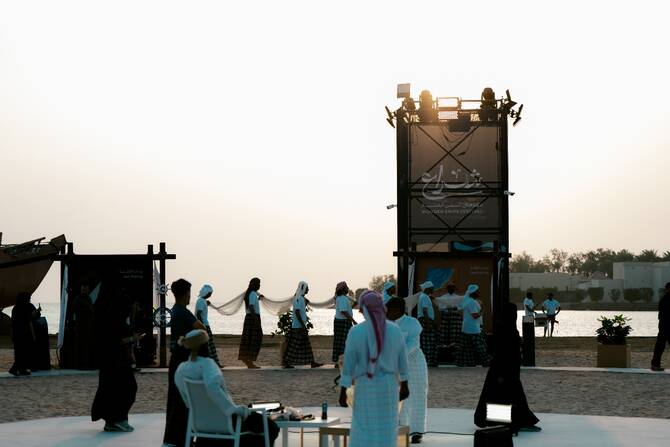


Jeddah: The Saudi Heritage Commission brought Jeddah’s waterfront to life with the Shiraa Wooden Ships Festival, a cultural celebration highlighting the Kingdom’s deep-rooted maritime heritage and its historic relationship with the sea.
The event, which ran from Jan. 13-16, invited visitors to explore how seafaring shaped coastal life, trade and cultural exchange across the generations.
A Heritage Commission representative said: “Shiraa reflects our commitment to reconnecting people with the sea and reviving maritime heritage through an interactive cultural experience.
“The program restores the human journey with the sea and highlights the historical role of ports in trade, discovery and cultural communication across the ages.”
At the heart of the festival was the Al-Qilafa exhibition, which traced maritime heritage from Qur’anic references to everyday coastal life, the wooden ship itself being a living symbol of memory.
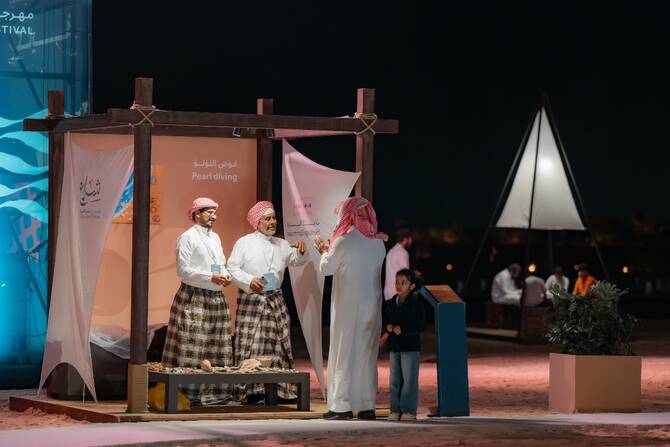
The exhibition unfolded as a narrative journey through a series of interconnected zones. It opened with a contemplative reflection on the sea as a source of divine provision, drawing on Qur’anic references to present the sea as a blessing whose abundance shaped livelihoods and traditions across generations. This introduction was followed by an exploration of the lives of sailors, where traditional costumes, everyday coastal objects, fishing and pearl-diving tools illustrated how survival at sea evolved into skilled crafts supported by accumulated knowledge and expertise.
Saleh Al-Ghamdi, who attended with his children, described the experience as a memorable one, and added: “It was both informative and enjoyable. My children learned how fishermen lived and how wooden ships were built. Offering an event of this scale free of charge is impressive, and I hope to see more initiatives like this.”
The journey continued by examining the broader impact of maritime activity, with ships and maritime crafts displayed alongside maps tracing historic sailing routes, showing how ports became gateways for trade, cultural exchange and discovery, and how coastal cities grew in rhythm with the sea.
Musical instruments associated with coastal sea songs, including a semsemiah, were presented with folkloric maritime chants, reflecting how rituals, music and customs carried the spirit of the sea beyond labor and into community life. Artifacts recovered from the Umluj shipwreck anchored this final section, reinforcing the idea of maritime heritage as a living legacy preserved in memory, practice and culture within coastal communities today.
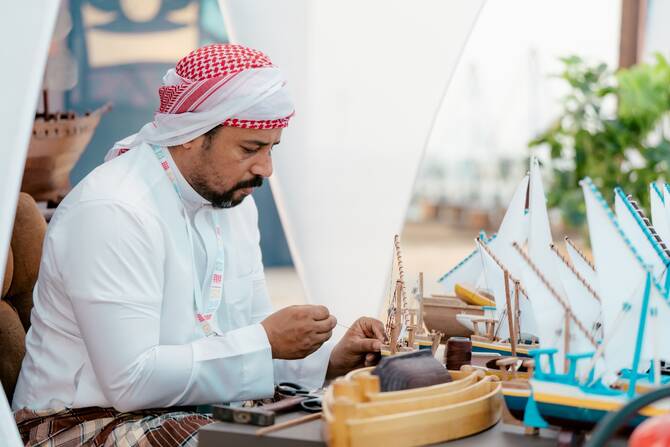
Beyond the exhibition, visitors entered the artisans’ pavilions, an interactive journey across six stations showcasing traditional maritime crafts, including wooden shipbuilding, net making, rope making, sail making, pearl diving and jewelry creation. These crafts reflected a complete maritime journey, from constructing the ship to transforming the sea’s treasures into artistic value.
The partners’ pavilions highlighted institutions supporting maritime heritage and sustainability. Amal Mohammed, from the Saudi Red Sea Authority, said the authority’s participation aimed to raise awareness of coastal development efforts, and added: “We want visitors to understand how maritime heritage connects to building a thriving and sustainable coastal tourism sector.”
Students from King Abdulaziz University’s Faculty of Maritime Studies also engaged with visitors, introducing academic pathways in maritime transport, navigation, marine engineering and port management.
Abdulrahman Hamid said the interest from young visitors was encouraging, and added: “There is growing demand for maritime expertise locally and internationally, in line with Saudi Vision 2030. Many young boys and girls showed curiosity about maritime studies, and we explained that while the field is challenging, it offers important career opportunities.”
Families and children gathered at Shiraa Square, an interactive entertainment space featuring traditional games, hands-on shipbuilding activities, remote-controlled boat racing in collaboration with the Saudi Sailing Federation, and sailboat riding.
Artistic expression was highlighted in the Al-Danah zone through the visual arts concept “Dreamed by Us,” featuring photography by Alan Villers. Designed as a tranquil space inspired by the symbolism of pearls, the area combined video content and interactive elements by ZFX and ID Scenes with sculptures, installations and light-based artworks that explored themes of beauty, patience and discovery.
The festival also featured interactive workshops at Craft Shore, where visitors tried net making, opening oysters to extract pearls, creating sea-inspired canvases and sculpting waves in clay.
Farah Ahmed, who was visiting from Makkah, said the activities brought heritage to life in an engaging way, adding: “It wasn’t just something to observe, it was hands-on and educational, and we learned a great deal while enjoying the experience.”
High school student Hanan Soufi said the festival had influenced her academic ambitions, and added: “I’m interested in marine engineering, and visiting the King Abdulaziz University booth helped me understand that women can pursue these studies.
“The Al-Qilafa exhibition was especially informative, from traditional clothing and tools to navigation, port cities and maritime music. It was truly a standout experience.”


