Torrential rains flood southern Thailand

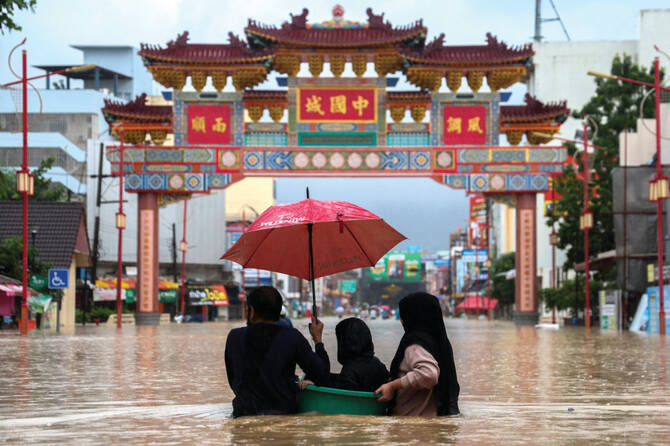
People wade through a flooded area in Hat Yai district, Songkhla, Thailand, on Saturday after heavy rain battered four provinces. (AFP)
Short Url
Updated 25 November 2025
Follow

Torrential rains flood southern Thailand

  • At least 13 people killed and more than 1,200 people evacuated from homes

BANGKOK: Residents of southern Thailand waded through waist-deep floods on Tuesday, with a main tourist town left inundated by days of heavy rain, stranding people in homes and hotels, and killing at least 13 in the region.

The government declared a state of emergency in southern Songkhla province on Tuesday, as the meteorological department forecast more rain and possible flash floods this week.

Torrential rains since late last week inundated the tourist hub of Hat Yai and the southern region, killing 13 people in four flood-hit provinces, the department of disaster prevention and mitigation said.

Local television footage in recent days has showed rescuers in Hat Yai evacuating people via boats, jet skis and military trucks amid high floodwaters.

Some have used inflatable children’s swimming pools to float their kids to safety.

“I was stranded for four days,” a woman wearing a rain poncho and holding her baby under an umbrella in the city told local TV station TNN on Monday.

“I decided to leave because I have an infant and I am afraid more water will come,” she said.

The woman, her child and her bedridden mother were evacuated by boat, she added.

More than 1,200 people have been evacuated from their homes in Songkhla since Thursday, the province’s public relations department said.

Prime Minister Anutin Charnvirakul told reporters on Tuesday that more boats and trucks would be deployed to aid in evacuations.

Thailand regularly records heavy rainfall from June to September, but experts say human-induced climate change has intensified extreme weather, making conditions increasingly unpredictable.


Japan restarts world’s biggest nuclear plant

Updated 12 sec ago
Follow

Japan restarts world’s biggest nuclear plant

  • Japan wants to revive atomic energy to reduce its reliance on fossil fuels

KARIWA: The world’s biggest nuclear power plant was restarted Wednesday for the first time since the 2011 Fukushima disaster, its Japanese operator said, despite persistent safety concerns among residents.

The plant was “started at 19:02” (1002 GMT), Tokyo Electric Power Company spokesman Tatsuya Matoba said of the Kashiwazaki-Kariwa plant in Niigata prefecture.

The regional governor approved the resumption last month, although public opinion remains sharply divided.

On Tuesday, a few dozen protesters — mostly elderly — braved freezing temperatures to demonstrate in the snow near the plant’s entrance, whose buildings line the Sea of Japan coast.

“It’s Tokyo’s electricity that is produced in Kashiwazaki, so why should the people here be put at risk? That makes no sense,” Yumiko Abe, a 73-year-old resident, told AFP.

Around 60 percent of residents oppose the restart, while 37 percent support it, according to a survey conducted in September.

TEPCO said Wednesday it would “proceed with careful verification of each plant facility’s integrity” and address any issues appropriately and transparently.

Kashiwazaki-Kariwa is the world’s biggest nuclear power plant by potential capacity, although just one reactor of seven was restarted.

The facility was taken offline when Japan pulled the plug on nuclear power after a colossal earthquake and tsunami sent three reactors at the Fukushima atomic plant into meltdown in 2011.

However, resource-poor Japan now wants to revive atomic energy to reduce its reliance on fossil fuels, achieve carbon neutrality by 2050 and meet growing energy needs from artificial intelligence.

Prime Minister Sanae Takaichi has voiced support for the energy source.

Fourteen reactors, mostly in western and southern Japan, have resumed operation since the post-Fukushima shutdown under strict safety rules, with 13 running as of mid-January. The vast Kashiwazaki-Kariwa complex has been fitted with a 15-meter-high (50-foot) tsunami wall, elevated emergency power systems and other safety upgrades.

However, residents raised concerns about the risk of a serious accident, citing frequent cover-up scandals, minor accidents and evacuation plans they say are inadequate.