GENEVA: Trump administration freezes on US foreign aid have led many United Nations organizations to cut staff, budgets and services in places as diverse as Afghanistan, Sudan, Ukraine and far beyond.
Secretary-General Antonio Guterres has lamented the “severe cuts” and cited some fallout last week: Over 9 million people in Afghanistan will miss out on health and protection services; cash allocations that helped 1 million people in Ukraine last year have been suspended; funding for programs for people fleeing Sudan have run out, among other things.
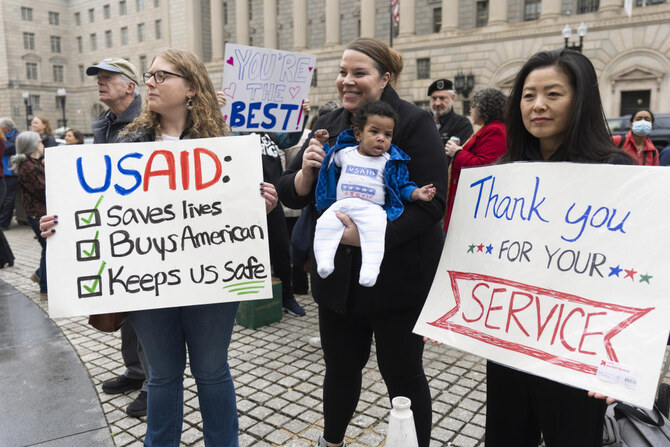
Many independent NGOs — some that work with the United Nations — have cited many project closures because of the US administration’s decision to eliminate more than 90 percent of foreign aid contracts, cut some $60 billion in funding, and terminate some 10,000 contracts worldwide involving the US Agency for International Development, USAID.
For their part, UN agencies have been scrambling to revise their operations, make strategic cuts, seek funding elsewhere, and appeal to the administration to restore US support. Some hope federal court rulings will salvage some US foreign aid outlays.
Here’s what some UN organizations say about the impact of the US funding freezes and their response to them — so far.
Less UN help for people on the move: Refugees and Migrants
UNHCR : The UN refugee agency, which got over 40 percent of its nearly $5 billion budget last year from the United States, told The Associated Press on Wednesday the pause in US funding allocations have affected operations and its “first cost saving efforts” will involve cutting $300 million in planned activities.
Some partners — UN organizations often rely on and fund outside groups — have pulled back or halted some activities that, for example, have led to suspended services for nearly 180,000 forcibly displaced women in girls in Central African Republic, Uganda and South Sudan. In Ethiopia, 200,000 forcibly displaced women and girls will be affected by the closure of services, it said.
“If new funding is not forthcoming soon, more cuts in direct life-saving assistance will be inevitable,” spokesman Matthew Saltmarsh said.
IOM: The International Organization for Migration, which is run by Amy Pope of the United States and got more than 40 percent of its $3.4 billion budget in 2023 from the US, said it was “acting accordingly” in response to the US order to pause foreign assistance funding that was affecting staff, operations and beneficiaries.
Devex, a news organization focusing on global development, reported last month that IOM sent dismissal notices to some 3,000 employees who had been working on a US resettlement program following the funding freezes. The agency declined to comment to the AP.
UN health agencies sound the alarm
WHO: The Trump administration has been especially tough with the World Health Organization. One of his earliest executive orders announced a US pullout from the UN health agency, which can’t take full effect until next January, as well as a recall of US staff working with WHO and funding pauses.
WHO says a global measles and rubella lab network is “at risk of collapse” because its cost of about $8 million a year is entirely funded by the US The funding cuts have affected the global response to mpox, and WHO has tapped its own emergency funds to fill gaps left in the response to Ebola in Uganda.
On Wednesday, WHO said US cuts in bilateral funding to fight tuberculosis will have a “devastating response on TB programs” — which the United States has generally contributed $200-$250 million to every year over the last decade.
UNAIDS : The AIDS-fighting agency said Wednesday that US funding has “served as the backbone” for HIV prevention in many countries hit hard by the virus. US funding amounts to 55 percent of the total AIDS budget in Uganda, and the funding freeze has led to the closure of drop-in centers and service points that provide antiretroviral therapy.
It said a rapid assessment estimated that 750,000 people in Haiti are affected by the US freeze, and 70 percent of the 181 total sites funded through the US President’s Emergency Plan for AIDS Relief, or PEPFAR, had closed: “Patients have flooded the remaining sites, which are unable to meet the increased demand.”
A “large portion” of PEPFAR-funded staff working on HIV response in South Africa will be affected because dozens of USAID implementing partners received termination letters last week, UNAIDS said.
At a regular briefing Thursday, UN spokesman Stephane Dujarric highlighted the impact of funding cuts on Afghanistan alone, saying more than 200 health facilities have closed — depriving 1.8 million people from essential health services in the country.
Unlocking aid from UN coffers
OCHA: The UN Office for the Coordination of Humanitarian Affairs said Thursday it was releasing $110 million from its emergency response fund to help address underfunded crises in Africa, Asia and Latin America.
Tom Fletcher, the UN humanitarian chief who heads the office, told the Security Council on Thursday the US funding cuts to foreign aid amounted to “body blow to our work to save lives.”
He said he had asked partners to provide lists of areas where they have to cut back.
“It is of course for individual countries to decide how to spend their money. But it is the pace at which so much vital work has been shut down that adds to the perfect storm that we face,” Fletcher said.


![]()

From staff cuts to aid reductions, UN humanitarian agencies scramble in wake of US funding freeze
Short Url
https://arab.news/8t3mj
From staff cuts to aid reductions, UN humanitarian agencies scramble in wake of US funding freeze
- Secretary-General Antonio Guterres has lamented the “severe cuts” and cited some fallout last week
- Here’s what some leading UN organizations have said about the impacts of the US foreign aid freeze and their response to it — so far


Latest updates


© 2026 SAUDI RESEARCH & PUBLISHING COMPANY, All Rights Reserved And subject to Terms of Use Agreement.