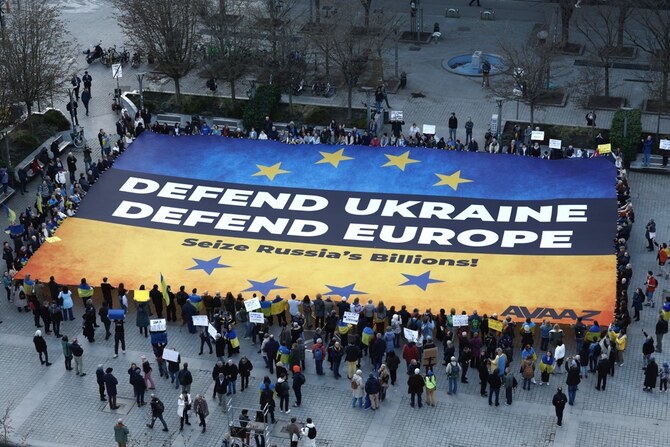
BRUSSELS: European leaders aim to endorse bold measures to ramp up defense spending and pledge support for Ukraine on Thursday, after Donald Trump’s suspension of military aid to Kyiv fueled concerns the continent can no longer be sure of US protection.
Leaders of the European Union’s 27 countries will be joined by Ukrainian President Volodymyr Zelensky at a summit in Brussels, although their show of solidarity may be marred by Hungary refusing to endorse a statement backing Kyiv.
The meeting takes place against a backdrop of dramatic defense policy decisions driven by fears that Russia, emboldened by its war in Ukraine, may attack an EU country next and that Europe cannot rely on the US to come to its aid.
US President Donald Trump has insisted he is committed to the NATO security alliance that links North America and Europe.
But he has also said Europe must take more responsibility for its security and previously suggested the US would not protect a NATO ally that did not spend enough on defense.
His decision to shift from staunch US support for Ukraine to a more conciliatory stance toward Moscow has deeply alarmed Europeans who see Russia as the biggest threat to their security.
“I want to believe that the United States will stand by us. But we have to be ready if that is not the case,” French President Emmanuel Macron said of the war in Ukraine in an address to the French nation on the eve of the summit.
In a sign of the gravity of the moment, Macron said France is open to discussing extending the protection offered by its nuclear arsenal to its European partners.
On Tuesday, the parties aiming to form Germany’s next government agreed to loosen borrowing limits to allow billions of euros of extra defense spending.
The European Commission – the EU’s executive body – also unveiled proposals that it said could mobilize up to 800 billion euros ($862.9 billion) for European defense, including a plan to borrow up to 150 billion euros ($161.8 billion) to lend to EU governments.
Diplomats expect leaders at the summit to give the proposals a broad welcome and instruct officials to quickly turn them into draft legislation. EU members will then have to agree on the nitty-gritty, which will not be straightforward.
On Ukraine, almost all EU leaders are keen to reassure Zelensky that he can still rely on Europe for support after his bruising Oval Office clash with Trump last week.
But EU members have so far not been able to agree on a proposal by foreign policy chief Kaja Kallas to put a figure on the military aid they will pledge to Ukraine this year.
Officials have suggested the EU should vow to at least provide 20 billion euros this year, as it did in 2024.
The plan foresees each EU member state contributing according to the size of its economy, amid complaints from Nordic and Baltic states and the Netherlands that some bigger countries such as France, Italy and Spain are not doing enough.
Paris, Rome and Madrid reject those accusations, arguing that public estimates do not reflect the true value of their military aid to Ukraine.
The leaders are expected to call upon officials “to advance work swiftly on initiatives, notably that of the High Representative (Kallas), to coordinate increased EU military support to Ukraine,” according to a draft text seen by Reuters.
However, it is unclear whether the text on Ukraine will be endorsed by all 27 leaders, due to a veto threat from Hungarian Prime Minister Viktor Orban, a Trump ally who has also maintained friendly ties to the Kremlin.
In a letter to European Council President Antonio Costa dated Saturday, Orban said there were “strategic differences in our approach to Ukraine that cannot be bridged.”


![]()

EU leaders to back defense surge, support Zelensky after US aid freeze
Short Url
https://arab.news/4g2ct
EU leaders to back defense surge, support Zelensky after US aid freeze
- Prime ministers and presidents gather in Brussels


Latest updates


© 2026 SAUDI RESEARCH & PUBLISHING COMPANY, All Rights Reserved And subject to Terms of Use Agreement.