

Pakistan PM congratulates China on annual political meetings, invites President Xi to visit

Chinese Ambassador to Pakistan Jiang Zaidong speaks during a meeting with Prime Minister Shehbaz Sharif in Islamabad on March 7, 2025. (Photo courtesy: PMO)
Short Url
Updated 07 March 2025
Follow

Pakistan PM congratulates China on annual political meetings, invites President Xi to visit

  • China has set ambitious economic growth, defense spending targets amid shifting geopolitical realities
  • Shehbaz Sharif says Beijing has made ‘remarkable progress’ in achieving national development goals

ISLAMABAD: Prime Minister Shehbaz Sharif on Friday congratulated China on convening two major annual political meetings, where Beijing set an ambitious economic growth target and announced a substantial increase in defense spending amid a changing geopolitical environment, while also inviting Chinese President Xi Jinping to visit.
China’s “Two Sessions,” comprising the National People’s Congress and the Chinese People’s Political Consultative Conference, began on March 4 and 5, respectively, shaping the country’s policy direction for the year.
The meetings upheld a GDP growth target of approximately 5 percent for 2025, as Beijing navigates global trade uncertainties following the return of Donald Trump’s administration in Washington.
China also announced a 7.2 percent increase in defense spending, underscoring its commitment to military modernization and national security amid rising regional and global tensions.
“I extend my warm congratulations to President Xi Jinping, Premier Li Qiang and the Chinese people on the successful convening of the ‘Two Sessions’ in Beijing,” Sharif said in a social media post on X.
“China is making remarkable progress in achieving its national development goals,” he continued. “We are particularly impressed by China’s modernization under President Xi’s visionary leadership.”
The prime minister reaffirmed that Pakistan and China would continue to work together to strengthen bilateral cooperation and achieve the “shared objectives of peace and development.”
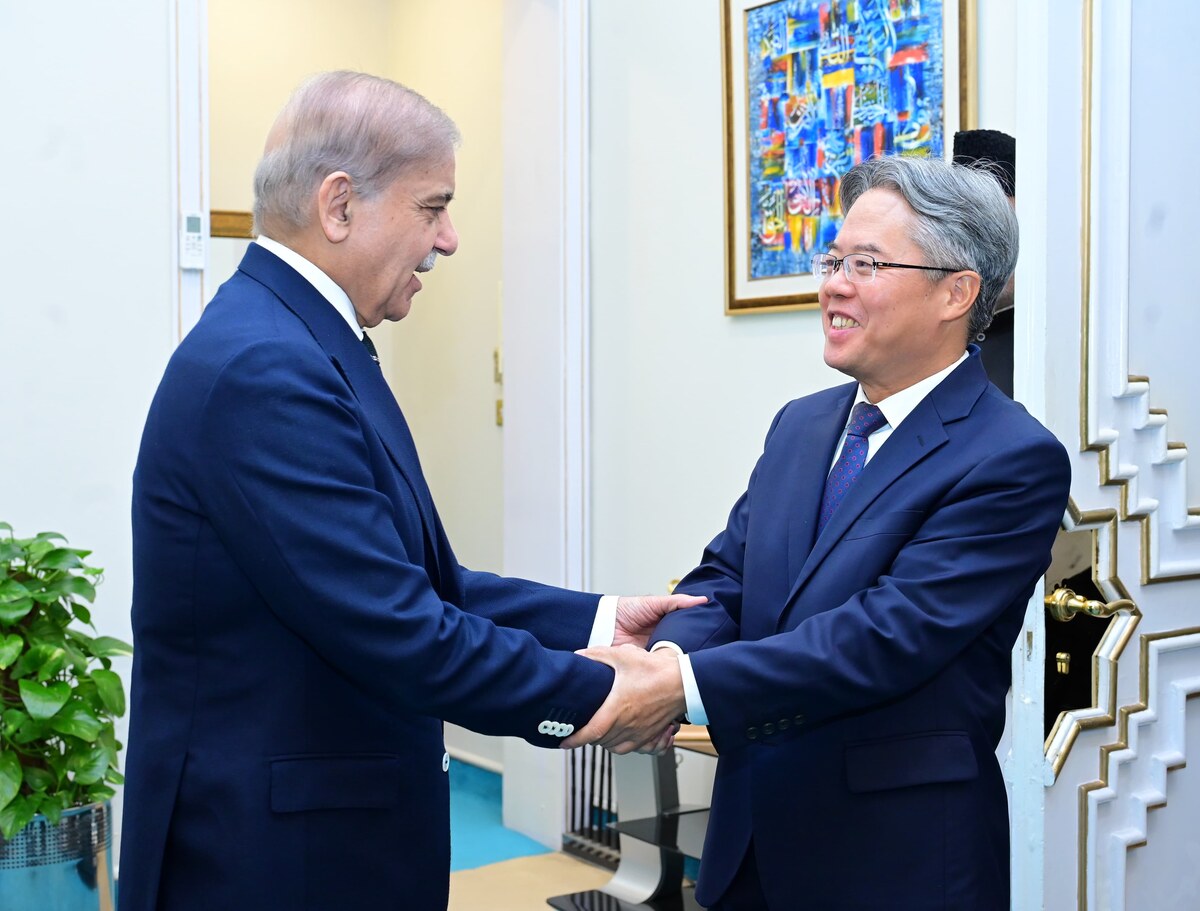


Chinese Ambassador to Pakistan Jiang Zaidong shakes hands with Prime Minister Shehbaz Sharif in Islamabad on March 7, 2025. (Photo courtesy: PMO)

Pakistan and China have long collaborated on infrastructure development and regional connectivity, with the China-Pakistan Economic Corridor (CPEC) serving as the flagship project of their strategic partnership.
As both nations move toward the next phase of CPEC, their focus has shifted to business and industrial cooperation, aiming to boost investment, manufacturing and technology transfer.
Bilateral cooperation, however, faces challenges, particularly security threats to Chinese personnel and projects in Pakistan. Attacks on CPEC-linked infrastructure and Chinese nationals by militant groups have raised concerns.
Additionally, delays in project execution, financial constraints and bureaucratic hurdles have slowed some CPEC initiatives, requiring both countries to enhance policy coordination and implementation efficiency.
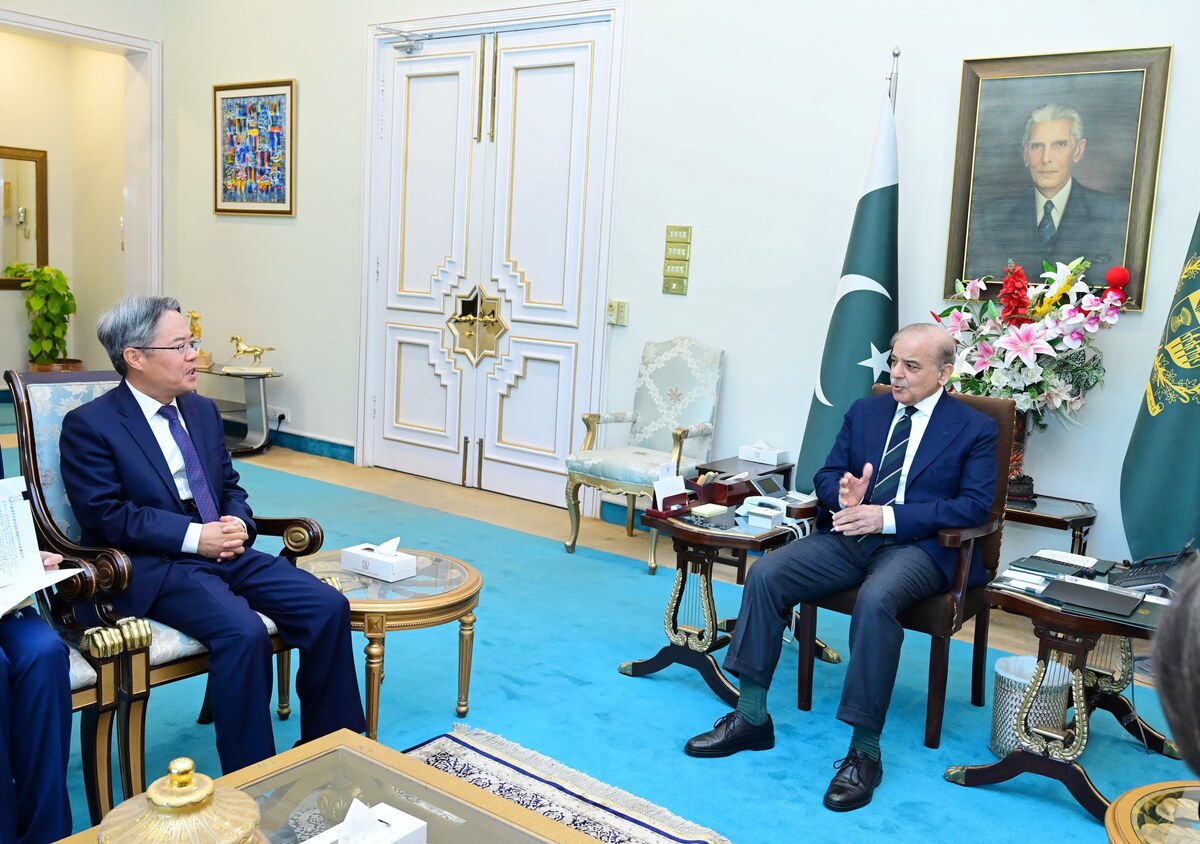


Chinese Ambassador to Pakistan Jiang Zaidong gestures during a meeting with Prime Minister Shehbaz Sharif in Islamabad on March 7, 2025. (Photo courtesy: PMO)

The Prime Minister’s Office also issued a statement on Friday, saying China’s Ambassador Jiang Zaidong met Sharif earlier in the day. Among other things, they discussed “progress on security and counter-terrorism cooperation between both countries.”
The prime minister also noted this year marked the tenth anniversary of President Xi Jinping’s visit to Pakistan in 2015, as he renewed his invitation for the Chinese leader to visit the country again.


Pakistan’s seafood exports to China hit nearly $255 million in 2025 as market reach widens

Updated 26 January 2026
Follow

Pakistan’s seafood exports to China hit nearly $255 million in 2025 as market reach widens

  • Frozen fish and cephalopods lead exports as shipments expand beyond China’s coastal hubs
  • Growth reflects Pakistan’s push to diversify exports and tap China’s inland consumer markets

ISLAMABAD: Pakistan’s seafood exports to China rose to nearly $255 million in 2025, underscoring Beijing’s growing importance as a destination for Pakistani marine products, according to data from China’s General Administration of Customs (GACC) published by state-run APP on Monday.

The figures point to a broader geographic and product diversification of Pakistan’s seafood trade with China at a time when Islamabad is seeking to boost foreign exchange earnings and reduce reliance on a narrow set of export sectors.

“The gains were driven by sustained demand for frozen fish, cephalopods, and a growing range of processed seafood products in both coastal and inland markets,” APP said in a report, citing China Customs data.

Frozen fish remained the single largest export category, contributing about $64.6 million to Pakistan’s seafood shipments to China. Imports were concentrated in major coastal and metropolitan entry points, with Guangdong province emerging as the largest destination by value and volume, importing 8.48 million kilograms worth $15.7 million. Shandong and Beijing followed, each exceeding 7 million kilograms, while Shanghai, Tianjin and Zhejiang also recorded substantial volumes.

At the same time, smaller but notable shipments were recorded in inland provinces including Sichuan, Yunnan, Guizhou and Chongqing, suggesting a widening distribution footprint supported by expanding cold-chain logistics and growing demand away from China’s traditional port cities.

Cephalopods emerged as another key growth pillar. Exports of frozen cuttlefish and squid reached nearly $31 million, while frozen octopus rose to almost $12 million, reflecting demand from catering chains and seafood processors supplying China’s foodservice and ready-to-cook segments.

Affordable pelagic fish also performed strongly. Frozen sardines, sardinella, brisling and sprats recorded imports of around $14.9 million, supported by household consumption and mass-market food manufacturers.

In addition to core frozen categories, Pakistan exported roughly $14.4 million each in two higher-value segments classified by China Customs as “fish” and “fish products,” indicating a gradual shift toward processed and value-added seafood lines.

Analysts cited in the APP report attributed the overall growth to improved compliance with Chinese food safety standards, expanded approvals for Pakistani processing facilities and competitive pricing backed by Pakistan’s marine resource base. Investments in cold-chain logistics and streamlined customs procedures were also seen as supporting higher volumes and broader market access.