Pakistan’s seafood exports to China hit nearly $255 million in 2025 as market reach widens

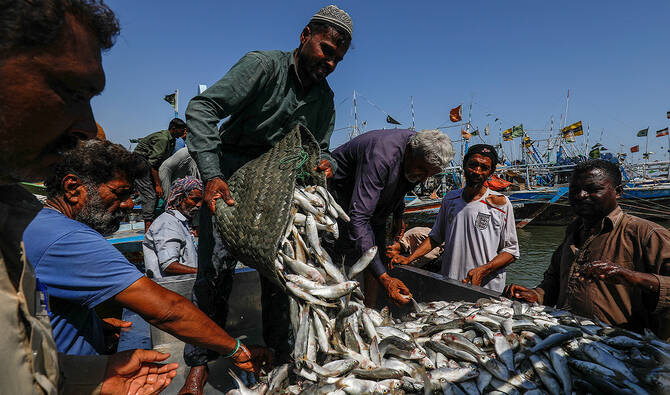
Fishermen unload baskets of fish from a boat after they returned with the day's catch during the Muslim fasting month of Ramadan, amid the outbreak of the coronavirus disease (COVID-19), at a harbor in Ibrahim Hyderi fishing village on the outskirts of Karachi, Pakistan April 29, 2020. (Reuters/File)
Short Url
Updated 26 January 2026
Follow

Pakistan’s seafood exports to China hit nearly $255 million in 2025 as market reach widens

  • Frozen fish and cephalopods lead exports as shipments expand beyond China’s coastal hubs
  • Growth reflects Pakistan’s push to diversify exports and tap China’s inland consumer markets

ISLAMABAD: Pakistan’s seafood exports to China rose to nearly $255 million in 2025, underscoring Beijing’s growing importance as a destination for Pakistani marine products, according to data from China’s General Administration of Customs (GACC) published by state-run APP on Monday.

The figures point to a broader geographic and product diversification of Pakistan’s seafood trade with China at a time when Islamabad is seeking to boost foreign exchange earnings and reduce reliance on a narrow set of export sectors.

“The gains were driven by sustained demand for frozen fish, cephalopods, and a growing range of processed seafood products in both coastal and inland markets,” APP said in a report, citing China Customs data.

Frozen fish remained the single largest export category, contributing about $64.6 million to Pakistan’s seafood shipments to China. Imports were concentrated in major coastal and metropolitan entry points, with Guangdong province emerging as the largest destination by value and volume, importing 8.48 million kilograms worth $15.7 million. Shandong and Beijing followed, each exceeding 7 million kilograms, while Shanghai, Tianjin and Zhejiang also recorded substantial volumes.

At the same time, smaller but notable shipments were recorded in inland provinces including Sichuan, Yunnan, Guizhou and Chongqing, suggesting a widening distribution footprint supported by expanding cold-chain logistics and growing demand away from China’s traditional port cities.

Cephalopods emerged as another key growth pillar. Exports of frozen cuttlefish and squid reached nearly $31 million, while frozen octopus rose to almost $12 million, reflecting demand from catering chains and seafood processors supplying China’s foodservice and ready-to-cook segments.

Affordable pelagic fish also performed strongly. Frozen sardines, sardinella, brisling and sprats recorded imports of around $14.9 million, supported by household consumption and mass-market food manufacturers.

In addition to core frozen categories, Pakistan exported roughly $14.4 million each in two higher-value segments classified by China Customs as “fish” and “fish products,” indicating a gradual shift toward processed and value-added seafood lines.

Analysts cited in the APP report attributed the overall growth to improved compliance with Chinese food safety standards, expanded approvals for Pakistani processing facilities and competitive pricing backed by Pakistan’s marine resource base. Investments in cold-chain logistics and streamlined customs procedures were also seen as supporting higher volumes and broader market access.


At Gulfood expo, minister urges Pakistani firms to boost exports to end reliance on foreign debt

Updated 10 sec ago
Follow

At Gulfood expo, minister urges Pakistani firms to boost exports to end reliance on foreign debt

  • The Dubai expo brought together more than 8,500 exhibitors from 195 countries, showcasing over 1.5 million food and beverage products
  • Planning Minister Ahsan Iqbal says Islamabad is committed to promoting productivity, quality and innovation within the private sector 

ISLAMABAD: Planning Minister Ahsan Iqbal on Thursday urged Pakistani companies participating in the Gulfood food and beverage exhibition in Dubai to expand exports and focus on value-added products, saying it was the only way for Pakistan to end reliance on foreign debt.

Gulfood’s 31st edition, being held in Dubai from Jan. 26 till Jan. 30, has brought together more than 8,500 exhibitors from 195 countries, showcasing over 1.5 million food and beverage products across 12 sectors, making it one of the most influential platforms for global agri-food trade.

Pakistan has made its largest-ever showing at the world’s leading food and beverage trade exhibition, with a total of 142 Pakistani companies participating in the 2026 edition, according to a statement from the Ministry of Information released this week.

On Thursday, Iqbal visited toured various stalls and interacted with exhibitors at Pakistan Pavilion at the exhibition and encouraging them to focus on enhancing exports and value-addition, Pakistan’s Press Information Department (PID) said.

“If we are to permanently free ourselves from reliance on the IMF (International Monetary Fund) and foreign debt, there is only one way forward, promoting and expanding our exports,” he was quoted as saying. “I am particularly encouraged to see that Pakistani exporters are now focusing on value added products.”

Pakistan has struggled with boom-bust cycles for decades and secured 22 IMF bailouts since 1958. The country is currently navigating a long, tricky path to economic recovery under a $7 billion IMF program secured in Sept. 2024.

Pakistan has been increasingly using global trade exhibitions to promote value-added food exports, particularly to Gulf and Middle Eastern markets, which remain among the country’s largest destinations for rice, meat and processed food products.

Of the 142 Pakistani firms, 67 companies are participating under the Trade Development Authority of Pakistan (TDAP), while 75 companies are taking part independently, across four specialized pavilions covering rice, pulses and grains, world food, beverages, and meat and poultry. Notably, 30 rice exporters are participating under TDAP, underlining Pakistan’s position as one of the world’s leading rice suppliers.

Iqbal visited the Biryani Festival stall at Pakistan Pavilion and appreciated the initiative to showcase and promote Pakistani Basmati rice.
“We are committed to promoting productivity, quality, and innovation within the private sector so that ‘Made in Pakistan’ becomes a global symbol of quality, and Pakistani products are visible on every stall, in every shop, and on every shelf across international markets,” he said.