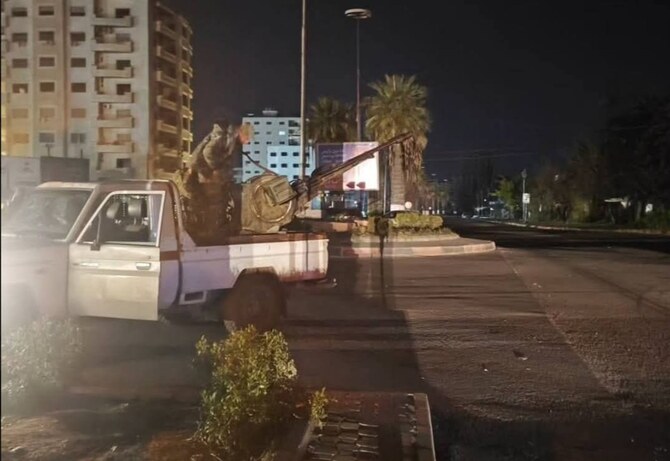
BEIRUT: A Syrian Arab Republic war monitor said Wednesday that four civilians have been killed in a security operation in the coastal city of Latakia that was launched after a deadly attack on security services.
Latakia province is a former stronghold of the government of ousted president Bashar Assad and the heartland of his family’s Alawite minority.
The Syrian Observatory for Human Rights said the operation in the city’s Daatur district killed “four civilians,” including two “guards at a local school” on Tuesday and two construction workers on Wednesday.
State media had said that forces launched the campaign after “militia remnants” supporting Assad killed two personnel in an ambush.
Mustafa Kneifati, a security official in Latakia province, said that “during the operation, the criminal cell threw bombs at the security patrols, wounding a number of personnel.”
“Our forces responded immediately to the sources of fire and managed to arrest a number of people involved in these criminal acts, and neutralized a number of others,” Kneifati added in a statement on the interior ministry’s Telegram channel.
The Observatory said “a cautious calm” returned to Daatur “after the arrest of a number of residents and wanted persons.”
Restoring and maintaining security across Syria remains one of the most pressing challenges for the new authorities after Islamist-led rebels overthrew Assad on December 8.
In Sanamayn, in the Daraa province in the south, the Observatory said security forces carried out a “large-scale campaign... searching for wanted men and weapons.”
The operation came a day after clashes in the city between security forces and a group linked to the ousted government’s military security killed three fighters and wounded “three civilians including a child,” the Britain-based Observatory said.
Daraa province’s Telegram channel reported ongoing “military operations to purge the area of armed elements.”
A local security official, Abdul-Razzaq Al-Khatib, was quoted as saying that “military reinforcements” reached the city in the morning, with clashes ongoing in buildings in the southwest.
He said Tuesday’s clashes resulted in an unspecified number of casualties, while gunfire also wounded a member of the security forces at a checkpoint.
Daraa province, the cradle of the 2011 uprising which led to Syria’s civil war, returned to government control in 2018 but has been plagued by unrest in recent years.
Syria has seen clashes and shootings in a number of areas, often blamed on Assad supporters, with the new authorities announcing campaigns targeting “regime remnants” and making arrests.
Latakia initially saw heightened tensions and violence, including reprisals against people seen as linked to the former government, though incidents have decreased somewhat despite occasional attacks on checkpoints, according to the Observatory.


Syria monitor says security forces kill four in former Assad bastion
https://arab.news/95xb6
Syria monitor says security forces kill four in former Assad bastion

- The Syrian Observatory for Human Rights said the operation in the city’s Daatur district killed “four civilians,” including two “guards at a local school“
- Mustafa Kneifati, a security official in Latakia province, said that “during the operation, the criminal cell threw bombs at the security patrols, wounding a number of personnel“


Iranian strikes kill two in UAE, injure eight in Qatar as regional conflict escalates
- UAE defense ministry said Iran fired 137 missiles and 209 drones at the territory
- Qatar intercepted most of the 65 missiles and 12 drones launched by Iran, said officials
ABU DHABI: Explosions rocked cities across the Gulf on Saturday, killing two people in Abu Dhabi, while smoke and flames rose from Dubai landmark The Palm as Iran launched waves of attacks in retaliation for US and Israeli strikes.
The attacks hit airports in Abu Dhabi, Dubai and Kuwait, as well as Gulf military bases and residential areas, raising fears of a wider conflict and rattling a region long seen as a haven of peace and security.
Across the UAE, Iran fired 137 missiles and 209 drones at the territory, the country’s defense ministry said, as projectiles streaked across the skies of every Gulf state but Oman, a mediator in the recent US-Iran talks.
The UAE defense ministry said most of the missiles and drones were intercepted but at Abu Dhabi’s Zayed International Airport officials said at least one person was killed and seven wounded in an “incident.”
Earlier, falling debris killed a Pakistani civilian in Abu Dhabi, the United Arab Emirates’ capital, officials said.
At Dubai International Airport four people were injured according to airport authorities and four others were also hurt at the luxury Palm development.
In Qatar, officials said Iran launched 65 missiles and 12 drones toward the Gulf state, most of which were intercepted, but eight people were injured in the salvos, with one of them in critical condition.
“We are scared of what the future is for us now, and we can’t say how the next few days are going to be,” Maha Manbaz, a nursing student in Doha told AFP.
Terrified’
Smoke poured from US bases in Abu Dhabi and Bahrain’s capital Manama, home of the American navy’s Fifth Fleet, witnesses saw.
A drone struck Kuwait’s international airport and a base housing US personnel was targeted. Three Kuwaiti soldiers and 12 other people were wounded, authorities said.
After Iran’s Revolutionary Guards reported missile strikes, US Central Command (CENTCOM) said on X that no American naval vessels were hit, damage to US facilities was minimal, and no US casualties had been reported.
Residential buildings were also targeted in Manama, with officials saying firefighters and civil defense teams had been dispatched to the scene.
“The sound of the first explosion terrified me,” said a 50-year-old retiree living near the US base in Manama’s Juffair area, where residents were quickly evacuated.
The UAE, Saudi Arabia and Qatar warned they reserved the right to respond to the attacks.
The oil-and-gas-rich Arab monarchies, lying just across the Gulf from Iran, are long-term American allies and host a clutch of US military bases.
“The Gulf states are sandwiched between Iran and Israel, and have to bear the worst inclinations of both,” said Bader Al-Saif, an assistant professor at Kuwait University.
“Iran’s attacks on the Gulf are misplaced. They’ll only alienate its neighbors and invite further distancing from Iran,” he added.
Conflict is unusual in the Gulf, which has traded on its reputation for stability to become the Middle East’s commercial and diplomatic hub.
‘Significant damage’
The unprecedented barrage targeted Qatar’s Al Udeid base, the region’s biggest US military base, as well as Riyadh and eastern Saudi Arabia.
The UAE, Qatar and Kuwait all announced that their airspace was closed.
An AFP journalist in Qatar saw one missile destroyed in a puff of white smoke, while another in Dubai saw a volley of Patriot interceptors taking off.
Iran fired missiles at Al Udeid last June after US strikes targeted Iranian nuclear facilities during a brief war with Israel.
The escalation also saw Saudi Crown Prince Mohammed bin Salman and UAE President Mohamed bin Zayed speak for the first time since a public row in late December.
The Saudi de facto ruler called the Emirati president and the pair discussed Iran’s retaliatory strikes on the Gulf and expressed solidarity and sympathy.
In Kuwait, an Iranian missile attack caused “significant damage” to the runway at an air base hosting Italian air force personnel, Italian Foreign Minister Antonio Tajani was quoted by the ANSA news agency as saying.
Late on Saturday, Kuwaiti officials said a drone targeted a naval base there with air defense forces intercepting the projectile, according to a post by the defense ministry on X.
For many residents in the Gulf, which has drawn a cosmopolitan, largely expat population, the reaction was one of shock.
“I heard the explosions, I don’t know what I felt,” a Lebanese woman living in Riyadh told AFP.
“We came to the Gulf because it’s known to be safer than Lebanon. Now I don’t know what to do or how to think really.”