ROME: Just before breaking the Ramadan fast on Sunday evening, Hasan Zaheda played basketball with his son in the tiny courtyard of the basement-level apartment on Rome’s outskirts where the refugee family is rebuilding their lives.
They have no pictures from their native Syria – they fled Damascus at the height of the civil war with only one change of clothes, diapers and milk for their toddler. But there is a framed photo of little Riad meeting Pope Francis, who brought them and two other Muslim families back with him to Italy from refugee camps in the Greek island of Lesbos almost a decade ago.
“He’s a gift from paradise,” Zaheda said Sunday, chuckling. “Pope Francis, a gift from our God, that God sent us to save us.”
As the Zahedas began to observe the holy month of Ramadan, Francis, 88, entered his third week of battling pneumonia in a hospital not far away. The least they can do, the family said, is to be close to him in prayer night and day.
“We look for his health bulletin every day,” said the mother, Nour Essa, 39, after recalling meeting the pontiff suddenly in Lesbos. “What shocked me the most is that the father of the church was a modest man, who didn’t have prejudices, open toward other ethnicities and religion.”
The family journeyed on the pope’s plane – one of the most visible moments of advocacy for migrants that marked Francis’ papacy. The Zahedas remember how kindly Francis patted Riad’s head as he passed down the aisle to speak with journalists.
But “miraculous” as it appeared to them, it was only the beginning of a new life in Italy to which they’re still adjusting.
Essa, a biologist, and Zaheda, an architect who worked as a civil servant in Damascus, decided to leave Syria in 2015 after he was drafted into the military. They sold their house to pay for a smuggler, walking through the night trying not to make a sound in the desert and at one point riding for ten hours in different trucks.
After scrambling to get through Daesh-controlled territory, they made it into Turkiye and then had three failed attempts to reach the Greek islands by boat before arriving in Lesbos in early 2016.
“I always thank God that my son was so small, and that he has no memory of all these things,” Essa said as Riad watched a Syrian soap opera in the cramped living room with his grandfather, who fled about a year after them. On the walls, Hasan’s haunting paintings of white faces against swirling black and red tell of the parents’ all-too-vivid memories.
After more than one month in a Lesbos camp, the family was approached for an interview by a stranger – Daniela Pompei, the head of migration and integration for the Catholic charity Sant’Egidio.
She had been tasked with finding families with appropriate paperwork that Francis could bring back to Rome with him, and asked them to make a decision on the spot. They accepted, and the charity, with Vatican funds, eventually brought more than 300 refugees from Greece and 150 from another papal trip to Cyprus in 2021.
Sant’Egidio’s goal was to spare migrants longer journeys by sea across different routes in the Mediterranean, which have killed tens of thousands of asylum-seekers willing to “die for hope” over the years, Pompei said.
But the real test has been integration, from processing their asylum cases to learning Italian to school and job placement. Initiatives like the pope’s make all the difference because they signal to the refugees that their new communities are willing to welcome them, despite faith differences.
“The pope has long appealed to open parishes, to welcome at least one family in each parish, to push us Catholics too to counter what he called, with a very strong term in Lampedusa, ‘the globalization of indifference,’” Pompei said.
In the characteristic Roman accent they’ve acquired, the Zaheda parents told of their challenges – having to reenroll in university so their degrees can be recognized, helping their families come to Europe, taking care of their son.
Working or studying 12 hours a day, they rarely have time to socialize with other Syrian families and the migrants who comprise most of their neighbors in the modest brick-faced apartment buildings as well as most of Riad’s classmates.
His best friend is from Ecuador, and Riad plans to study Spanish in middle school. He’s joined a local basketball team, and pictures from the court line his bedroom, where a large Syrian flag hangs by his bunkbed. He likes to read The Little Prince in English, but his Arabic is tentative, even though he spends most afternoons with his grandfather, who loves to sketch local churches.
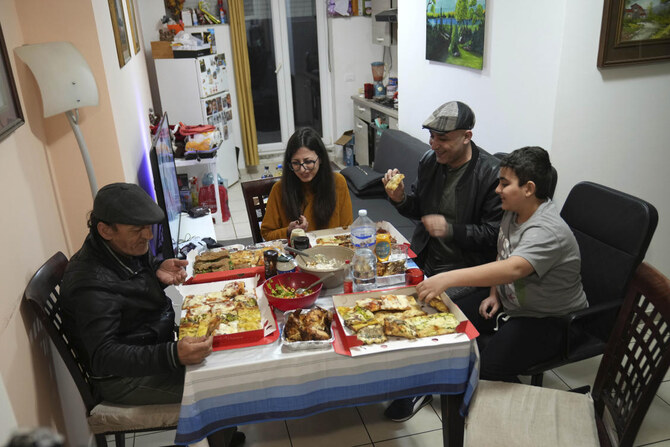
For Sunday’s iftar – the meal breaking the day’s fast – the family topped a little table with yogurt-and-chickpea tisiyeh salad and take-out pizza in typical Roman flavors like zucchini flowers and anchovies.
As Riad packed his backpack for the school week, his parents said their future hinges on the little boy – for whom they will likely stay in Italy, instead of joining relatives in France or returning to a Syria they probably couldn’t recognize.
“I always wish that he can build his future, that he can build a position as the son of an undocumented migrant who arrived in Italy and who wanted to leave his mark in a new country,” Zaheda said.


![]()

Syrian refugee family that Pope Francis brought to Rome prays for him as they build new life
Short Url
https://arab.news/g8yff
Syrian refugee family that Pope Francis brought to Rome prays for him as they build new life
- Nearly a decade after Pope Francis plucked them from a refugee camp in Greece, a Syrian couple and their child have carved out a quiet life in suburban Rome
- While they observe Ramadan, they’re praying for the hospitalized pope, whom they refer to as a gift from heaven – and a leader who showed the world migrants aren’t to be feared


Latest updates


© 2026 SAUDI RESEARCH & PUBLISHING COMPANY, All Rights Reserved And subject to Terms of Use Agreement.