KARACHI: Pakistan and the International Monetary Fund (IMF) on Tuesday formally kicked off talks for the first review of a $7 billion bailout program that Islamabad secured last year, the finance ministry confirmed in a statement.
A Pakistani finance ministry official told Arab News on Monday, requesting anonymity, that a nine-member mission led by Nathan Porter had landed in Pakistan to assess the country’s economic performance to determine the release of a $1.1 billion tranche over the following three weeks.
Pakistan’s macroeconomic indicators have gradually improved since it secured the IMF bailout last summer. The country’s consumer price index (CPI) inflation rate, maintaining a downward trend on Monday, hit a more than 9-year low at 1.51 percent year-on-year in February.
Pakistan’s current account recorded a surplus of $682 million from July 2024 till January 2025, compared to a deficit of $1.8 billion during the same period of the previous year, according to the central bank data. The Pakistan Stock Exchange (PSX) also reported record gains last year, with frequent bullish trends dominating the market.
Pakistan’s current account recorded a surplus of $682 million in January, marking the sixth consecutive month since the country reported a current account surplus. The Pakistan Stock Exchange (PSX) also reported record gains last year, with frequent bullish trends dominating the market.
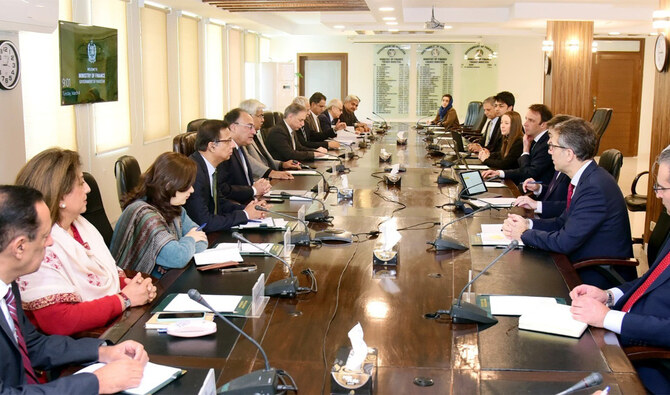
“Pictures of kick-off meeting held today,” the finance ministry wrote as caption of two photos shared with media on WhatsApp. The pictures showed Pakistani officials, led by Finance Minister Muhammad Aurangzeb, involved in discussions with an IMF delegation led by its Pakistan mission chief Nathan Porter.
Pakistan’s finance ministry has so far not shared any details of the talks between the government and the IMF. However, local media has widely covered the delegation’s visit.
Speaking to international news agency Reuters, Aurangzeb said Pakistan is “well-positioned” for the first review.
“They are here. We will have two rounds of talks, first technical and then policy level,” Aurangzeb said. “I think we are well positioned,” he added.
The IMF team usually spends around two weeks reviewing fiscal reforms and policy.
Last week, a separate IMF team visited Pakistan to discuss around $1 billion in climate financing on top of the EFF. That disbursement will take place under the IMF’s Resilience and Sustainability Trust, created in 2022 to provide long-term concessional cash for climate-related spending, such as adaptation and transitioning to cleaner energy.


![]()

Pakistan, IMF kick off talks on $7 billion bailout program review
Short Url
https://arab.news/c6rvw
Pakistan, IMF kick off talks on $7 billion bailout program review
- IMF delegation led by Nathan Porter arrived in Pakistan on Monday to assess country’s economic performance
- Pakistan secured the $7 billion Extended Fund Facility (EFF) last summer as part of an economic recovery plan


Latest updates


Recommended


© 2026 SAUDI RESEARCH & PUBLISHING COMPANY, All Rights Reserved And subject to Terms of Use Agreement.