

IMF, Pakistan to open $1 billion climate financing talks today

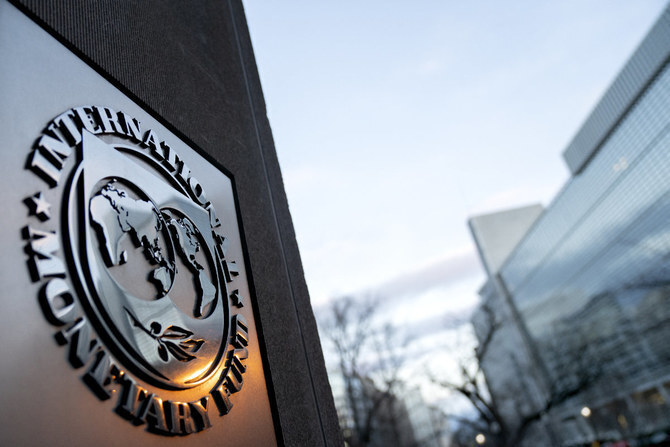
The seal for the International Monetary Fund is seen near the World Bank headquarters (R) in Washington, DC. (AFP/ file)
Short Url
Updated 24 February 2025
Follow

IMF, Pakistan to open $1 billion climate financing talks today

  • Khurram Schehzad says mission to visit from Feb. 24-28 for discussions on climate resilience funding
  • Disbursement will take place under the Fund’s Resilience and Sustainability Trust, created in 2022 

ISLAMABAD: Pakistan and the International Monetary Fund mission will open discussions from today, Monday, for around $1 billion in climate financing for Pakistan, an adviser to the country’s finance minister said.

Khurram Schehzad told Reuters last week the IMF mission will visit from February 24-28 for a “review and discussion” of climate resilience funding.

The disbursement will take place under the Fund’s Resilience and Sustainability Trust, created in 2022 to provide long-term concessional cash for climate-related spending, such as adaptation and transitioning to cleaner energy.

Pakistan made a formal request in October last year for around $1 billion in funding from the IMF under the trust, to address the nation’s vulnerability to climate change.

Pakistan’s Geo News TV had earlier reported that the IMF would issue the $1 billion for climate financing this week. 

The country’s economy is on a long path to recovery after being stabilized under a $7 billion IMF Extended Fund Facility it secured late last year.

“Another IMF mission will arrive in Pakistan in the first week of March for a first review of that facility,” Schehzad said.

The Global Climate Risk Index places Pakistan among the countries most vulnerable to climate change.

Floods in 2022, which scientists said were aggravated by global warming, affected at least 33 million people and killed more than 1,700. The country’s economic struggles and high debt burden impinged its ability to respond to the disaster.


Growing pressure on Arab banks amid complex cross-border contracts, legal risks 

Updated 7 sec ago
Follow

Growing pressure on Arab banks amid complex cross-border contracts, legal risks 

DAMMAM: Arab banks — numbering around 520 this year — are facing mounting challenges, led by the growing complexity of cross-border banking contracts and rising legal risks tied to modern financial products, Wissam Fattouh, secretary-general of the Union of Arab Banks, told Al-Eqtisadiah. 

Fattouh said addressing these challenges, driven by global economic and financial shifts, requires Arab banks — whose combined assets exceed $5.5 trillion — to strengthen risk management, continue structural reforms, and expand cooperation with foreign banks and financial institutions in line with the nature of global financial markets. 

He noted that the “Certified International Arbitrator” credential offered by the UAB to Arab banks is one of the professional tools supporting governance in banking transactions and providing effective, specialized alternatives to traditional litigation, particularly in cross-border disputes. 

Growing complexity of financial products and services 

Fattouh said the certification represents a specialized professional program aimed at preparing qualified banking and legal professionals to handle international commercial and banking disputes, particularly those linked to the financial sector, as financial products and services become more complex, regulations tighten, and global compliance requirements increase. 

In November, the UAB told Al-Eqtisadiah that the assets of 11 Saudi banks included among the 100 largest Arab banks last year, accounted for 24 percent of the total, reaching $1.1 trillion out of $4.5 trillion. 

The top 10 Arab banks were led by Qatar National Bank, followed by First Abu Dhabi Bank, Saudi National Bank, Emirates NBD, Al-Rajhi Bank, Abu Dhabi Commercial Bank, National Bank of Egypt, National Bank of Kuwait, Riyad Bank, and Kuwait Finance House. 

Fattouh said Arab banks have demonstrated a clear ability in recent years to withstand global economic shocks, supported by solid capitalization and liquidity levels, as well as a relative improvement in asset quality, strengthening the sector compared with several other emerging markets. 

Betting on continued development of regulatory frameworks 

Fattouh expects the Arab banking sector to continue playing a pivotal role in financing productive sectors, supporting small and medium-sized enterprises, and contributing to funding the transition toward a green economy, as well as advancing digital transformation across Arab economies. 

He stressed that this role depends on the continued development of regulatory frameworks and stronger risk management, particularly amid rising cyber risks, compliance challenges, and global market volatility. 

He added that digitalization has become essential for improving operational efficiency, noting that the UAB will focus in 2026 on enhancing dialogue between Arab banks and regulators, supporting the development of banking and financial policies, and contributing to regional financial stability. 

He further said that the Union also plans to organize specialized training programs in risk management, compliance, digitalization, and finance.