

Pakistan closes key border crossing with Afghanistan over ‘construction of trenches’ by Taliban authorities

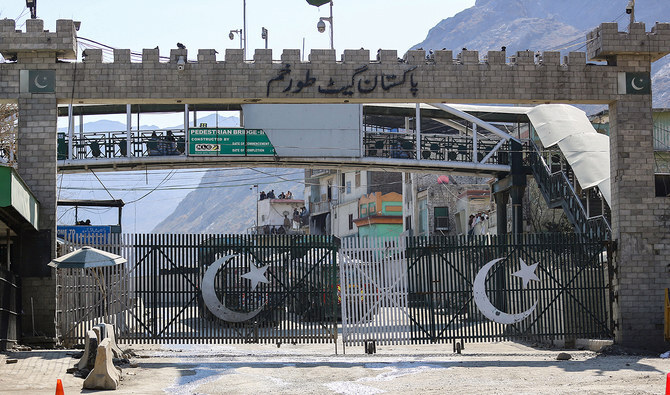
The closed Torkham gate is seen from the zero point at the Torkham border crossing between Afghanistan and Pakistan, in Nangarhar province on February 23, 2023. (AFP/File)
Short Url
Updated 23 February 2025
Follow

Pakistan closes key border crossing with Afghanistan over ‘construction of trenches’ by Taliban authorities

  • The development comes at a time of strained ties between Pakistan and Afghanistan over a surge in militants attacks in Pakistan’s western provinces
  • The closure of Torkham border crossing in Pakistan’s Khyber Pakhtunkhwa has suspended movement of pedestrians as well as trucks carrying trade goods

ISLAMABAD: Pakistan has closed a key crossing on its northwestern border with Afghanistan over the “construction of trenches” near the frontier, a Pakistani police official said on Sunday, which has led to the suspension of cross-border movement.

The Torkham border crossing was closed late on Friday night, when Afghan Taliban authorities initiated “construction of trenches and other development work” along the border, according to Naheed Khan, a senior police official in Pakistan’s Khyber district that borders Afghanistan.

The closure of border crossing by Pakistani authorities has resulted in suspension of movement of pedestrians and trade between the two neighboring countries, but there were no reports of skirmishes between the two sides.

“It [Torkham crossing] is closed both for pedestrians and heavy vehicles since 12 at night on Feb. 21. No firing is reported from either side,” Khan told Arab News.

“Some families of Bacha Mina, a dusty village near the border on Pakistani side, have left the area for safer places to dodge any eventuality. Also some loaded trucks have returned to Jamrud Bazaar.”

There was no immediate comment from the Afghan side on the closure of the key border crossing.

The development comes at a time of strained ties between Pakistan and Afghanistan over a surge in militants attacks in Pakistan’s western provinces that border Afghanistan.

Islamabad has frequently accused Afghanistan of sheltering and supporting militant groups that launch cross-border attacks. Afghan officials deny involvement and insist that Pakistan’s security issues are an internal matter of Islamabad.

In the past, border clashes between Pakistani and Afghan forces have led to the closure of key crossings like Torkham and Chaman, severely disrupting trade and halting the movement of people between the two countries.

In August, the Torkham border was shut down for three days after the Afghan Taliban announced they were investigating reports of Pakistani fighter jets allegedly violating Afghan airspace in Nangarhar and Kunar provinces.

Tensions escalated again between the two countries in December, following reports of Pakistani airstrikes targeting alleged militant camps in Afghanistan. Afghan officials reported the strikes resulted in civilian casualties.


Pakistan, UK launch £10 million higher education partnership

Updated 15 December 2025
Follow

Pakistan, UK launch £10 million higher education partnership

  • Pak-UK Education Gateway second phase expands climate research, scholarships, university exchanges
  • First phase was launched in 2018 and delivered 165 partnerships, 2,000 joint studies and £5 million in grants

ISLAMABAD: Pakistan’s Higher Education Commission (HEC) and the British Council have launched the £10 million second phase of the Pak-UK Education Gateway, the HEC said on Monday, a joint initiative aimed at deepening collaboration between universities in both countries on research, mobility and higher-education reform.

The program, funded equally by the HEC and the British Council, builds on a partnership launched in 2018 and seeks to strengthen institutional ties between Pakistani and British universities, focusing on shared challenges including climate change, skills development and economic growth.

Education cooperation has become an increasingly important pillar of broader Pakistan-UK relations, as both countries look to expand academic mobility, research collaboration and international recognition of qualifications at a time when higher-education systems face pressure to respond to climate risks, labor-market shifts and funding constraints.

“This £10 million partnership is set to deepen collaboration between UK and Pakistani universities on critical issues like Climate Change and Mobility. A true system-to-system commitment,” the HEC said in an X post. 

According to the British Council and HEC, the first phase of the Pak-UK Education Gateway supported 165 institutional partnerships, generated around 2,000 joint research papers and awarded £5 million in research grants. Officials say the second phase aims to build on that foundation as part of a longer-term effort to internationalize Pakistan’s higher-education sector.

“Education is the building block of growth and prosperity. Our work on education in Pakistan supports people throughout their lives: from helping reform education policy at the school level, to our strong partnership in higher education,” British High Commissioner Jane Marriott said in a statement.

“This next phase builds on our already strong relationship, and will unlock opportunities to help both our higher education sectors thrive.”

Opportunities under the second phase include increased funding for scholarships, joint research grants and faculty exchanges, alongside a Start-Up Challenge Fund to support Pakistan-UK university collaborations pursuing commercial opportunities and access to new markets.

The program will also focus on leadership and governance reforms within Pakistan’s higher-education system, including quality assurance, improved campus accessibility for people with disabilities, and greater participation of women in senior leadership roles. It further aims to expand opportunities for Pakistani students to study UK-accredited courses without leaving their home cities, alongside a commitment to mutual recognition of qualifications.

Pakistan’s Minister for Federal Education and Professional Training Khalid Maqbool Siddiqui said the initiative had already delivered concrete results since its launch in 2018, calling education “the bridge that connects people, cultures, and futures.”

Acting HEC Chairperson Nadeem Mahbub described the Gateway as a system-to-system partnership rather than a stand-alone program, noting that it had benefited institutions and students in both countries.