

Bangladesh resumes direct trade with Pakistan after over 50 years

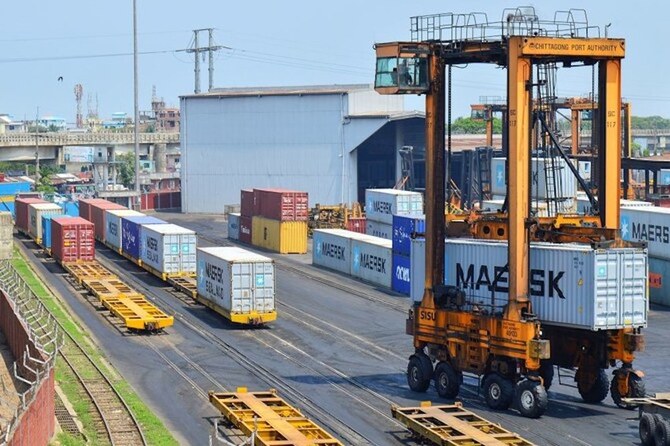
This file photo shows a general view of Bangladesh’s Chittagong Port, where a rice delivery of 25,000 tonnes from Pakistan is expected in March 2025. (Moheen Reeyad)
Short Url
Updated 23 February 2025
Follow

Bangladesh resumes direct trade with Pakistan after over 50 years

  • Bilateral ties have started to grow since the ouster of ex-PM Sheikh Hasina last August
  • Rice import may increase other opportunities for Bangladesh-Pakistan trade, expert says

DHAKA: Bangladesh will receive a delivery of 25,000 tonnes of rice from Pakistan next month, its food ministry said on Sunday, confirming the resumption of direct bilateral trade between the two governments after more than five decades.

Following decades of acrimonious ties, Bangladesh-Pakistan relations have started to grow after the ouster of former Prime Minister Sheikh Hasina last August.

Bangladesh’s interim government has had more bilateral exchanges with Pakistan since, with the chief adviser, Nobel laureate Muhammad Yunus, having met twice with Pakistani Prime Minister Shehbaz Sharif.

Earlier this month, Dhaka finalized a deal to import rice from Pakistan, the food ministry said.

“The first consignment of 25,000 tonnes will arrive in Bangladesh on March 3,” Zia Uddin Ahmed, an additional secretary at the ministry, told Arab News.

“Since 1971, this is the first time Bangladesh initiated rice import at (the government-to-government) level from Pakistan.”

Their growing trade ties followed the two South Asian nations’ direct maritime contact in November, when a Pakistani cargo ship docked in Bangladesh for the first time since 1971 with imports and exports organized by private businesses.

Amena Mohsin, an international relations expert and lecturer at the North South University, said resuming trade with Pakistan is an important move for Bangladesh.

“We want that bilateral relationship with Pakistan to move forward. We always diversify our relationships (but) most importantly, at the moment, we are experiencing a low point row with India … In this context, this latest decision to import rice from Pakistan is very significant,” she told Arab News.

In her 15 years of uninterrupted rule, Hasina’s government was hostile toward Pakistan but closely allied with India, where she fled last year following a student-led popular uprising and remains exiled. Her removal from office was followed by the cooling of relations between Dhaka and New Delhi.

“But (as we move) forward to strengthen the bilateral ties with Pakistan, the issue of 1971 should be resolved at the same time,” Mohsin added, referring to the 1971 war of independence, which he said still weighs heavy on the minds of the people of Bangladesh.

Dhaka’s decision to import rice from Pakistan has significance in addressing an ongoing crisis of the staple due to floods and economic instability, which has led the government to import large quantities from India to avoid shortage.

“At the moment, there is a rice crisis in the Bangladesh market, and we are in need of sourcing rice from different sources at a competitive price,” Dr. Khondaker Golam Moazzem, research director at the Centre for Policy Dialogue in Dhaka, told Arab News.

“From that perspective, finding a new source (for importing rice) is a positive thing for us.”

Now that trade has resumed, Bangladesh and Pakistan have the potential to increase commerce ties in different areas, he added.

“Our businessmen can explore the Pakistan markets and consider the feasibility in terms of costs. With this latest rice import, opportunities to import other goods have increased here,” Moazzem said.

“It’s a new addition to the market, especially considering Bangladesh’s ongoing trade diversification efforts.”


Ten cops killed as separatist militants launch ‘coordinated’ attacks in Pakistan’s southwest — police

Updated 10 min 35 sec ago
Follow

Ten cops killed as separatist militants launch ‘coordinated’ attacks in Pakistan’s southwest — police

  • The attacks began in Balochistan’s capital of Quetta at around 6am with a powerful explosion, followed by intense gunfire

QUETTA: At least 10 security officials and 37 militants were killed as “coordinated” attacks were launched by separatist militants, affiliated with the Balochistan Liberation Army (BLA), across several cities of Pakistan’s southwestern Balochistan province, an official quoted by AFP said Saturday.

The attacks in the provincial capital of Quetta began at around 6am with a powerful explosion, followed by intense gunfire that lasted for two hours along with multiple explosions.

Residents of Dalbandin and Nuhski said they heard explosions and gunfire in the districts early Saturday morning, while there were reports of similar attacks in Mastung, Gwadar, Pasni and Turbat.

A senior police official, who requested anonymity, told Arab News that the militants attempted to enter the provincial capital of Quetta but police and other law enforcement agencies stopped them.

“The terrorists attacked a police mobile at Sariab road which resulted in the killing of two policemen,” he said. “Police and other law enforcement agencies denied space to the terrorists in Quetta city and a clearance operation is still going on.”

Balochistan, which borders Iran and Afghanistan, is the site of a decades-long insurgency waged by Baloch separatist groups who often attack security forces and foreigners, and kidnap government officials.

Shahid Rind, the Balochistan chief minister’s aide for media and political affairs, said police and paramilitary Frontier Corps (FC) had foiled the attacks and were chasing the assailants.

“After the killing of more than 70 terrorists at different places in Balochistan in the last two days, terrorists have attempted to attack at a few places in Balochistan, which have been foiled by timely action by the police and FC,” he said on X.

“At present, the pursuit of the fleeing terrorists is underway. More details will be revealed very soon.”

In a statement issued on Saturday, BLA said the group had launched ‘Operation Herof 2.0,’ which included a series of attacks in multiple cities of Balochistan.

Saturday’s attacks follow coordinated attacks carried out by the group in Aug. 2024 in various districts of Balochistan which killed dozens of people.

The separatists accuse the central government of stealing the region’s resources to fund development elsewhere in the country. The Pakistani government denies the allegations and says it is working for the uplift of local communities in Balochistan.

Pakistan Railways has suspended train service from Balochistan to other parts of the country for a day, following Saturday’s attacks.

“Quetta-Peshawar bound Jaffar Express, and Quetta-Chaman passenger trains have been canceled due to the prevailing security situation in Balochistan,” Muhammad Kashif, the railways controller in Quetta division, told Arab News.

At least four police officials in as many districts confirmed to AFP the situation was not completely under control yet.
“At least four policemen were killed in Quetta alone,” he added, speaking on condition of anonymity as he was not authorized to speak to the media.
A senior military official based in Islamabad confirmed the attacks, adding they were “coordinated but poorly executed.”