China backs Trump’s Ukraine peace bid at G20 as US allies rally behind Zelensky

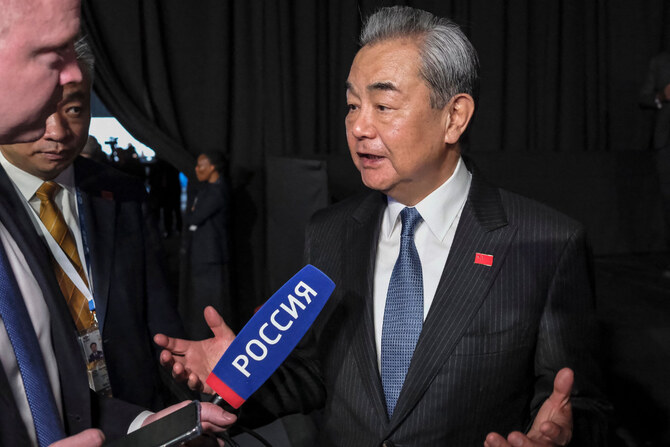
China's Foreign Minister Wang Yi (R) speaks to journalists during the G20 Foreign Minister Meeting at the Nasrec Expo Centre in Johannesburg on Feb. 20, 2025. (AFP)
Short Url
Updated 21 February 2025
Follow

China backs Trump’s Ukraine peace bid at G20 as US allies rally behind Zelensky

  • China says supports US, Russia talks on Ukraine at G20 meeting
  • Says willing to continue to play a role in resolving crisis

BEIJING: China came out in support of US President Donald Trump’s bid to strike a deal with Russia to end the war in Ukraine, at a G20 meeting in South Africa on Thursday, while US allies rallied around Ukrainian President Volodymyr Zelensky.
Less than a month into his presidency, Trump has upended US policy on the war, scrapping a campaign to isolate Moscow with a phone call to Russian President Vladimir Putin and talks between senior US and Russian officials that have sidelined Ukraine.
Trump on Wednesday then denounced Zelensky as a “dictator,” prompting statements of support for the Ukrainian president from G20 members such as Australia, Germany and the United Kingdom.
“China supports all efforts conducive to peace (in Ukraine), including the recent consensus reached between the United States and Russia,” Wang Yi told other G20 foreign ministers gathered in Johannesburg, according to a statement from his ministry.
“China is willing to continue playing a constructive role in the political resolution of the crisis,” he added.
Wang did not reiterate the point he made at the Munich Security Conference last Friday that all stakeholders in the Russia-Ukraine conflict should participate in any peace talks.
Beijing wants to ensure its involvement in whatever deal Trump seeks to strike with the Kremlin to prevent a currently diplomatically-isolated Russia from slipping out from under its influence, and because its ties to Russia offer China an “in” with European officials worried about being frozen out of any talks, analysts say.
“By going straight to Putin, President Trump has erased what Beijing had hoped could be a key piece of initial leverage,” said Ruby Osman, a China expert at the Tony Blair Institute for Global Change.
“Instead, China might turn its attention to discussing a Chinese role in eventual reconstruction and peacekeeping — something that would give Beijing a significantly more vested interest in European security architecture,” she added.
The Trump administration said on Tuesday it had agreed to hold more talks with Russia on ending the nearly three-year long conflict after a 4-1/2-hour long meeting in Saudi Arabia.
Russia said the talks had been useful, but hardened its demands, notably insisting it would not tolerate the NATO alliance granting membership to Ukraine.



’I begged them’: the Guinean mother deported from Belarus without her baby

Updated 5 sec ago
Follow

’I begged them’: the Guinean mother deported from Belarus without her baby

CONAKRY: It’s been nine months since Mariam Soumah, a 23-year-old Guinean woman, says she last saw her baby girl Sabina. The mother is in Guinea, while her daughter is — against her will — in an orphanage in Belarus.
Several months ago, Belarus forcibly deported the young migrant mother to her west African homeland without her baby, according to Soumah and rights groups that have taken up her case.
The reports drew condemnation by UN experts, rights groups and Guinean diplomats.
“I begged them not to do it,” Soumah told AFP during an interview in the slums of Guinea’s capital Conakry, swiping through recent photos on her phone of Sabina — who turned one in November — wearing a red dress.
In a bid to escape poverty, Soumah said she had traveled across Africa to get to Belarus, hoping to get to the EU.
The migration route has become popular in recent years, with the EU accusing the regime of President Alexander Lukashenko of encouraging migrants to try to enter the bloc via Belarus.
Like many, Soumah was lured online to come to authoritarian Belarus on a student visa.
“I didn’t want to go (to Europe) by sea. I looked on a map and saw Belarus was surrounded by Schengen countries.”

- 600 grams -

Her ordeal began in Belarus just as she tried to renew her visa.
Having fallen pregnant there with a Guinean man who left to try to get to the EU, Soumah went into labor more than two months before her due date.
Sabina weighed just 600 grams when she was born in November 2024.
She was rushed to intensive care, where Belarusian doctors managed to save her.
But shortly afterwards, Soumah said she was restricted from seeing her child unless she paid hefty medical bills.
She was later imprisoned for breaking migration rules and forced on a plane without her daughter.
“I said I will only go back with my baby. I begged them, please, just let my baby recover and I will go home with her,” Soumah told AFP.
“They said no.”
Since her deportation in August, Soumah said she has been allowed two short video calls to see Sabina, who is being kept in a Minsk orphanage.
UN experts have called reports of the forced separation “extremely concerning.”
The Guinean embassy in Moscow, which oversees Belarus, told AFP it was following the case with “great humanitarian concern” and said it had demanded “clarifications.”
The embassy said UNICEF Belarus — which told AFP it cannot comment on individual cases — is aware and could help organize “humanitarian support” for the child.
Belarusian authorities did not respond to an AFP request for comment.

- ‘From morning to night’ -

Attempts to restrict Soumah from Sabina began while she was recovering from an emergency C-section.
“Already in hospital, I asked, ‘how is my baby?’ and they told me she was sick and tired,” Soumah said.
She only knew that Sabina had been moved to another hospital.
After 10 days, she walked through Minsk “looking from morning to night” before finding the hospital her daughter was in and visiting her daily.
After Sabina was discharged from intensive care and moved to another hospital, Soumah was handed a medical bill of around $33,000.
Upon seeing it, “I raised my hands into the air,” she said.
She was then blocked from seeing Sabina until she paid.
“I kept coming and they kept saying she was sleeping... or out with the nurses.”

- ‘What orphanage?’ -

According to Soumah, a woman in the hospital last summer announced to her that Sabina was being sent to an orphanage.
“I said: what? What orphanage?” Soumah, herself an orphan, recalled.
Simultaneously, immigration services were ramping up the pressure.
She tried to sign up for more studies for a new visa but was refused.
In July, Soumah said she was jailed for breaking immigration rules.
The exiled rights group Human Constanta — which monitors migrant rights in Belarus — slammed the heavy-handed response for what is classified an administrative, not criminal, offense.
“They simply did not care and separated the mother and child,” Enira Bronitskaya, of Human Constanta, said, calling the process “manipulative.”

- Deportation -

“Threatening her not to give her her child is, of course, illegal,” Bronitskaya said, since there was no official ruling to strip Soumah of her parental rights.
In prison, Soumah said immigration officers tried to get her to find a family member that could fund a ticket home.
Nobody could and “anyway I would not leave without my baby,” she said.
Then, one day she said she was handcuffed, driven to the airport, put on a flight to Istanbul and told not to come back.
In Turkiye, Soumah opened her phone to call the woman who raised her.
“I am coming,” she told her, sobbing.
“But I have nothing, not even my child.”