

Death toll in Pakistan mall fire rises to 67: local government

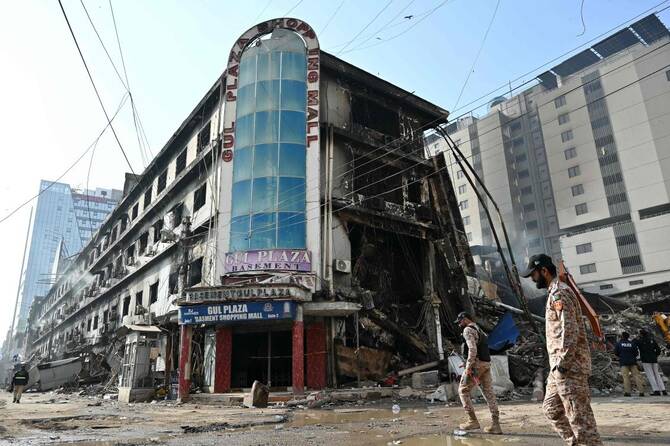
Paramilitary personnel walk past charred remains of a shopping mall in Karachi on Jan. 22, 2026, after a massive fire broke out on January 17. (AFP)
Short Url
Updated 23 January 2026
Follow

Death toll in Pakistan mall fire rises to 67: local government

  • Spokesperson: ‘Post-mortem examinations of 67 bodies have been completed’

KARACHI: The death toll from a mall fire in Pakistan’s biggest city rose to at least 67 people, an unnamed spokesperson from the local government said on Friday.

Investigators are yet to announce what caused the fire, six days after the blaze gutted the three-story Gul Plaza on January 17.

“Post-mortem examinations of 67 bodies have been completed,” said the spokesperson, adding that DNA analysis was ongoing.

“The identities of eight individuals have been confirmed through DNA analysis,” the spokesperson added.

Families have criticized the slow pace of the recovery operation, with more than 50 giving DNA samples in the hope of finding their missing relatives.

The provincial government has announced that it will give 10 million rupees ($35,720) to each family of the deceased. All 1,200 shopkeepers will also be compensated.

Fires are common in Karachi’s markets and factories, which are known for their poor infrastructure, but a blaze on such a scale is rare.

The provincial government was taking measures to ensure fire safety procedures were followed at malls and markets, he said without giving further details.


‘Doomsday Clock’ moves closer to midnight over threats from nukes, climate change, AI

Updated 28 January 2026
Follow

‘Doomsday Clock’ moves closer to midnight over threats from nukes, climate change, AI

  • At the end of the Cold War, the clock was as close as 17 minutes to midnight. In the past few years, to address rapid global changes, the group has changed from counting down the minutes until midnight to counting down the seconds

WASHINGTON: Earth is closer than it’s ever been to destruction as Russia, China, the US and other countries become “increasingly aggressive, adversarial, and nationalistic,” a science-oriented advocacy group said Tuesday as it advanced its “Doomsday Clock” to 85 seconds till midnight.

The Bulletin of the Atomic Scientist members had an initial demonstration on Friday and then announced their results on Tuesday.

The scientists cited risks of nuclear war, climate change, potential misuse of biotechnology and the increasing use of artificial intelligence without adequate controls as it made the annual announcement, which rates how close humanity is from ending.

Last year the clock advanced to 89 seconds to midnight.

Since then, “hard-won global understandings are collapsing, accelerating a winner-takes-all great power competition and undermining the international cooperation” needed to reduce existential risks, the group said.

They worry about the threat of escalating conflicts involving nuclear-armed countries, citing the Russia-Ukraine war, May’s conflict between India and Pakistan and whether Iran is capable of developing nuclear weapons after strikes last summer by the US and Israel.

International trust and cooperation is essential because, “if the world splinters into an us-versus-them, zero-sum approach, it increases the likelihood that we all lose,” said Daniel Holz, chair of the group’s science and security board.

The group also highlighted droughts, heat waves and floods linked to global warming, as well as the failure of nations to adopt meaningful agreements to fight global warming — singling out US President Donald Trump’s efforts to boost fossil fuels and hobble renewable energy production.

Starting in 1947, the advocacy group used a clock to symbolize the potential and even likelihood of people doing something to end humanity. 

At the end of the Cold War, it was as close as 17 minutes to midnight. In the past few years, to address rapid global changes, the group has changed from counting down the minutes until midnight to counting down the seconds.

The group said the clock could be turned back if leaders and nations worked together to address existential risks.