

I begged them: the Guinean mother deported from Belarus without her baby

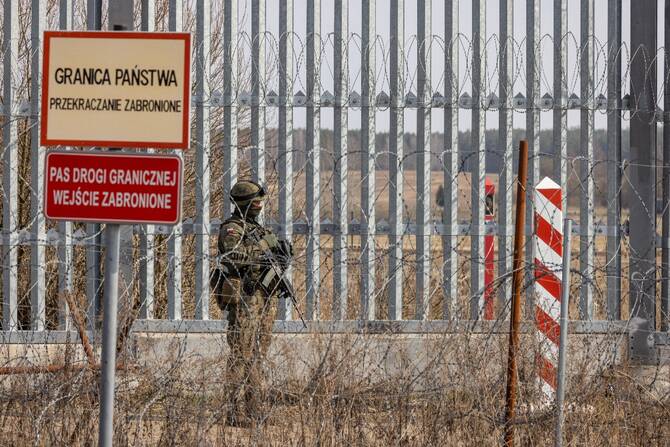
A Polish soldier stands next to the placard reading "Border State" at the Belarusian border in Ozierany Male, eastern Poland. (AFP)
Short Url
Updated 23 January 2026
Follow

I begged them: the Guinean mother deported from Belarus without her baby

  • The reports drew condemnation by UN experts, rights groups and Guinean diplomats

CONAKRY: It’s been nine months since Mariam Soumah, a 23-year-old Guinean woman, says she last saw her baby girl Sabina. The mother is in Guinea, while her daughter is — against her will — in an orphanage in Belarus.
Several months ago, Belarus forcibly deported the young migrant mother to her west African homeland without her baby, according to Soumah and rights groups that have taken up her case.
The reports drew condemnation by UN experts, rights groups and Guinean diplomats.
“I begged them not to do it,” Soumah told AFP during an interview in the slums of Guinea’s capital Conakry, swiping through recent photos on her phone of Sabina — who turned one in November — wearing a red dress.
In a bid to escape poverty, Soumah said she had traveled across Africa to get to Belarus, hoping to get to the EU.
The migration route has become popular in recent years, with the EU accusing the regime of President Alexander Lukashenko of encouraging migrants to try to enter the bloc via Belarus.
Like many, Soumah was lured online to come to authoritarian Belarus on a student visa.
“I didn’t want to go (to Europe) by sea. I looked on a map and saw Belarus was surrounded by Schengen countries.”

- 600 grams -

Her ordeal began in Belarus just as she tried to renew her visa.
Having fallen pregnant there with a Guinean man who left to try to get to the EU, Soumah went into labor more than two months before her due date.
Sabina weighed just 600 grams when she was born in November 2024.
She was rushed to intensive care, where Belarusian doctors managed to save her.
But shortly afterwards, Soumah said she was restricted from seeing her child unless she paid hefty medical bills.
She was later imprisoned for breaking migration rules and forced on a plane without her daughter.
“I said I will only go back with my baby. I begged them, please, just let my baby recover and I will go home with her,” Soumah told AFP.
“They said no.”
Since her deportation in August, Soumah said she has been allowed two short video calls to see Sabina, who is being kept in a Minsk orphanage.
UN experts have called reports of the forced separation “extremely concerning.”
The Guinean embassy in Moscow, which oversees Belarus, told AFP it was following the case with “great humanitarian concern” and said it had demanded “clarifications.”
The embassy said UNICEF Belarus — which told AFP it cannot comment on individual cases — is aware and could help organize “humanitarian support” for the child.
Belarusian authorities did not respond to an AFP request for comment.

- ‘From morning to night’ -

Attempts to restrict Soumah from Sabina began while she was recovering from an emergency C-section.
“Already in hospital, I asked, ‘how is my baby?’ and they told me she was sick and tired,” Soumah said.
She only knew that Sabina had been moved to another hospital.
After 10 days, she walked through Minsk “looking from morning to night” before finding the hospital her daughter was in and visiting her daily.
After Sabina was discharged from intensive care and moved to another hospital, Soumah was handed a medical bill of around $33,000.
Upon seeing it, “I raised my hands into the air,” she said.
She was then blocked from seeing Sabina until she paid.
“I kept coming and they kept saying she was sleeping... or out with the nurses.”

- ‘What orphanage?’ -

According to Soumah, a woman in the hospital last summer announced to her that Sabina was being sent to an orphanage.
“I said: what? What orphanage?” Soumah, herself an orphan, recalled.
Simultaneously, immigration services were ramping up the pressure.
She tried to sign up for more studies for a new visa but was refused.
In July, Soumah said she was jailed for breaking immigration rules.
The exiled rights group Human Constanta — which monitors migrant rights in Belarus — slammed the heavy-handed response for what is classified an administrative, not criminal, offense.
“They simply did not care and separated the mother and child,” Enira Bronitskaya, of Human Constanta, said, calling the process “manipulative.”

- Deportation -

“Threatening her not to give her her child is, of course, illegal,” Bronitskaya said, since there was no official ruling to strip Soumah of her parental rights.
In prison, Soumah said immigration officers tried to get her to find a family member that could fund a ticket home.
Nobody could and “anyway I would not leave without my baby,” she said.
Then, one day she said she was handcuffed, driven to the airport, put on a flight to Istanbul and told not to come back.
In Turkiye, Soumah opened her phone to call the woman who raised her.
“I am coming,” she told her, sobbing.
“But I have nothing, not even my child.”


Trump taking steps toward installing a Columbus statue near the White House

Updated 6 sec ago
Follow

Trump taking steps toward installing a Columbus statue near the White House

  • Trump endorses a traditional view of Columbus as leader of the 1492 mission that marked the unofficial beginning of European colonization in the Americas

ANNAPOLIS, Maryland: President Donald Trump is taking steps toward installing near the White House a replica of a statue of famed explorer Christopher Columbus that had been tossed into Baltimore’s harbor during his first term amid protests against institutional racism.
John Pica, a Maryland lobbyist and president of the Italian American Organizations United, said his group owns the statue and agreed to loan it to the federal government for placement at or near the White House.
Pica told The Associated Press in an interview that he was contacted about the statue around Columbus Day last year by an intermediary who said the White House was looking for a statue of the explorer. Pica says his organization took a straw vote and unanimously decided to send the statue to the White House. They signed the loan agreement Wednesday.
Asked if he was optimistic the statue would make it to the White House, Pica said, “Cautiously optimistic, yes.” The exact timing for any planned installation was unclear, he said, though he added, “possibly within two weeks.”
Maryland state Delaware Nino Mangione, a Republican who has worked with the Italian American group to find the statue a new home after it was pulled from the harbor, also confirmed the plans for the statue, which were first reported earlier Wednesday by The Washington Post.
The White House declined to comment to the AP on plans for the statue but reaffirmed Trump’s affinity for Columbus, whose legacy has shifted as historians and educators amplify how white European figures and their descendants treated Native Americans and enslaved Africans to develop the New World.
“In this White House, Christopher Columbus is a hero,” said Trump spokesman David Ingle. “And he will continue to be honored as such by President Trump.”
Trump wants to put his own stamp on American history ahead of big anniversary celebration
For Pica and his group, the statue’s Washington placement would celebrate a famous Italian who holds iconic status among Italian Americans. For Trump, it would be another move to reshape the telling of US history as the nation marks the 250th anniversary of the signing of the Declaration of Independence.
Trump endorses a traditional view of Columbus as leader of the 1492 mission that marked the unofficial beginning of European colonization in the Americas and the development of the modern economic and political order. But in recent years, Columbus also been recognized as a primary example of Western Europe’s conquest of the New World, its resources and its native people.
The statue now headed to Washington is a replica of one toppled by protesters on July 4, 2020, and thrown into Baltimore’s Inner Harbor after anger boiled over following the death of George Floyd at the hands of police. It was one of many statues of Columbus that were vandalized around the same time, with protesters saying the Italian explorer was responsible for the genocide and exploitation of native peoples in the Americas.
“I was there when we got it out of the harbor,” Mangione said, adding that artist Will Hemsley used parts of the old statue, first unveiled during Ronald Reagan’s presidency, “to build and restore a beautiful, brand new statue.”
In recent years, some individuals, institutions and government entities have displaced Columbus Day with recognition of Indigenous Peoples Day. President Joe Biden in 2021 became the first US president to mark Indigenous Peoples Day with a proclamation.
The statue may not be permanent
Pica emphasized that his group is lending the statue and would reclaim it if a future administration wanted it taken down.
Trump dismisses the shift on Columbus as “left-wing arsonists” bending history and twisting Americans’ collective memory. “I’m bringing Columbus Day back from the ashes.,” he declared last April. Echoing his 2024 campaign rhetoric, he complained that “Democrats did everything possible to destroy Christopher Columbus, his reputation, and all of the Italians that love him so much.”
Trump issued a Columbus Day proclamation last October and ignored Indigenous Peoples Day. He praised Columbus as “the original American hero, a giant of Western civilization, and one of the most gallant and visionary men to ever walk the face of the earth.”
That tribute reflected Trump’s broader take on history. Last spring, he signed an executive order titled “Restoring Truth and Sanity to American History,” which bemoaned “a concerted and widespread effort to rewrite our Nation’s history” in a way that misrepresents the US “as inherently racist, sexist, oppressive, or otherwise irredeemably flawed.”
Since the order, the administration has demanded a comprehensive review of exhibits across all Smithsonian museums and pushed Executive Branch agencies and state and local entities — especially colleges, universities and schools — that receive federal funding to roll back their diversity initiatives.