Trump restricts AP access over Gulf of Mexico issue

1 / 2
The AP says in its stylebook that the Gulf of Mexico has carried that name for more than 400 years. (Screenshot/Google Maps/AFP)
2 / 2
The AP says in its stylebook that the Gulf of Mexico has carried that name for more than 400 years. (Screenshot/Google Maps)
Short Url
Updated 20 February 2025
Follow

Trump restricts AP access over Gulf of Mexico issue

  • Associated Press said it would continue to use the gulf’s established name disregarding the Trump administration’s effort to rebrand it as Gulf of America

LONDON: US President Donald Trump said on Tuesday that he will block the Associated Press from the Oval Office and Air Force One until the news agency stops referring to the Gulf of Mexico.
Trump signed an executive order in January directing the Interior Department to change the name of the body of water to the Gulf of America. The AP, citing editorial standards, said it would continue to use the gulf’s established name.
The White House has kept the AP out of several press pool gatherings during the past week, calling the news agency’s decision divisive and misinformation.
“We’re going to keep them out until such time as they agree that it’s the Gulf of America,” Trump told reporters at Mar-a-Lago in Florida on Tuesday in his first public comments on the issue.
The agency has retained access to the White House complex itself.


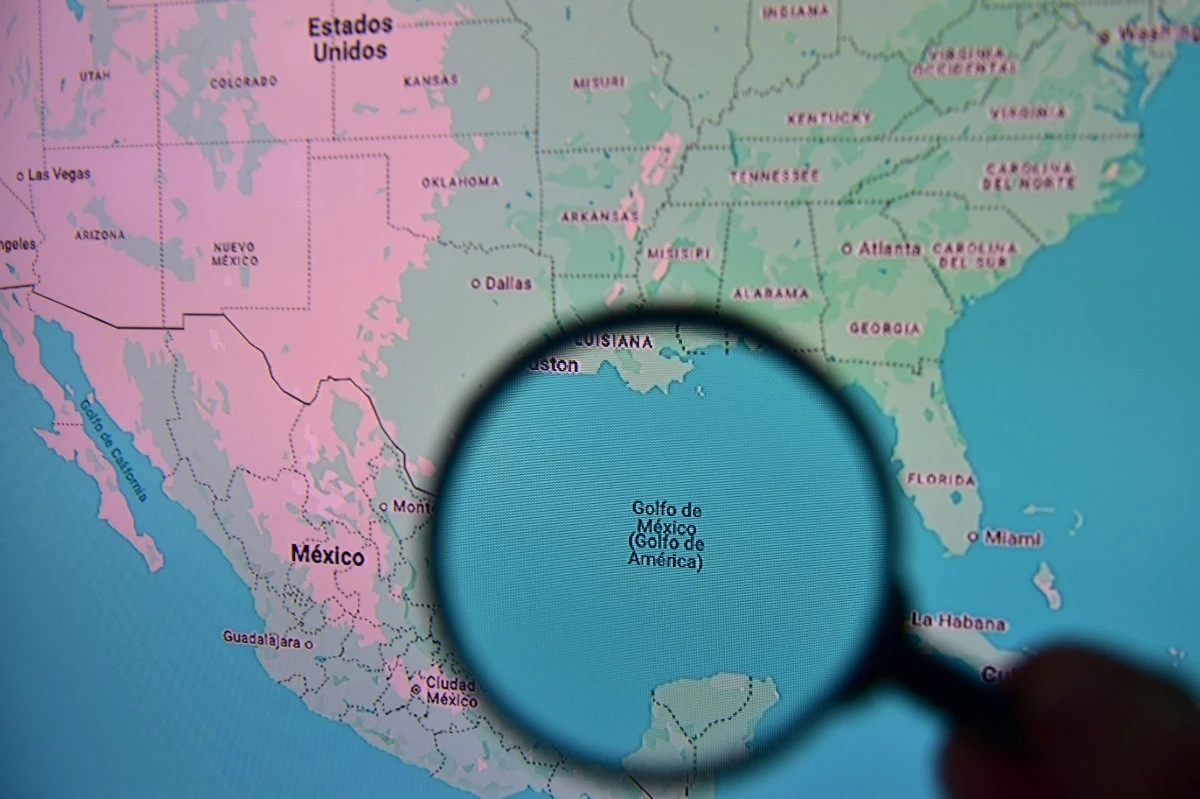
The Gulf of Mexico, branded as Gulf of America, is pictured through a magnifying glass on the Google Maps app on a computer in Bogota on February 11, 2025. (AFP) 

The AP says in its stylebook that the Gulf of Mexico has carried that name for more than 400 years. As a global news agency, the AP says it will refer to the gulf by its original name while acknowledging the new name Trump has chosen.
“This is about the government telling the public and press what words to use and retaliating if they do not follow government orders,” said AP spokesperson Lauren Easton.
The White House Correspondents’ Association, which represents journalists covering the president, has protested the Trump administration’s actions against the AP.
Most news organizations, including Reuters, continue to call the body of water the Gulf of Mexico, although, where relevant, Reuters style is to include the context about Trump’s executive order.
“Reuters stands with the Associated Press and other media organizations in objecting to coverage restrictions imposed by the White House on the AP, because of the AP’s independent editorial decisions,” Reuters said in a statement on Saturday.
BBC says will fight Trump's $10 bn defamation lawsuit

Updated 16 December 2025
Follow

BBC says will fight Trump's $10 bn defamation lawsuit

LONDON: The BBC said Tuesday it would fight a $10-billion lawsuit brought by US President Donald Trump against the British broadcaster over a documentary that edited his 2021 speech ahead of the US Capitol riot.
“As we have made clear previously, we will be defending this case,” a BBC spokesperson said in a statement sent to AFP, adding the company would not be making “further comment on ongoing legal proceedings.”
The lawsuit, filed in federal court in Miami, seeks “damages in an amount not less than $5,000,000,000” for each of two counts against the British broadcaster, for alleged defamation and violation of the Florida Deceptive and Unfair Trade Practices Act.
The video that triggered the lawsuit spliced together two separate sections of Trump’s speech on January 6, 2021 in a way that made it appear he explicitly urged supporters to attack the Capitol, where lawmakers were certifying Joe Biden’s 2020 election win.
The lawsuit comes as the UK government on Tuesday launched the politically sensitive review of the BBC’s Royal Charter, which outlines the corporation’s funding and governance and needs to be renewed in 2027.
As part of the review, it launched a public consultation on issues including the role of “accuracy” in the BBC’s mission and contentious reforms to the corporation’s funding model, which currently relies on a mandatory fee for anyone in the country who watches television.
Minister Stephen Kinnock stressed after the lawsuit was filed that the UK government “is a massive supporter of the BBC.”
The BBC has “been very clear that there is no case to answer in terms of Mr.Trump’s accusation on the broader point of libel or defamation. I think it’s right the BBC stands firm on that point,” Kinnock told Sky News on Tuesday.
Trump, 79, had said the lawsuit was imminent, claiming the BBC had “put words in my mouth,” even positing that “they used AI or something.”
The documentary at issue aired last year before the 2024 election, on the BBC’s “Panorama” flagship current affairs program.

Apology letter 

“The formerly respected and now disgraced BBC defamed President Trump by intentionally, maliciously, and deceptively doctoring his speech in a brazen attempt to interfere in the 2024 Presidential Election,” a spokesperson for Trump’s legal team said in a statement to AFP.
“The BBC has a long pattern of deceiving its audience in coverage of President Trump, all in service of its own leftist political agenda,” the statement added.
The British Broadcasting Corporation, whose audience extends well beyond the United Kingdom, faced a period of turmoil last month after a media report brought renewed attention to the edited clip.
The scandal led the BBC director general, Tim Davie, and the organization’s top news executive, Deborah Turness, to resign.
Trump’s lawsuit says the edited speech in the documentary was “fabricated and aired by the Defendants one week before the 2024 Presidential Election in a brazen attempt to interfere in and influence the Election’s outcome to President Trump’s detriment.”
The BBC has denied Trump’s claims of legal defamation, though BBC chairman Samir Shah has sent Trump a letter of apology.
Shah also told a UK parliamentary committee last month the broadcaster should have acted sooner to acknowledge its mistake after the error was disclosed in a memo, which was leaked to The Daily Telegraph newspaper.
The BBC lawsuit is the latest in a string of legal actions Trump has taken against media companies in recent years, several of which have led to multi-million-dollar settlements.