

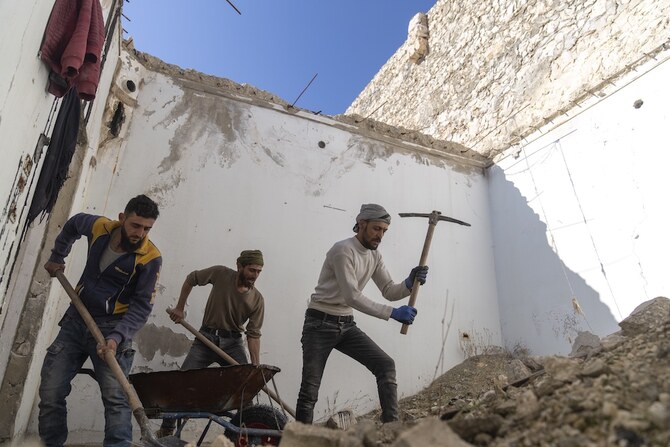

LONDON: Sanctions imposed on the regime of former Syrian President Bashar Assad by the West are harming the country’s recovery, Human Rights Watch said on Tuesday.
Sanctions put in place by the US, the UK, the EU and others are “hindering reconstruction efforts and exacerbating the suffering of millions of Syrians,” and have no clear removal mechanism, HRW added.
Hiba Zayadin, HRW’s senior Syria researcher, said the country “is in desperate need of reconstruction and Syrians are struggling to survive. With the collapse of the former government, broad sanctions now stand as a major obstacle to restoring essential services such as health care, water, electricity, and education.”
HRW said the country’s long-running civil war has left its economy and infrastructure devastated, with millions of people having fled and 90 percent of the remaining population living in poverty.
Around 13 million are unable to access sufficient food, and 16.5 million are reliant on humanitarian aid.
The organization said sanctions, some of which have been in place for almost half a century but which were ramped up by the West in 2011 after the outbreak of the conflict, are making it harder to alleviate this suffering and to deliver aid despite humanitarian exemptions.
HRW said sanctions should be lifted to allow “access to basic rights,” including “restoring Syria’s access to global financial systems, ending trade restrictions on essential goods, addressing energy sanctions to ensure access to fuel and electricity, and providing clear legal assurances to financial institutions and businesses to mitigate the chilling effect of overcompliance.”
US sanctions hinder nearly all trade and financial transactions with Syria, while the Caesar Act sanctions foreign companies doing business with the government, “particularly in oil and gas, construction, and engineering,” HRW said.
EU and UK sanctions focus largely on Syrian crude oil exports, investments, and the activities of Syrian banks.
Western powers have proposed changes to the sanctions regime since Assad’s ouster in December, but the head of the Syrian Arab Republic’s Investment Agency, Ayman Hamawiye, said earlier this year that the only concrete changes — tweaks to US sanctions affecting energy remittance payments — were “inadequate” so far.
“Rather than using broad sectoral sanctions as leverage for shifting political objectives, Western governments should recognize their direct harm to civilians and take meaningful steps to lift restrictions that impede access to basic rights,” Zayadin said.
“A piecemeal approach of temporary exemptions and limited waivers is not enough. Sanctions that harm civilians should immediately be lifted, not refined.”
HRW said Syria requires at least $250 billion to begin its reconstruction, focusing on essential infrastructure.
It highlighted the crumbling water network and overwhelmed healthcare system as two examples in desperate need of financial help, as well as the education sector, with around 2 million Syrian children out of fulltime school.
HRW said sanctions should not “have a disproportionately negative impact on human rights or create unnecessary suffering,” and “should not be punitive, but should instead be designed to deter and correct human rights abuses.”
It added: “To be effective, sanctions must be tied to clear, measurable, and attainable conditions for their removal, with regular monitoring to assess progress.
“The Caesar Act in the United States was designed to punish the Assad government, but in a post-Assad world, its broad and indefinite restrictions risk harming civilians without advancing clear human rights objectives.”


