France says EU working toward ‘rapid’ easing of Syria sanctions

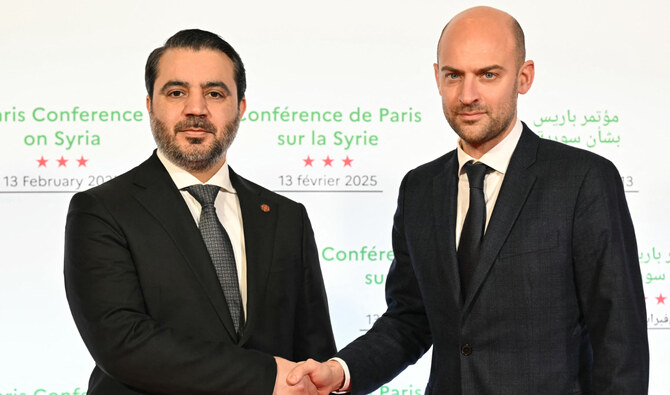
Syria’s Minister of Foreign Affairs Asaad Hassan Al-Shibani shakes hands with his French counterpart in Paris on Thursday. (AFP)
Short Url
Updated 13 February 2025
Follow

France says EU working toward ‘rapid’ easing of Syria sanctions

  • Paris conference focused on protecting Syria from destabilizing foreign interference, coordinating aid efforts

PARIS: France’s Foreign Minister Jean-Noel Barrot said Thursday that the EU was working toward swiftly easing Syria sanctions as Paris hosted a conference on the transition in the war-torn country after President Bashar Assad’s fall.

Opposition fighters toppled Assad in December after a lightning offensive.

The new authorities, headed by interim leader Ahmad Al-Sharaa, have sought to reassure the international community that they have broken with their jihadist past and will respect the rights of minorities.

They have been lobbying the West to ease sanctions imposed against Assad to allow the country to rebuild its economy after five decades of his family’s rule and almost 14 years of civil war.

“We are working with my European counterparts toward a rapid lifting of sectorial economic sanctions,” Barrot said, after EU foreign ministers agreed last month to ease them, starting with key sectors such as energy.

Syria’s Foreign Minister Asaad Al-Shaibani is in Paris for the conference, in his first such official visit to Europe for talks after he attended the World Economic Forum in Davos last month.

The French presidency said earlier that the United States, Germany, Britain, the European Union and the United Nations were also to be represented, as were several Gulf nations and Syria’s northern neighbor Turkiye.

French President Emmanuel Macron is due to address attendees.

There has been concern among Western governments over the direction the new Syrian leadership will take in particular on religious freedom, women’s rights and the status of the Kurdish minority in the northeast of Syria.

Shaibani on Wednesday said a new government would take over next month from the interim cabinet, vowing that it would represent all Syrians in their diversity.

German Foreign Minister Annalena Baerbock, ahead of the Paris meeting, emphasized the need for “all actors” in Syria to be included.

“It is essential that women be represented,” she said.

Several diplomatic sources had said the conference also aimed to focus on protecting Syria from destabilizing foreign interference and coordinating aid efforts.

Turkish-backed factions launched attacks against Kurdish-held areas in northern Syria at around the same time as the offensive that overthrew Assad, and have since seized strategic areas.


Khartoum markets back to life but ‘nothing like before’

Updated 3 sec ago
Follow

Khartoum markets back to life but ‘nothing like before’

  • The hustle and bustle of buyers and sellers has returned to Khartoum’s central market, but “it’s nothing like before,” fruit vendor Hashim Mohamed told AFP, streets away from where war first broke out
KHARTOUM: The hustle and bustle of buyers and sellers has returned to Khartoum’s central market, but “it’s nothing like before,” fruit vendor Hashim Mohamed told AFP, streets away from where war first broke out nearly three years ago.
On April 15, 2023, central Khartoum awoke to battles between the Sudanese army and the paramilitary Rapid Support Forces (RSF), who had been allies since 2021, when they ousted civilians from a short-lived transitional government.
Their war has since killed tens of thousands and displaced millions.
In greater Khartoum alone, nearly four million people — around half the population — fled the city when the RSF took over.
Hashim Mohamed did not.
“I had to work discreetly, because there were regular attacks” on businesses, said the fruit seller, who has worked in the sprawling market for 50 years.
Like him, those who stayed in the city reported having lived in constant fear of assaults and robberies from militiamen roaming the streets.
Last March, army forces led an offensive through the capital, pushing paramilitary fighters out and revealing the vast looting and destruction left behind.
“The market’s not what it used to be, but it’s much better than when the RSF was here,” said market vendor Adam Haddad, resting in the shade of an awning.
In the market’s narrow, dusty alleyways, fruits and vegetables are piled high on makeshift stalls or tarps spread on the ground.
Two jobs to survive
Khartoum, where entire neighborhoods have been damaged by the fighting, is no longer threatened by the mass starvation that stalks battlefield cities and displacement camps elsewhere in Sudan.
But with the economy a shambles, a good living is still hard to provide.
“People complain about prices, they say it’s too expensive. You can find everything, but the costs keep going up: supplies, labor, transportation,” said Mohamed.
Sudan has known only triple-digit annual inflation for years. Figures for 2024 stood at 151 percent — down from a 2021 peak of 358 percent.
The currency has also collapsed, going from trading at 570 Sudanese pounds to the US dollar before the war to 3,500 in 2026, according to the black market rate.
One Sudanese teacher, who only a few years ago could provide comfortably for his two children, told AFP he could no longer pay his rent with a monthly salary of 250,000 Sudanese pounds ($71).
To feed his family, pay for school and cover health care, he “works in the market or anywhere” on his days off.
“You have to have another job to pay for the bare minimum of basic needs,” he said, asking for anonymity to protect his privacy and to avoid “problems with security services.”
Beyond Khartoum, the war still rages, with the RSF in control of much of western and southern Sudan and pushing into the central Kordofan region.
For Adam Haddad, the road to recovery will be a long one.
“We don’t have enough resources or workers or liquidity going through the market,” he said, adding that reliable electricity was still a problem.
“The government is striving to restore everything, and God willing, in the near future, the power will return and Khartoum will become what it once was.”