KARACHI: International Monetary Fund (IMF) Managing Director Kristalina Georgieva on Monday acknowledged Pakistan’s economic progress, saying the country was moving in the “right direction” by staying the course of IMF-backed structural reforms.
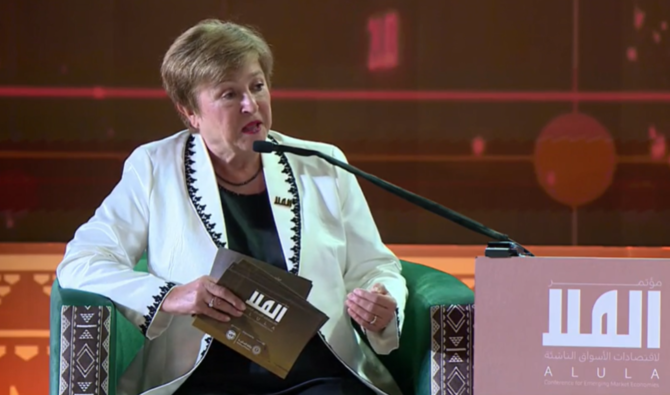
She said this while moderating a panel discussion, titled “A Path for Emerging Market Resilience,” on the second day of AlUla Conference for Emerging Market Economies in Saudi Arabia. The discussion featured Pakistan’s finance minister, Muhammad Aurangzeb, and his counterparts from Türkiye, Brazil and Egypt.
Pakistan, which averted a default in 2023, is currently navigating a path to economic recovery under a $7 billion IMF program and has undertaken several reforms in taxation, energy and others sectors as well as with regard to better management of loss-making state-owned enterprises (SOEs).
Aurangzeb shared the South Asian nation had achieved a primary surplus on the fiscal deficit front with its overall debt-to-GDP ratio having declined to mid-60s from more than 73 percent, thanks to “prudent fiscal management.”
“This is indeed the right trajectory, the right direction to travel and I want to thank you for your dedication to stay the course,” Georgieva said after Aurangzeb detailed his government’s efforts to keep the fiscal and current account deficits in check.
The statement by the IMF chief comes days before the arrival of a team of IMF experts to review Pakistan’s performance under the ongoing loan program. A successful review would lead to the release of around $1 billion to the cash-strapped South Asian nation.
Georgieva lauded Pakistan for “improving the overall performance of the economy” through privatization and trying to reform the loss-making SOEs, especially the government’s failed attempt to sell off its stake in the Pakistan International Airlines (PIA).
“You rightly pointed out the bane of our country has been the twin deficits,” Aurangzeb said, adding that Pakistan’s tax-to-GDP ratio was languishing between 9 percent to 10 percent, the lowest in the region, but the government was able to increase it to 10.8 percent in end-December by mobilizing local resources.
In its 37-month loan agreement with the Washington-based lender, Pakistan has agreed to increase the country’s tax-to-GDP level to 13.5 percent to join the comity of nations and to bring a certain level of sustainability to the primary surplus that it has achieved.
Aurangzeb said his country was working and making “tough policy choices with respect to what is a good cost and bad cost.”
The government of Prime Minister Shehbaz Sharif is trying to rid Pakistan’s economy of the recurring boom-and-bust cycles by enticing overseas Pakistanis to remit their earnings through formal banking channels as well as increasing exports. Pakistan expects worker remittances to rise above $35 billion this year through June.
“If we have to grow sustainably it has to be export-led growth. And we have to change fundamentally the DNA of the economy and we are working toward that,” Aurangzeb said.
“We just need to make sure we make it sustainable as we go forward.”
To a question, the minister said developing economies like Pakistan were relatively in a good place as they had entered 2025 on a “relatively strong note” in terms of market stability, resilience of the banking system, and the bold and structural reforms, which a number of economies were undertaking at this point.
“Therefore, a lot is in our control in terms of staying the course,” Aurangzeb said, adding Pakistan’s recent 10-year agreement with the World Bank Group would allow it to look at the existential issues of population control and climate change.
The use of artificial intelligence (AI) is going to become a huge enabler and game changer for a productivity-led economic growth in Pakistan, according to the finance minister. The use of agri-tech and AI-inspired precision farming will hike crop yields by 5 percent to 20 percent, while AI-powered digital banking and other services have already begun to help increase Pakistan’s IT exports by 25 percent.
“What we need to do is to ensure that the third largest freelancer population in the country gets the requisite resources,” he added.


![]()

Pakistan economy moving in ‘right direction’ — IMF chief
Short Url
https://arab.news/244ej
Pakistan economy moving in ‘right direction’ — IMF chief
- Pakistan, which averted a default in 2023, is currently navigating a path to economic recovery under a $7 billion IMF program
- Finmin says Pakistan has achieved a primary surplus on the fiscal side, with overall debt-to-GDP ratio having declined to mid-60s
Latest updates





Recommended


© 2026 SAUDI RESEARCH & PUBLISHING COMPANY, All Rights Reserved And subject to Terms of Use Agreement.