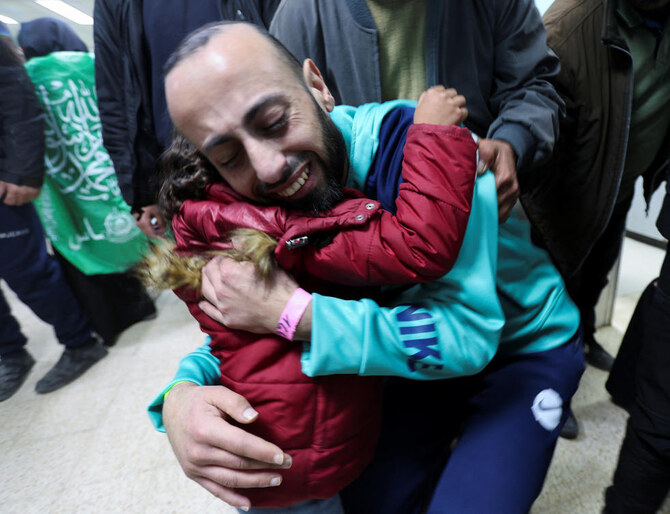
KHAN YOUNIS: Palestinian medic and ambulance worker Tarek Rabie Safi, freed from an Israeli jail as part of a ceasefire deal between Israel and Hamas, said he was underfed and abused during almost a year in captivity.
Safi, a 39-year-old father of two, was released along with 368 other Palestinian detainees on Saturday, after Hamas freed three Israeli hostages from Gaza.
Palestinian prisoners and Israeli hostages have both complained of harsh treatment in the hands of their captors.
“I was held by the Israeli army in the Gaza ‘envelop’, which is Sde Teiman where I stayed for four months (and I was subjected to) torture of our bodies (physical torture) and hunger,” a gaunt-looking Safi said.
“(There was) no (decent) food, or drinks, or (medical) treatment. My arm was broken, and they did not treat me, and they did not get me checked by a doctor.”
The Israeli military rejected the claims in an emailed response to Reuters’ queries, saying detainees are given food and drink regularly and have access to medical care, and that if necessary, they are transferred to a medical facility with advanced capabilities.
Safi, who was detained in March last year near Khan Younis in southern Gaza, said a detainee who was in the same room with him had died as a result of his treatment.
“A young man who was with me was martyred, Mussab Haniyeh, may God have mercy on him, in the same room. This young man was strong, but due to the lack of food, lack of drinks and frequent torture, he was martyred in front of our eyes,” Safi said.
After four months in the detention center, Safi was moved to other Israeli jails until his release in Khan Younis, where he was reunited with his family in emotional scenes.
The Israeli military said it is aware of incidents of detainee deaths, but cannot comment since investigations are pending.
The Palestinian Prisoner Association, which documents Israeli detentions of Palestinians, said that Israel is carrying out “systematic crimes and revenge attacks” against prisoners, most recently in the Israeli-occupied West Bank’s Ofer prison.
Abdullah Al-Zaghari, head of the association, said that the group had documented horrific testimonies, including severe beatings and shackling prisoners for days and weeks without food or water.
Reuters is unable to independently confirm the reports.
Human rights group Amnesty International said last year that 27 released detainees it had interviewed consistently described being subjected to torture on at least one occasion during their arrest.


Palestinian detainee says he was tortured in Israeli detention center


https://arab.news/zyy2j
Palestinian detainee says he was tortured in Israeli detention center

- “(There was) no (decent) food, or drinks, or (medical) treatment. My arm was broken, and they did not treat me, and they did not get me checked by a doctor”: Safi


Iran says any US attack including limited strikes would be ‘act of aggression’
- Foreign ministry spokesman said any state would react to an act of aggression as part of its inherent right of self-defense
- Trump said Friday he was considering a limited strike if Tehran did not reach a deal with the US
TEHRAN: Iran said Monday that any US attack, including limited strikes, would be an “act of aggression” that would precipitate a response, after President Donald Trump said he was considering a limited strike on Iran.
“And with respect to your first question concerning the limited strike, I think there is no limited strike,” foreign ministry spokesman Esmaeil Baqaei said at a briefing in Tehran attended by an AFP journalist.
“An act of aggression would be regarded as an act of aggression. Period. And any state would react to an act of aggression as part of its inherent right of self-defense ferociously so that’s what we would do.”
Trump said Friday he was considering a limited strike if Tehran did not reach a deal with the United States.
“I guess I can say I am considering that,” he replied following a question from reporters.
The two countries concluded a second round of indirect talks in Switzerland on Tuesday under Omani mediation, against the backdrop of a major US military build-up in the region.
Further talks, confirmed by Iran and Oman but not by the United States, are scheduled for Thursday.
Foreign Minister Abbas Araghchi is leading the negotiations for Iran, while the United States is represented by envoy Steve Witkoff and Trump’s son-in-law Jared Kushner.
Trump is wondering why Iran has not “capitulated” in the face of Washington’s military deployment, Witkoff said in an interview with Fox News broadcast on Sunday.
Baqaei responded Monday by saying that Iranians had never capitulated at any point in their history.


