

Emerging economies must ‘punch their weight’ in global policy

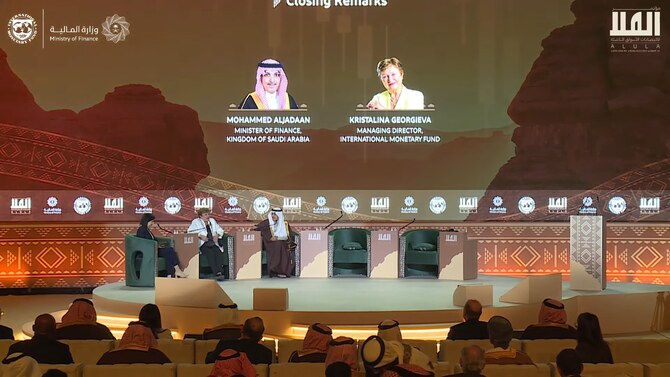
Organized by the Saudi Ministry of Finance and the International Monetary Fund, the forum highlighted the need for developing nations to assert their global influence. AN photo
Short Url
Updated 17 February 2025
Follow

Emerging economies must ‘punch their weight’ in global policy

RIYADH: Emerging economies must play a greater role in global economic discussions, Saudi Arabia’s Minister of Finance, Mohammed Al-Jadaan, said at the closing of the AlUla Conference for Emerging Market Economies. 

Organized by the Saudi Ministry of Finance and the International Monetary Fund, the forum highlighted the need for developing nations to assert their global influence, focusing on economic diversification, deregulation, and digital transformation. 

Al-Jadaan stressed that emerging markets play a crucial role in shaping international economic policies and must be confident in their contributions. 

“Emerging economies will need to punch their weight. They need to gain more confidence, they need to acknowledge, understand—even with humbleness—that they have something to say to the world,” he said. 

He also criticized the dominance of advanced economies in global decision-making forums, emphasizing that “advanced economies have a lot to say, but they cannot resolve a lot of the key global issues alone.” 

IMF Managing Director Kristalina Georgieva echoed this sentiment, highlighting that economic growth and dynamism are increasingly driven by emerging markets. 

“Where is the youth population? Where is the potential for high growth that benefits everybody? It also benefits advanced economies—it is in the emerging world,” she said. 

Georgieva outlined three critical steps for emerging markets: diversification, deregulation, and digitalization. 

“Diversify your economy, your trade relations, your engagement, your vision for how you move forward,” she urged. 

She also emphasized the role of government in facilitating economic growth by reducing unnecessary regulations. 

“The government should do that—give indication as to where, what is the direction to travel, and then get out of the way,” she said, calling for the removal of bureaucratic obstacles. 

Finally, she stressed the necessity of embracing digital transformation, particularly in artificial intelligence and financial transparency, to ensure competitiveness in a rapidly evolving global economy. 

The conference, described by Al-Jadaan as “possibly the first global forum” dedicated solely to the economic prospects of emerging markets, provided a platform for leaders to discuss pressing challenges and opportunities. 

“Bringing experts and discussing issues, challenges, and means of actually cooperating and working together to improve the lives of the people and the emerging economies and the world at large” was a core objective, he said. 

As the event concluded, Georgieva asked the audience if they would be interested in a second edition of the conference, receiving an enthusiastic applause. 

She confirmed that the IMF and the Saudi Ministry of Finance would document key takeaways and begin preparations for future discussions. 

“We will work with our regional office and the Ministry of Finance so we can publish proceedings from the conference. But also, we will start immediately on thinking about how we bring this forward,” she said, indicating prospects for another conference edition. 

Georgieva expressed optimism about the future of emerging economies, stating her vision for a world where developing nations are no longer seen as “emerging” but as equal players in the global economy. 

“My dream, by the time I finish my term, is that we retire the term ‘emerging’ because you will have fully emerged,” she said. 


Jordan’s capital spending hits $1.97bn in 2025, achieves record budget execution rate

Updated 14 sec ago
Follow

Jordan’s capital spending hits $1.97bn in 2025, achieves record budget execution rate

JEDDAH: Jordan’s capital spending surged 20 percent in 2025 to 1.4 billion dinars ($1.97 billion), achieving a record 96 percent execution rate as the government boosted growth, infrastructure, and development projects nationwide.

This aligns with government directives to implement capital projects funded under the General Budget Law, aimed at stimulating economic growth and accelerating economic activity, according to Jordan News Agency, Petra.

Jordan’s record 2025 capital spending supports its Economic Modernization Vision, funding strategic infrastructure, energy, and industrial projects to drive growth, create jobs, and strengthen fiscal and economic resilience.

The increase also reflects the government’s strategy to encourage private sector participation while enhancing public services and infrastructure across the Kingdom.

“According to preliminary financial data, capital spending increased by approximately 230 million dinars by the end of 2025, or 20 percent, compared with 2024,” Petra reported.

It added: “With this increase, the ratio of actual capital spending to targeted allocations under the 2025 General Budget Law reached about 96 percent, marking the highest execution rate on record, compared with an average of 82 percent in previous years.”

Detailed figures show that approximately 333 million dinars were spent on projects under the Economic Modernization Vision, while around 180 million dinars were allocated to municipal development and 123 million dinars to decentralization initiatives in the governorates.

An additional 55 million dinars supported projects of the Jordan Tourism Board, as per the same source.

Capital funding also targeted major initiatives, including 50 million dinars for initial works on the National Carrier Project, part of the government’s planned 250 million dinars investment. 

A further 29 million dinars went toward completing Princess Basma Hospital, supplying natural gas to industrial zones, maintaining school buildings, and rehabilitating roads nationwide.

Allocations were also directed to upgrading computer systems and advancing the digital transformation of services across several ministries.

Looking ahead, Jordan’s 2026 budget is set to build on the momentum of 2025 by prioritizing the second phase of the Economic Modernization Vision.

With capital spending estimated at 1.6 billion dinars, including 400 million dinars for EMV projects, the government plans over $10 billion in strategic investments across water, energy, and transport, health, as well as infrastructure, largely in partnership with the private sector and funded primarily from external sources.

Flagship projects such as the National Water Carrier, the Aqaba–Shidiyah/Maan–Ghor Al-Safi railway, and the Risheh gas pipeline are expected to spur growth, create jobs, and enhance public services, while fiscal discipline and transparent oversight seek to maintain macroeconomic stability and expand reliance on domestic revenue for public spending.