

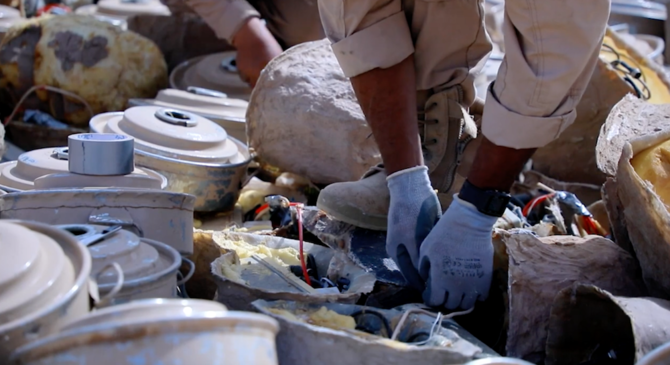
Saudi project clears 536 Houthi mines in Yemen

The total included nine anti-personnel mines, 48 anti-tank mines, 478 unexploded ordnances and one explosive device. (Project Masam)
Short Url
Updated 16 February 2025
Follow

Saudi project clears 536 Houthi mines in Yemen

RIYADH: Members of Saudi Arabia’s Project Masam removed 536 explosive devices from various regions of Yemen last week.

The total included nine anti-personnel mines, 48 anti-tank mines, 478 unexploded ordnances and one explosive device, according to a recent report.

Ousama Al-Gosaibi, the initiative’s managing director, said a total of 481,776 mines had been cleared since its inception in 2018.

The explosives were planted indiscriminately and posed a threat to civilians, including children, women and the elderly.

The demining operations took place in Marib, Aden, Jouf, Shabwa, Taiz, Hodeidah, Lahij, Sanaa, Al-Bayda, Al-Dhale and Saada.

The initiative trains local demining engineers and provides them with modern equipment. It also offers support to Yemenis injured by the devices.

Teams are tasked with clearing villages, roads and schools to facilitate safe movement for civilians and the delivery of humanitarian aid.


Saudi wildlife center releases 140 wild animals into royal reserve

The initiatives aim to enhance ecological balance and restore biodiversity in natural habitats. (SPA)
Updated 07 February 2026
Follow

Saudi wildlife center releases 140 wild animals into royal reserve

  • This milestone reflects significant progress in the management and governance of wildlife across the Kingdom, supporting the goals of the Saudi Green Initiative and aligning with the objectives of Saudi Vision 2030

RIYADH: The National Center for Wildlife released 140 wild animals into the King Salman bin Abdulaziz Royal Reserve as part of ongoing programs to reintroduce endangered species. The initiatives aim to enhance ecological balance and restore biodiversity in natural habitats.

The release, carried out in cooperation with the King Salman bin Abdulaziz Royal Reserve Development Authority, included 30 Arabian oryx, 70 reem gazelles (sand gazelles), and 40 houbara bustards, the SPA reported on Thursday. 

The initiative forms part of efforts to reintroduce species to their natural habitats and establish stable, self-sustaining wildlife populations capable of breeding, contributing to improved ecosystem functioning and sustainability.

The NCW continues to implement its strategic plans for wildlife development, with the total number of animals reintroduced through its specialized programs now exceeding 10,000.

This milestone reflects significant progress in the management and governance of wildlife across the Kingdom, supporting the goals of the Saudi Green Initiative and aligning with the objectives of Saudi Vision 2030.