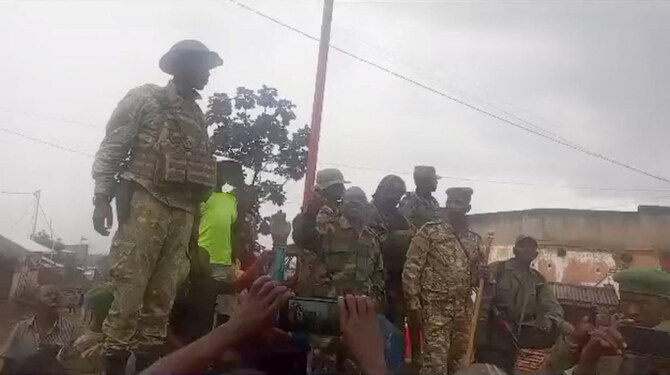
CONGO: Chaotic scenes unfolded in the eastern Congo city of Bukavu on Saturday after Rwanda-backed M23 rebels reached its outskirts, while a threat by Uganda’s army chief to attack a Congolese town raised fears of the conflict flaring into a wider regional war.
The rebels have been pushing south toward Bukavu, the second-largest city in eastern Democratic Republic of Congo, since they seized Goma, the largest city, at the end of last month.
On Saturday, the World Food Programme’s depot in Bukavu, which housed 6,800 metric tons of food, was being looted, a spokesperson told Reuters.
The stolen supplies would deepen the difficulties faced by those in need, Claude Kalinga said, with the agency’s activities already suspended for weeks due to the deteriorating security situation.
Sporadic gunfire was heard overnight and into Saturday morning, according to multiple Bukavu residents, who said the shots were fired by looters.
Corneille Nangaa, leader of a rebel alliance that includes the M23, said on Friday evening that the rebels had entered Bukavu and would continue their operation in the city on Saturday.
Two residents of the northern Bukavu suburb of Bagira said they had seen rebels on the streets and no sign of fighting.
An M23 source, two Congolese army officers and multiple Bukavu residents, however, said on Saturday that the rebels had not yet entered the city center.
One of the army officers said soldiers were being evacuated in order to avoid “carnage” like in Goma. About 3,000 people were killed in the days preceding the capture of that city, according to the United Nations.
Congolese soldiers could be seen on the streets of Bukavu on Saturday, according to eyewitnesses. The soldiers set fire to a weapons depot at their army base there, according to five residents and a military source.
The capture of Bukavu, a city of about 2 million according to the mayor, would represent an unprecedented expansion of territory under the M23’s control since the latest insurgency started in 2022, and deal a further blow to Kinshasa’s authority in Congo’s eastern borderlands, which are rich in minerals.
On Saturday, the chief of Uganda’s defense forces, General Muhoozi Kainerugaba, said in a post on X that he would attack the town of Bunia in neighboring eastern Congo unless “all forces” there surrendered their arms within 24 hours.
The threat by Kainerugaba, whose father is President Yoweri Museveni, adds to fears that Africa’s Great Lakes region risks slipping back into a broader war reminiscent of conflicts in the 1990s and 2000s that killed millions.
Uganda’s military has since 2021 supported the Congolese army in its fight against Islamist militants in the east, and deployed another 1,000 soldiers there in late January and early February.
But UN experts say Uganda has also backed the ethnic Tutsi-led M23.
UN Secretary-General Antonio Guterres urged dialogue between the warring parties in a speech at an African Union (AU) summit in Addis Ababa on Saturday.
Leaders from Eastern and Southern African regional blocs last weekend also urged all parties to hold direct talks, but Congolese President Felix Tshisekedi has repeatedly refused to talk directly to the M23 and canceled his appearance at the AU summit, sending his prime minister to represent Congo.
Tshisekedi returned to Kinshasa on Saturday morning, according to the presidency, after attending the Munich Security Conference in Germany on Friday.
Kigali has denied backing M23, and President Paul Kagame said on Facebook on Saturday that he had told the AU peace and Security Council that “Rwanda has nothing to do with Congo’s problems.”
The United States has warned of possible sanctions against Rwandan and Congolese officials. The European Union said on Saturday it is considering using all the means at its disposal to protect Congo.


![]()

Looting in eastern Congo’s Bukavu as M23 rebels reach suburbs
Short Url
https://arab.news/ysvzn
Looting in eastern Congo’s Bukavu as M23 rebels reach suburbs
- The stolen supplies would deepen the difficulties faced by those in need, Claude Kalinga said
- Two residents of the northern Bukavu suburb of Bagira said they had seen rebels on the streets and no sign of fighting.


Latest updates


© 2026 SAUDI RESEARCH & PUBLISHING COMPANY, All Rights Reserved And subject to Terms of Use Agreement.