

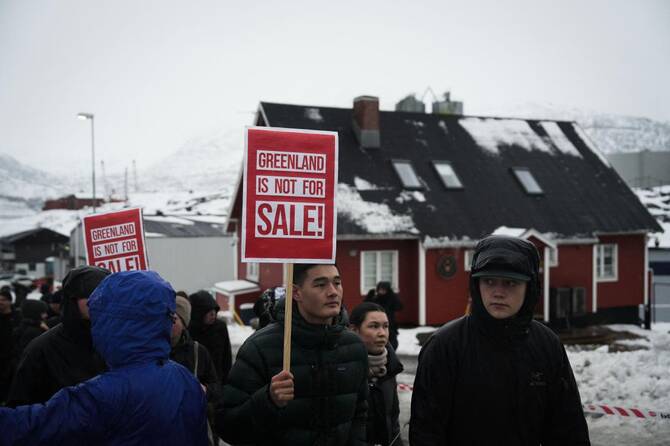

AMSTERDAM: The Netherlands’ foreign minister on Sunday said that US President Donald Trump’s threat to impose new tariffs on European allies until they agree to sell Greenland to the United States is “blackmail.”
“It’s blackmail what he’s doing ... and it’s not necessary. It doesn’t help the alliance (NATO) and it also doesn’t help Greenland,” David van Weel said in an interview on Dutch television.
Italy’s prime minister called US President Donald Trump’s threat to slap tariffs on opponents of his plan to seize Greenland a “mistake” on Sunday, adding she had told him her views.
“I believe that imposing new sanctions today would be a mistake,” Prime Minister Giorgia Meloni told journalists during a trip to Seoul, adding that “I spoke to Donald Trump a few hours ago and told him what I think.”
The United States will also suffer if Trump implements threats to impose tariffs on European countries opposing his plans to acquire Greenland, a French minister said on Sunday.
“In this escalation of tariffs, he has a lot to lose as well, as do his own farmers and industrialists,” French Agriculture Minister Annie Genevard told broadcasters Europe 1 and CNews.
Ireland’s Foreign Affairs Minister on Sunday described the tariffs being threatened by Trump over European allies’ stance on Greenland as “completely unacceptable”.
The decision “is completely unacceptable and deeply regrettable,” said Helen McEntee”.
“Ireland has been crystal clear that the future of Greenland is a matter to be determined by Denmark and by the Greenlandic people, in line with well-established democratic principles and international law,” she added.
In a post on Truth Social on Saturday, Trump said additional 10 percent import tariffs would take effect on February 1 on goods from Denmark, Norway, Sweden, France, Germany, the Netherlands, Finland and Great Britain — countries that have agreed to contribute personnel to a NATO exercise on Greenland.
Van Weel said the Greenland mission was intended to show the US Europe’s willingness to help defend Greenland and he was opposed to Trump making a connection with diplomacy over the island and trade.
Swedish Prime Minister Ulf Kristersson earlier rejected Trump’s threat to European nations of swinging tariffs if they did not let him acquire Greenland.
“We won’t let ourselves be intimidated,” he said in a message sent to AFP. “Only Denmark and Greenland decide questions that concern them.
“I will always defend my country and our allied neighbors,” he added, stressing that this was “a European question.
“Sweden is currently having intensive discussions with other EU countries, Norway and the United Kingdom to find a joint response,” he added.
Germany and its European partners will not be "blackmailed" by Donald Trump, German finance minister and vice chancellor Lars Klingbeil said on Sunday, after the U.S. president announced additional tariffs to pressure Europe in the Greenland dispute.
Germany will always extend a hand to the U.S. to find common solutions but Berlin cannot go along with Washington on this point, Klingbeil said in a statement.
"And so the very clear signal: we will not be blackmailed, and there will be a European response," he added.


