

Saudi nationals make up 70% of Red Sea Global workforce: top official

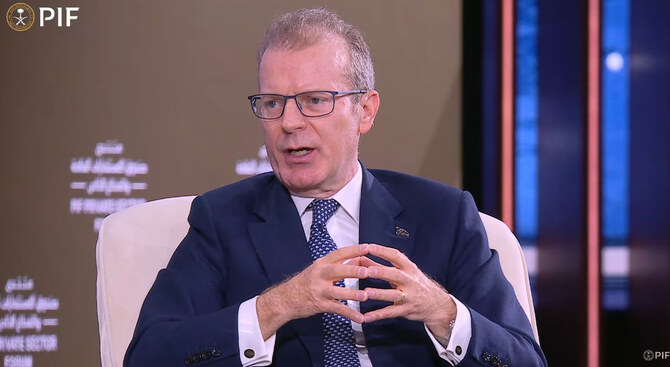
Red Sea Global Group Chief Financial Officer Martin Greenslade speaks at the PIF’s Private Sector Forum in Riyadh on Thursday.
Short Url
Updated 13 February 2025
Follow

Saudi nationals make up 70% of Red Sea Global workforce: top official

RIYADH: Saudi Arabia’s multi-project developer Red Sea Global currently employs 70 percent of its workforce from the local population, according to the firm’s group chief financial officer.

Speaking at the PIF’s Private Sector Forum in Riyadh on Feb.13, Martin Greenslade said that the Kingdom’s leisure tourism industry witnessed substantial growth in recent years, as the country welcomed 17.5 million tourists in 2024, representing a rise of 656 percent compared to 2019.

These developments align with Saudi Arabia’s National Tourism Strategy, which aims to attract 150 million tourists by the end of this decade.

“In our company, we are around 70 percent Saudis. When it comes to the hotels and the workforce, that is something we are scaling rapidly by providing opportunities to as many people as we can,” said Greenslade.

He added: “Saudi Arabia is witnessing a massively growing environment of leisure tourism. Over the last five years, leisure tourists increased in Saudi Arabia by over 600 percent, 17.5 million visitors a year, just for leisure tourism. If we add all the other tourists, we are well over 100 million. So, we are on a sweet spot of growth.”

Regarding the number of visitors to the Red Sea, Greenslade revealed that the figures are still in the thousands as hotels are currently under development, adding that they will grow significantly in the coming years.

He added that 92 percent of visitors to the Red Sea are from the Gulf Cooperation Council region, with the majority being Saudi citizens.

“Right now, we only have these few hotels opened, and they have a very limited number of keys. So, the number of tourists is in the thousands. And they have largely come from the Gulf Cooperation Council. So, there have been some challenges with international tourism; the events in Gaza are challenging. But we are putting on more international flights,” said Greenslade.

He added that Shura Island, which falls within the Red Sea, will see the opening of 11 hotels in 2025, while seven hotels will be opened in AMAALA this year.

During the talk, the Red Sea official added that the company has paid over $20 billion in contracts to suppliers, and around 70 percent of that has gone to Saudi-based organizations.

Greenslade said about the potential spending in 2025: “I do not want to give the exact amount this year, but we are spending billions of dollars a year on developing this destination. Some of those are funded through debt financing and some of those from the PIF.”

Greenslade added that developing the residential side of the Red Sea is very important, as it is one of the best ways to attract private investments.

He highlighted that individuals wishing to consider the Red Sea a second home can also buy a residential unit.

“When you finish the visit to Red Sea, you feel so sad to leave, and if you never want to leave, you can buy your own residence,” said Greenslade.

He mentioned that tourists visiting the Red Sea will have an unforgettable experience.

“If you want to go to somewhere truly breathtaking, somewhere iconic, somewhere very different from anywhere else on earth, you book a ticket to the Red Sea. You would fly and land at the brand-new airport. The airport in the Red Sea has a runway large enough to take any plane,” said Greenslade.

He added: “Tourists visiting the Red Sea will get an electric vehicle to reach the seaplane terminal or boat where they will be guided to an island. These islands are incredible, the corals are fantastic, the snorkeling is amazing.”

The official further said that the company is eyeing to plant 50 million mangroves in the Red Sea project, aimed at ensuring sustainability.

He also highlighted that resorts in the Red Sea are fully powered using solar energy, and the same initiative will also be taken in AMAALA.

“We want to redefine how tourism interacts with the environment. We call it regenerative tourism. Mangroves are very important. We are looking to plant and preserve around 50 million mangroves. Mangroves are extremely important to coastal protection and for the wildlife that settles in and around it,” said Greenslade.

He added: “We are aiming to increase biodiversity by 30 percent. So, we have got an enormous nursery, a million sq. feet building, one of the largest nurseries in the world. We will see some 30 million plants go through there.”


AI will never replace human creativity, says SRMG CEO 

Updated 30 January 2026
Follow

AI will never replace human creativity, says SRMG CEO 

  • Speaking to Maya Hojeij, senior business anchor at Asharq with Bloomberg, Jomana R. Alrashid expressed pride in SRMG platforms that had absorbed and adopted AI

RIYADH: Jomana R. Alrashid, CEO of Saudi Research and Media Group, highlighted how AI cannot replace human creativity during a session at The Family Office’s “Investing Is a Sea” summit at Shura Island on Friday. 

“You can never replace human creativity. Journalism at the end of the day, and content creation, is all about storytelling, and that’s a creative role that AI does not have the power to do just yet,” Alrashid told the investment summit. 

“We will never eliminate that human role which comes in to actually tell that story, do the actual investigative reporting around it, make sure to be able to also tell you what’s news or what’s factual from what’s wrong ... what’s a misinformation from bias, and that’s the bigger role that the editorial player does in the newsroom.”

Speaking on the topic of AI, moderated by Maya Hojeij, senior business anchor at Asharq with Bloomberg, the CEO expressed her pride in SRMG platforms that had absorbed and adopted AI in a way that was “transformative.”

“We are now translating all of our content leveraging AI. We are also now being able to create documentaries leveraging AI. We now have AI-facilitated fact-checking, AI facilities clipping, transcribing. This is what we believe is the future.”

Alrashid was asked what the journalist of the future would look like. “He’s a journalist and an engineer. He’s someone who needs to understand data. And I think this is another topic that is extremely important, understanding the data that you’re working with,” she said.

“This is something that AI has facilitated as well. I must say that over the past 20 years in the region, especially when it comes to media companies, we did not understand the importance of data.”


The CEO highlighted that previously, media would rely on polling, surveys or viewership numbers, but now more detailed information about what viewers wanted was available. 

During the fireside session, Alrashid was asked how the international community viewed the Middle Eastern media. Alrashid said that over the past decades it had played a critical role in informing wider audiences about issues that were extremely complex — politically, culturally and economically — and continued to play that role. 

“Right now it has a bigger role to play, given the role again of social media, citizen journalists, content creators. But I also do believe that it has been facilitated by the power that AI has. Now immediately, you can ensure that that kind of content that is being created by credible, tier-A journalists, world-class journalists, can travel beyond its borders, can travel instantly to target different geographies, different people, different countries, in different languages, in different formats.”

She said that there was a big opportunity for Arab media not to be limited to simply Arab consumption, but to finally transcend borders and be available in different languages and to cater to their audiences. 


The CEO expressed optimism about the future, emphasizing the importance of having a clear vision, a strong strategy, and full team alignment. 

Traditional advertising models, once centered on television and print, were rapidly changing, with social media platforms now dominating advertising revenue.

“It’s drastically changing. Ultimately in the past, we used to compete with one another over viewership. But now we’re also competing with the likes of social media platforms; 80 percent of the advertising revenue in the Middle East goes to the social media platforms, but that means that there’s 80 percent interest opportunities.” 

She said that the challenge was to create the right content on these platforms that engaged the target audiences and enabled commercial partnerships. “I don’t think this is a secret, but brands do not like to advertise with news channels. Ultimately, it’s always related with either conflict or war, which is a deterrent to advertisers. 

“And that’s why we’ve entered new verticals such as sports. And that’s why we also double down on our lifestyle vertical. Ultimately, we have the largest market share when it comes to lifestyle ... And we’ve launched new platforms such as Billboard Arabia that gives us an entry into music.” 

Alrashid said this was why the group was in a strong position to counter the decline in advertising revenues across different platforms, and by introducing new products.

“Another very important IP that we’ve created is events attached to the brands that have been operating in the region for 30-plus years. Any IP or any title right now that doesn’t have an event attached to it is missing out on a very big commercial opportunity that allows us to sit in a room, exchange ideas, talk to one another, get to know one another behind the screen.” 

The CEO said that disruption was now constant and often self-driving, adding that the future of the industry was often in storytelling and the ability to innovate by creating persuasive content that connected directly with the audience. 

“But the next disruption is going to continue to come from AI. And how quickly this tool and this very powerful technology evolves. And whether we are in a position to cope with it, adapt to it, and absorb it fully or not.”