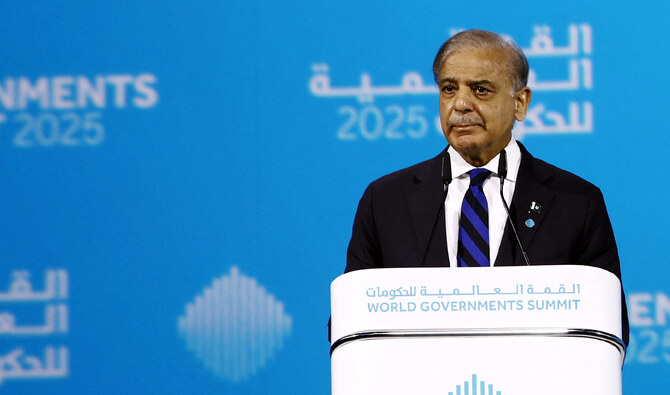

ISLAMABAD: Prime Minister Shehbaz Sharif on Tuesday called for global support to meet Pakistan’s $100 billion energy transition needs as he addressed participants at the World Governments Summit (WGS) in the United Arab Emirates (UAE).
The summit, being held in Dubai on Feb. 11-13 under the theme ‘Shaping Future Governments’, brings together a large number of heads of state/government, global policymakers, and leading private sector figures to discuss the future of governance, innovation and international cooperation.
Addressing the summit on Tuesday, the Pakistani prime minister urging stronger climate financing, technology sharing from governments, private investment, and multilateral cooperation for sustainable growth of developing nations.
“The global shift to a green economy requires a shared responsibility,” he said. “Pakistan’s energy transition alone demands $100 billion in investment and I call upon governments to strengthen climate financing and technology sharing, private investors to explore Pakistan’s green energy and infrastructure opportunities, multilateral institutions to support emerging economies like Pakistan in achieving sustainable growth.”
Sharif emphasized that while Pakistan was fully committed to mobilizing domestic resources and policy reforms, international partnerships and financial support remained critical to achieving this goal.
The South Asian country offers one of the most dynamic investment landscapes in Asia, with 70 percent of its dynamic, young and tech-savvy population under the age of 30, according to the prime minister. Pakistan is simplifying business regulations, enhancing legal protections and streamlining investment approvals to make it a leading destination for global capital.
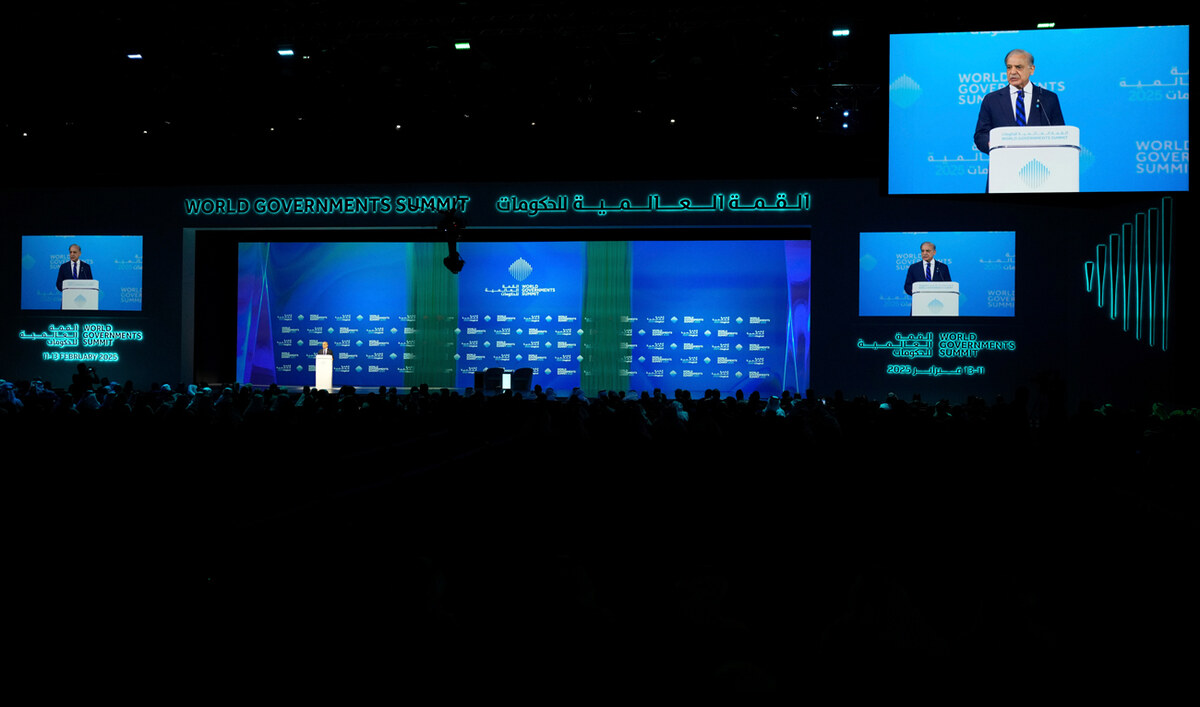
Pakistan Prime Minister Shehbaz Sharif speaks during the World Governments Summit in Dubai, United Arab Emirates, on February 11, 2025. (AP)
“To drive investment in key sectors, the Special Investment Facilitation Council (SIFC) has been established focusing on renewable energy and resilient infrastructure, technology and digital economy, minerals and industrial development and agricultural and food security,” he said.
Pakistan established the SIFC, a civil-military body, in June 2023 to attract foreign investment by eliminating bureaucratic hurdles and provide a one-window operation to foreign businesses.
Sharif said his country stands at a “defining moment of economic transformation” as inflation dropped to 2.4 percent in January, the lowest in nine years, with the interest rate capped at 12 percent, a major stimulus for private sector credit.
He said the Udaan Pakistan national economic transformation plan, which focuses on exports, e-Pakistan, environment and climate change, energy and infrastructure, equity and empowerment, has energy security and sustainability at the core of its agenda, not just as an economic necessity but as a national priority.
“Pakistan is committed to achieving a 60 percent clean energy mix by 2030 and transitioning 30 percent of all vehicles to electric mobility and we are rapidly scaling up solar, wind, hydro power and nuclear energy,” he added.
PAKISTANI, UAE LEADERS SEEK TO DEEPEN ECONOMIC PARTNERSHIP
Sharif earlier met with UAE President Sheikh Mohamed bin Zayed Al Nahyan, with the Pakistan PM’s office saying both leaders discussed ways to deepen cooperation between Pakistan and the UAE and explored opportunities to enhance mutual interests.
“The talks focused on economic, trade, and development fields, alongside other areas that align with both nations’ visions for sustainable economic growth and prosperity,” Sharif’s office said said in a statement.
The two figures also exchanged views on a number of regional and international issues of mutual interest, with a focus on recent developments in the Middle East.
“They emphasized the need for intensified international efforts for a comprehensive and lasting peace in Palestine based on the two-state solution to maintain regional security, stability, and peace,” Sharif’s office said.
The Pakistani premier also met with UAE Prime Minister Sheikh Mohammed bin Rashid Al-Maktoum, who established the WGS in 2013.
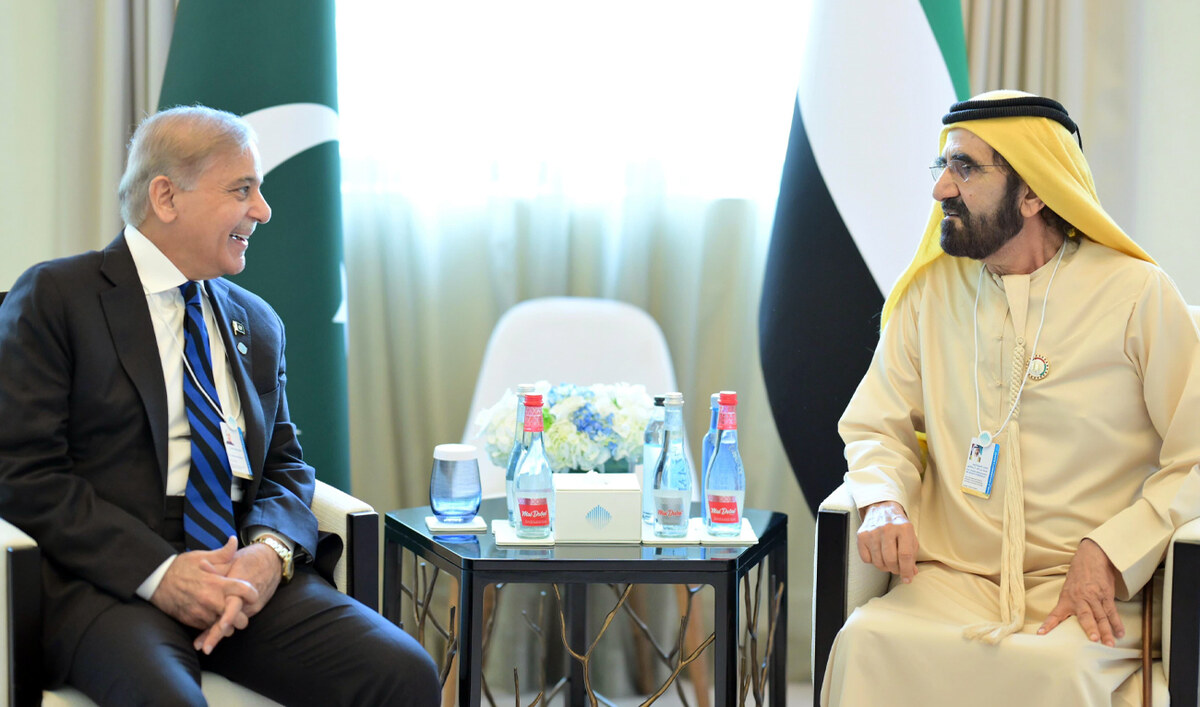
Pakistan’s Prime Minister Shehbaz Sharif meets United Arab Emirates (UAE) Prime Minister Sheikh Mohammed bin Rashid Al Maktoum, on the sidelines of the World Governments Summit 2025, in Dubai on February 11, 2025. (PMO)
“The Prime Minister lauded this transformative and timely initiative, providing a platform to world leaders, policy makers and experts, where they could gather under one roof to hold global discourse on the future of governance and better future,” Sharif’s office said in a statement.
The prime minister highlighted Pakistan’s pro-investment policies aimed at facilitating Emirati investors in key sectors such as energy, infrastructure, mining and IT.
“He invited Emirati businesses to explore investment opportunities in Pakistan,” the statement read.