

Pakistan says has ‘close interaction’ with Saudi Arabia, UAE in minerals and mining sectors

1 / 2
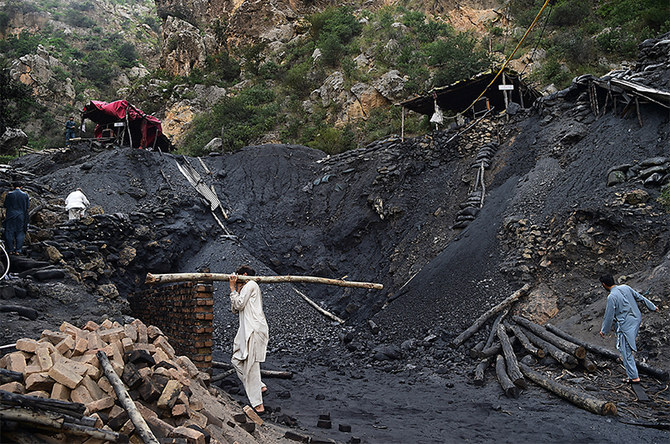
Pakistani miners fix a collapsed coal mine in Akhurwal village, in Darra Adam Khel town on September 12, 2018. (AFP/File)
2 / 2
Prime Minister Shehbaz Sharif (center) addresses a delegation of Pakistani businessmen in Dubai, UAE, on February 10, 2025. (PID)
Short Url
Updated 11 February 2025
Follow

Pakistan says has ‘close interaction’ with Saudi Arabia, UAE in minerals and mining sectors

  • Pakistan’s landscape is a treasure trove of diverse mineral deposits from coal reserves to gold and copper deposits and gemstones
  • Islamabad has expedited efforts in recent months to exploit this untapped mineral potential to speed up Pakistan’s economic growth

ISLAMABAD: Prime Minister Shehbaz Sharif said on Monday that Pakistan was having a “very close interaction” with Saudi Arabia and the United Arab Emirates (UAE) in minerals and mining sectors, amid Islamabad’s efforts to focus on key sectors to boost the country’s economy.

Pakistan’s landscape is a treasure trove of diverse mineral deposits from huge coal reserves in the southern Sindh province to gold and copper deposits in the southwestern Balochistan province. The northwestern Khyber Pakhtunkhwa province is home to several gemstone mines, including emerald mines in Swat, Mardan’s pink topaz mines, and peridot mines in Kohistan.

Petroleum Minister Musadik Malik said last month Pakistan and Saudi Arabia were in “advanced” stages of talks relating to investment in Reko Diq copper and gold mine, one of the world’s largest underdeveloped copper-gold mines, in Balochistan, with Saudi Arabia reportedly offering Pakistan a 15% investment stake in the project. The UAE, a key development and investment partner of Pakistan, has also recently expressed its “keen interest” in collaborating with Pakistan in mining, minerals and agriculture sectors, according to PM Sharif’s office.

While this huge mineral potential has remained largely unexplored, Pakistan has expedited efforts in recent months to exploit this untapped potential to speed up its economic growth.

“Mines and minerals, which is generally a G2G [government-to-government] corridor, in this, we are having a very close interaction with the UAE [United Arab Emirates] and Saudi Arabia,” PM Sharif told a group of Pakistani businessmen and investors in Dubai.

Sharif is currently in the UAE to attend the World Governments Summit (WGS) which is taking place from Feb. 11-13, bringing together a large number of heads of state/government, global policymakers, and leading private sector figures to discuss the future of governance, innovation and international cooperation. This is Sharif’s second visit to the UAE since assuming office in March last year.

His statement follows remarks by Petroleum Minister Malik, in which he said Pakistan and Saudi Arabia had done all the requisite homework with regard to a “very large asset.”

“Both sides have come up with valuation frameworks, the valuation ranges are in place, and both of the teams are empowered now to negotiate, and right now, we are under non-disclosure. So, I can’t give you the details, but suffice to say that we are expecting very big announcements very soon,” he said, on the sidelines of Future Minerals Forum (FMF) in Riyadh last month.

Reuters reported that Saudi Arabian mining company Manara Minerals could invest in Pakistan’s Reko Diq mine in the next two quarters, citing the Pakistani petroleum minister.

Saudi Arabia is the largest source of remittances to Pakistan, which were recorded at $728.3 million in January, and a key ally, whereas Pakistani policymakers consider the UAE an optimal export destination due to its geographical proximity, which minimizes transportation and freight costs while facilitating commercial transactions.

Pakistan, faced with a prolonged economic crisis, last year also signed several agreements worth $2.8 billion and $3 billion with Saudi Arabia and the UAE, respectively.


Pakistan urges concessional finance for developing nations to boost clean energy security

Updated 11 January 2026
Follow

Pakistan urges concessional finance for developing nations to boost clean energy security

  • Pakistan has emerged as one of world’s fastest growing solar markets, with 12GWs of off-grid and 6GWs of net-metered capacity in 2025
  • PM’s aide says Islamabad remains committed to Paris Agreement, looks for continued support in building a resilient and low-carbon future

ISLAMABAD: Pakistan has urged international partners to scale up concessional financing for developing countries, the country’s Press Information Department (PID) said on Sunday, citing an aide to Prime Minister Shehbaz Sharif.

The call was made by Sharif’s coordinator on climate change, Romina Khurshid Alam, while delivering Pakistan’s national statement at the 16th International Renewable Energy Agency (IRENA) Assembly in Abu Dhabi.

Pakistan has emerged as one of the world’s fastest growing solar markets, with 12 gigawatts (GWs) of off-grid and over 6GWs of net-metered solar capacity by the end of 2025. Last fiscal year, renewables accounted for a historic 53 percent of total electricity generation, according to Alam.

The prime minister’s aide stressed that affordable funding for developing nations is critical to accelerating their transition to clean energy and strengthening energy security amid rising climate and economic challenges.

“Alam reaffirmed Pakistan’s target of achieving 60 percent renewables in the power mix by 2030,” the PID said in a statement.

“In her call to action, she urged IRENA and Member States to increase concessional finance for developing nations, treat technologies such as energy storage and green hydrogen as global public goods, and strengthen regional cooperation for shared energy security.”

IRENA is a global intergovernmental agency for energy transformation that serves as the principal platform for international cooperation, supports countries in their energy transition, and provides state of the art data and analyzes on technology, innovation, policy, finance and investment. Its membership comprises 170 countries and the European Union (EU).

The 16th session of the IRENA Assembly is taking place on Jan. 10-12 in Abu Dhabi and focuses on the theme of “Powering Humanity: Renewable Energy for Shared Prosperity.” The session has gathered global leaders and energy decision-makers to discuss strategies and underline necessary actions for the acceleration of renewable energy across countries, regions, and the world, driving economic inclusion, equity, and human well-being.

Alam shared that Pakistan is taking action against energy poverty through initiatives like the Punjab Solar Panel Scheme 2026, which provides free or subsidized systems to low-income households.

She highlighted how distributed solar kits have restored power and livelihoods in flood-affected communities and offer a replicable model for climate-resilient recovery.

“Pakistan remains fully committed to the Paris Agreement and looks to IRENA for continued technical and financial support in building a resilient, inclusive, and low-carbon future,” Alam said.

Adopted in 2015 to combat climate change, the Paris Agreement binds nations to hold “the increase in the global average temperature to well below 2°C above pre-industrial levels” and pursue efforts “to limit the temperature increase to 1.5°C above pre-industrial levels.”