

Pakistan PM uses World Governments Summit to call for independent state of Palestine

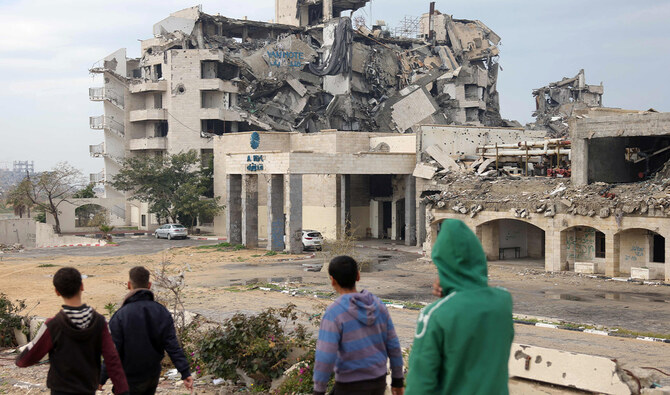
People walk past the heavily damaged Ayan Hotel in northern Gaza City on February 11, 2025. (AFP)
Short Url
Updated 11 February 2025
Follow

Pakistan PM uses World Governments Summit to call for independent state of Palestine

  • Gaza war has been paused since January 19 under ceasefire agreement between Israel and Hamas
  • Palestinian territory, encompassing Gaza Strip and West Bank, has been occupied by Israel since 1967

ISLAMABAD: Pakistani Prime Minister Shehbaz Sharif on Tuesday used the pulpit at the World Governments Summit in Dubai to call for the creation of an independent state of Palestine, saying it was the only path toward a “durable and just peace.”
The latest Gaza war, which began after an Oct. 7, 2023, Hamas attack on Israel, has been paused since Jan. 19 under the ceasefire agreement between Israel and Hamas that was brokered by Qatar and Egypt with support from the United States.
More than 48,000 Palestinians have been killed in the war, the Gaza health ministry says, and nearly all of Gaza’s 2.3 million population has been internally displaced by the conflict, which has caused a hunger crisis.
Some 1,200 people were killed in the October 7, 2023 Hamas-led attack on southern Israeli communities and about 250 were taken to Gaza as hostages, Israeli tallies show.
“This gathering could not have come at a more opportune time as the region begins to recover from the tumultuous aftershocks of the tragic conflict in Gaza, which has claimed [lives of] over 50,000 innocent Palestinians,” Sharif said as he addressed the WSG.
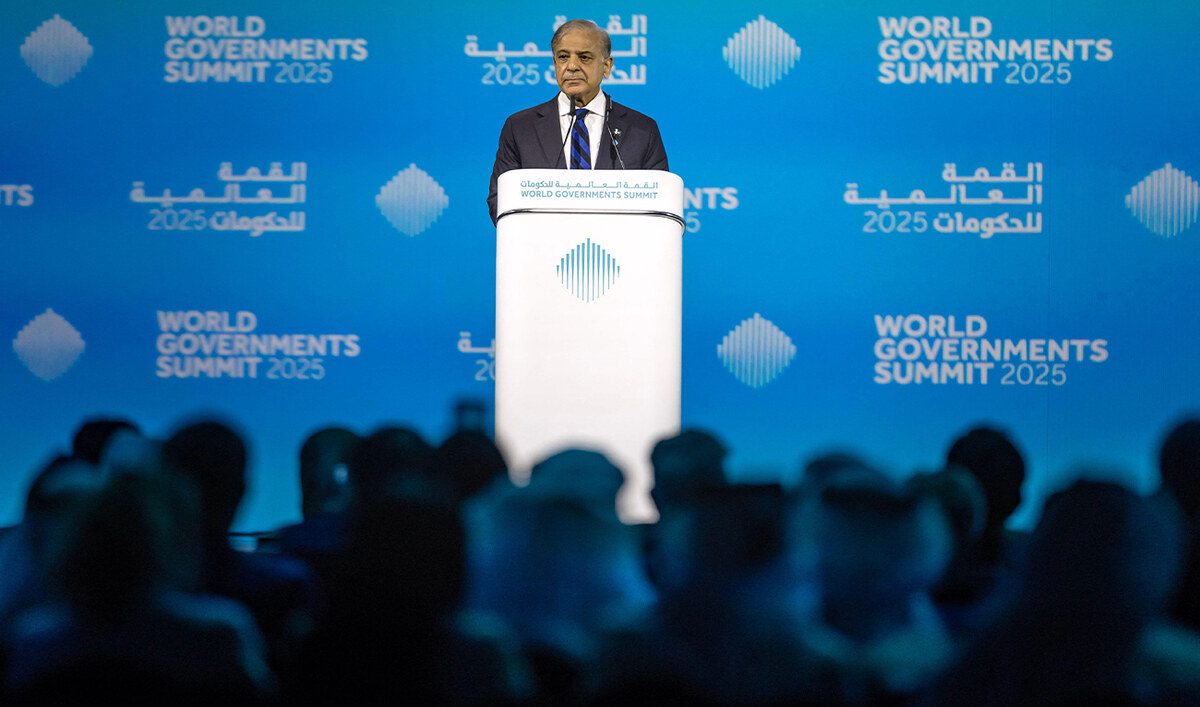


Pakistan's Prime Minister Shehbaz Sharif addresses the audience at the plenary hall during the World Governments Summit in Dubai on February 11, 2025. (AFP)

“It is now our hope that the genocidal operation will be followed by a lasting peace. However, Pakistan believes that durable and just peace is only possible through a two-state solution in accordance with the relevant UN resolutions, that is the creation of an independent state of Palestine, with pre-1967 boundaries and Al-Quds as its capital.”
Palestinian territory – encompassing the Gaza Strip and West Bank, including East Jerusalem – has been occupied by Israel since 1967.
Pakistan does not recognize Israel and has consistently called for an independent Palestinian state based on “internationally agreed parameters.”


Pakistan’s maritime sector records $360 million profits in 2025 — minister

Updated 5 sec ago
Follow

Pakistan’s maritime sector records $360 million profits in 2025 — minister

  • The reforms aimed to improve port efficiency, cut costs and implement long-delayed policies to position Pakistan as trade, logistics hub
  • In 2025, Karachi Port handled a record 54 million tons of cargo, while average vessel dwell time was cut by 24-36 hours, minister notes

KARACHI: Pakistan’s maritime sector posted a record Rs100 billion ($360 million) profit in 2025 following a year of sweeping reforms, Maritime Affairs Minister Junaid Anwar Chaudhry said on Saturday.

In recent years, Islamabad has taken a number of reforms to improve port efficiency, cut costs and cleared long-delayed policies to position the South Asian country as a regional trade and logistics hub.

Outlining his ministry’s annual performance, Chaudhry described 2025 as a “transformative year” marked by more than two dozen initiatives spanning legislation, digitization, infrastructure development and human resources.

In 2025, Karachi Port handled a record 54 million tons of cargo, while average vessel dwell time was cut by 24-36 hours through closer coordination among port authorities, customs and other agencies aimed at an average turnaround of five days, according to the minister.

“These reforms are modernizing our ports, shipping and fisheries to unlock the true potential of the blue economy,” the minister said, adding that Pakistan had aligned its regulatory framework with international standards, including conventions of the International Maritime Organization and the Hong Kong Convention on ship recycling.

He said a central plank of the overhaul was the finalization of the National Maritime Policy, which brings shipping, ports, fisheries and maritime security under a single framework to guide sustainable growth.

“The government also approved a National Shipping Policy aimed at expanding the Pakistan-flagged fleet to reduce reliance on foreign carriers, a longstanding drain on foreign exchange,” he added.

Pakistan concluded stakeholder consultations on the National Fisheries and Aquaculture Policy, which targets annual seafood exports of $2 billion and the creation of around two million jobs across coastal communities and allied industries, according to the minister.

Cost-cutting measures delivered substantial savings, Junaid Chaudhry said, and added: Reduced overtime at the Karachi Port Trust alone saved about Rs70 million a month, while the abolition of 2,152 redundant posts across maritime entities lowered human resource costs by billions of rupees.

“The Karachi Port Trust and the Port Qasim Authority reclaimed about 150 acres of encroached land valued at roughly Rs110 billion, while Port Qasim recovered an additional eight acres,” the minister stated.

Chaudhry said they introduced the Pakistan Maritime Century Framework 2047–2147 to advance the maritime sector, established an Artificial Intelligence Maritime Secretariat to monitor ports, shifted to paperless governance through a 100 percent e-office rollout, integrated the Pakistan Single Window with the Port Community System to streamline trade procedures, and introduced an electronic public asset disposal system to enhance transparency and efficiency.

The reform agenda supported several United Nations Sustainable Development Goals, including decent work and economic growth, industry and infrastructure, responsible consumption, life below water and strong institutions, according to the minister.

“Sustained implementation will be key to maintaining the momentum of these achievements, and the gains made in 2025 provide a strong foundation for turning Pakistan’s long coastline and strategic location into a durable blue economic advantage,” he added.