

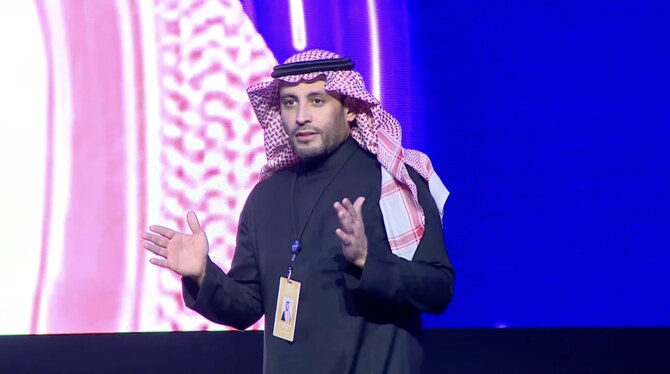

RIYADH: Investments totaling $1.78 billion marked the third day of the LEAP 2025 Tech Conference in Riyadh, aimed at accelerating artificial intelligence and digital talent development.
Industry leaders, investors, and policymakers have launched several initiatives to drive digital transformation in Saudi Arabia, aligning with Vision 2030 to position the Kingdom at the forefront of the digital age.
Among these, Equinix, a global leader in digital infrastructure, announced a $1 billion investment in data centers nationwide, starting with a 100-megawatt facility to serve hyperscale and retail customers in the region.
“Equinix has been at the center of technological advancements for 26 years. Our global interconnection hubs allow data to move seamlessly worldwide, and now, we are expanding further into Saudi Arabia,” said Judith Gardner, vice president of growth and emerging markets at Equinix.
Saudi Arabia’s Communications, Space, and Technology Commission has launched Cohort 3 of its innovative regulatory sandbox program, aimed at empowering innovators and startups to test new technologies.
Abdulaziz Al-Batli, general manager of technology enablement at CST, emphasized the commission’s approach, which balances ample space for innovation with necessary regulatory oversight.
To further solidify Saudi Arabia’s position as a regional technology and innovation hub, DAMAC’s EDGNEX unveiled plans to expand its investments in data centers for cloud computing and AI across the Kingdom.
The company aims to develop a 500-megawatt capacity by 2030, aligning with the country’s broader digital transformation goals.
This initiative complements the wave of investments announced at LEAP 2025, reinforcing Saudi Arabia’s commitment to enhancing its digital infrastructure and fostering an AI-driven economy.
Strengthening AI, startups, and emerging technologies
Several investment funds have substantially committed to supporting startups specializing in AI, gaming, and innovative tech solutions, fostering growth and innovation across various sectors.
The investment funds include JOA Capital, which has dedicated $80 million to an AI-powered infrastructure fund; Ula Capital, which has committed $75 million to a data-driven fund for AI and deep tech startups; the Sanabil Accelerator by Orbit, which is providing $60 million for over 200 early-stage tech startups; and Sharaka Financial, which is investing $30 million in startups in the MENA region.
Additionally, the National Technology Development Program has pledged $150 million to launch investment accelerator programs and support funds for startups in partnership with Draper Startup House, DMZ, Gener8tor, and Big Idea Ventures.
The startup companies receiving support include MERIT, which secured $28 million in Series B funding to focus on revolutionizing loyalty and rewards programs worldwide; BRKZ, which closed the second tranche of Series A with $22 million to meet the growing demand in Saudi Arabia’s construction sector; and Torod, which secured $11.3 million to develop the Kigndom’s first AI logistics agent.
Moreover, Ula.me raised $28 million in Series B funding to expand into the Kingdom and launch a generative AI-powered EdTech platform; Buildnow received $9.7 million in financing from Arbah and STV to expand operations; and Hydrata announced a $3 million investment in its gaming project, set to launch in 2025.
These investments bring the Kingdom’s total venture capital commitments announced at LEAP to nearly $700 million, with close to $100 million dedicated to startup investments.
AI innovations and talent development
WhiteHelmet introduced ASIF, the first AI-powered construction agent designed to revolutionize the building industry by optimizing speed and efficiency.
Additionally, Microsoft announced the establishment of the Kingdom’s first Data Center Academy in partnership with the National IT Academy.
“This initiative aligns with Microsoft’s mission to provide cutting-edge digital skills and training, ensuring Saudi Arabia’s workforce is ready for the AI-driven future,” said Zainab Al-Amein, vice president of national digital transformation at Microsoft.
Similarly, Huawei, in collaboration with the Ministry of Communications and Information Technology, unveiled plans for a Future Skills Center to enhance AI expertise in the region.
Accenture and Atomcamp also launched the first AI Academy in Saudi Arabia, aiming to train 20,000 Saudi professionals by 2030.
Expanding space and digital economy
CST Gov. Mohammed Al-Tamimi, highlighted key themes shaping LEAP 2025, including AI, cloud computing, quantum technologies, and the intersection of space and the digital economy.
“We are witnessing the second phase of our space track, with over 20 events dedicated to discussions on space competition and the connection between space and the digital economy,” said Al-Tamimi.
Gaming industry
The gaming industry also saw significant investments, with HGM announcing a $300 million commitment to bring top gaming titles to Riyadh. The Kingdom’s first major military shooter game is set to launch in October, developed by a team with experience in franchises like Call of Duty.
With these major announcements, LEAP 2025 continues to reinforce Saudi Arabia’s position as a global technology and innovation hub. The ongoing event is underscoring the country’s efforts to drive digital transformation, AI advancements, and economic diversification in line with Vision 2030.


