



RIYADH: Advanced technologies and innovative solutions were in focus at LEAP 2025, showcasing ideas that could shape industries and the future.
Among the key presentations was the Saudi Accelerated Innovation Lab, which introduced Aramco’s Robotics Assistant, or SARA.
SAIL, launched during LEAP 2024 by Saudi Aramco President and CEO Amin Nasser, also houses AramcoMetaBrain, a proprietary generative artificial intelligence model designed to enhance operational efficiency.
SARA, an AI-powered voice assistant, was introduced by Ibrahim Al-Sowayigh, innovation and commercialization leader at SAIL. He highlighted its potential to meet the highest cybersecurity and operational standards.
“In enterprises and highly regulated environments, there was one persistent problem: trust. That’s why one of the very first business opportunities we were introduced to was securing a device that can be trusted to connect to our internal Aramco network and comply with best-in-class cybersecurity requirements,” Al-Sowayigh said.
“We needed a device that is secure, industrial-grade, with intuitive-personalized interactions. That’s when we decided to build, not buy, and SARA — our very own industrial Gen-AI tabletop voice assistant — was born.”
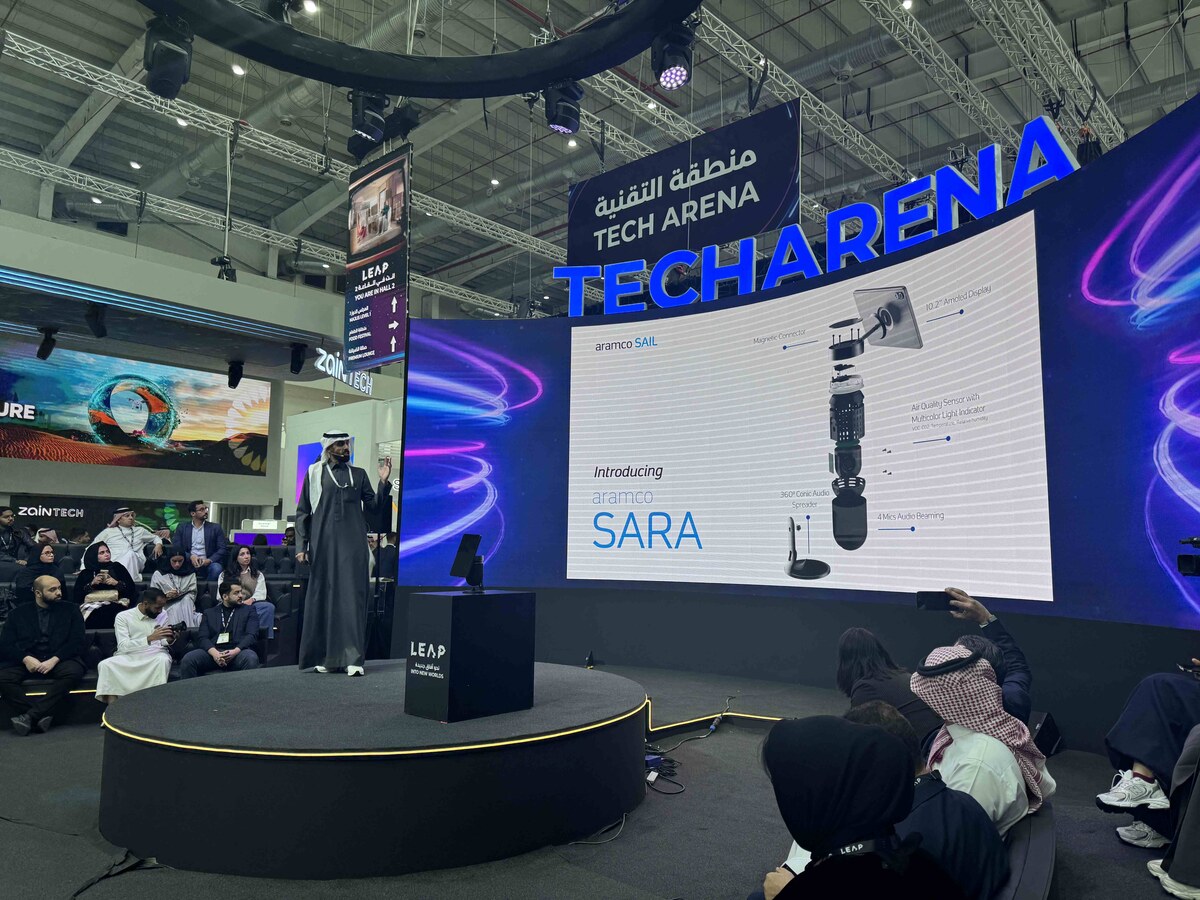
Ibrahim Al-Sowayigh introduces SARA, an AI-powered voice assistant. AN
AramcoMetaBrain powers SARA, enabling it to process vast amounts of industry-specific data, interpret complex queries, and provide highly contextualized responses. The model is trained in Aramco’s proprietary operational language, equipping it to navigate the company’s guidelines and processes.
SARA is poised for commercialization through Aramco Digital, offering enterprises a secure, integrated AI solution.
“SARA ensures that queries and data are processed and protected on-premise, giving organizations full control over their information while benefiting from cutting-edge AI capabilities,” Al-Sowayigh said.
“This makes SARA the ideal digital companion for industries requiring the highest levels of data security and operational efficiency.”
Smart contact lens
Tech innovation at LEAP 2025 extended beyond AI, with XPANCEO, a Dubai-based computing firm, unveiling a smart contact lens that aims to revolutionize vision enhancement and health monitoring.
The lens offers a full-screen, full-color augmented reality experience while functioning as a miniature laboratory for the eye. Integrated neuro-interfacing jet electrodes enable enhanced vision, including night vision and zoom capabilities.
“This is not actually science fiction, but rather what I will try to show you today. So this is already a rapidly developing reality,” said Valentyn Volkov, scientific partner at XPANCEO.
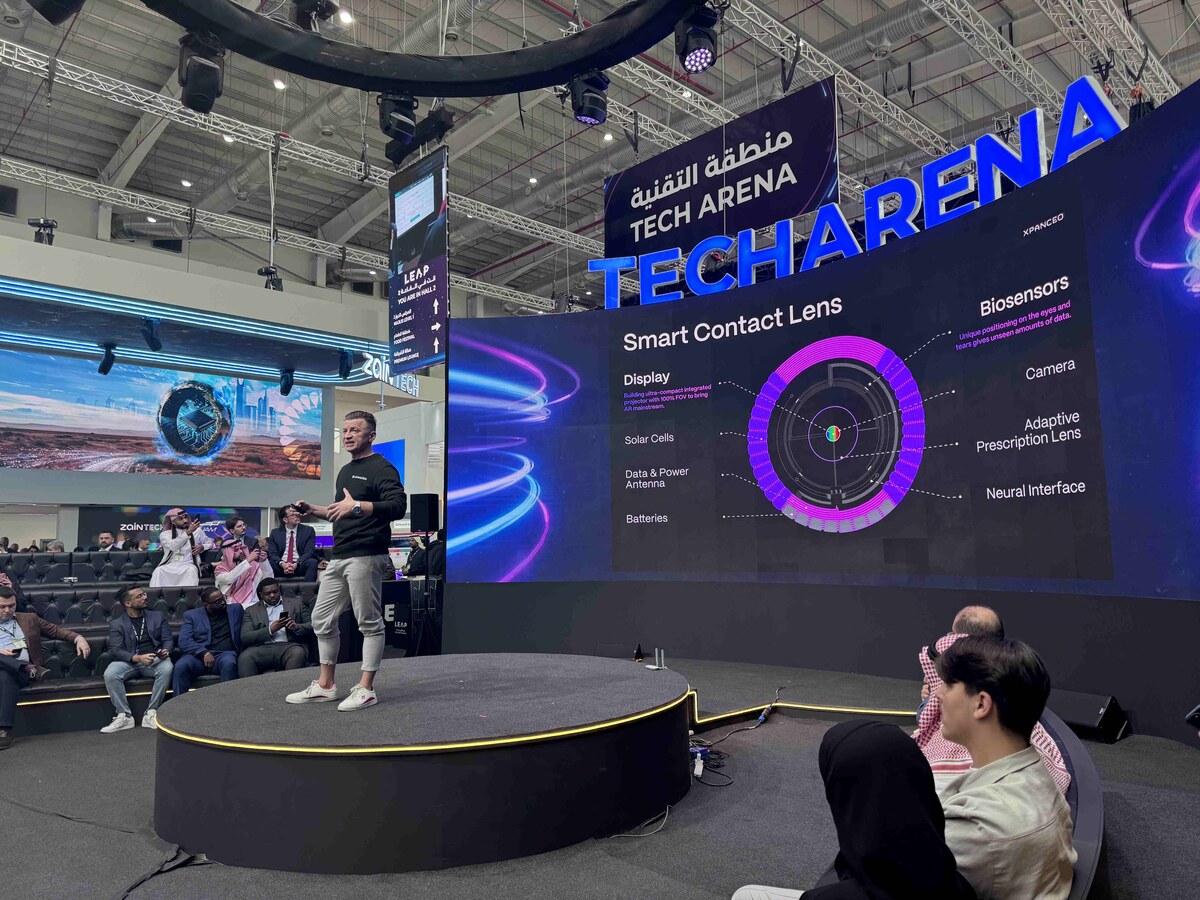
Dubai-based computing firm XPANCEO unveiled a smart contact lens. AN
The smart lenses, set for development in three phases, will initially improve vision in low-light conditions. The second iteration will incorporate health-tracking features such as stress levels, blood sugar, body temperature, and dry eyes. The final version aims to display visual content directly on the lenses, delivering a seamless augmented reality experience.
Despite progress, technological and biological challenges remain, as developers seek to miniaturize smartphone capabilities into a contact lens while ensuring biological compatibility.
A prototype was showcased at LEAP, with XPANCEO targeting a market release by the end of 2026.
Wearable technology
Dutch designer Anouk Wipprecht brought a futuristic vision to LEAP 2025 with her collection of robotic dresses that merge fashion and engineering.
Her designs include a heartbeat-monitoring dress featuring a central crystal that blinks in sync with the wearer’s pulse. Another highlight, the Spider Dress, incorporates animatronic mechanical limbs and 3D-printed sensors to monitor and protect the wearer’s personal space.
Using proximity and respiration sensors, the dress responds to external stimuli, adjusting its movements accordingly. Wipprecht noted that such designs are practical for crowded urban environments like New York, where wearers can use them to maintain personal space.
LEAP 2025 continues to showcase innovations that challenge the status quo, reinforcing Riyadh’s position as a global hub for technological advancement.


