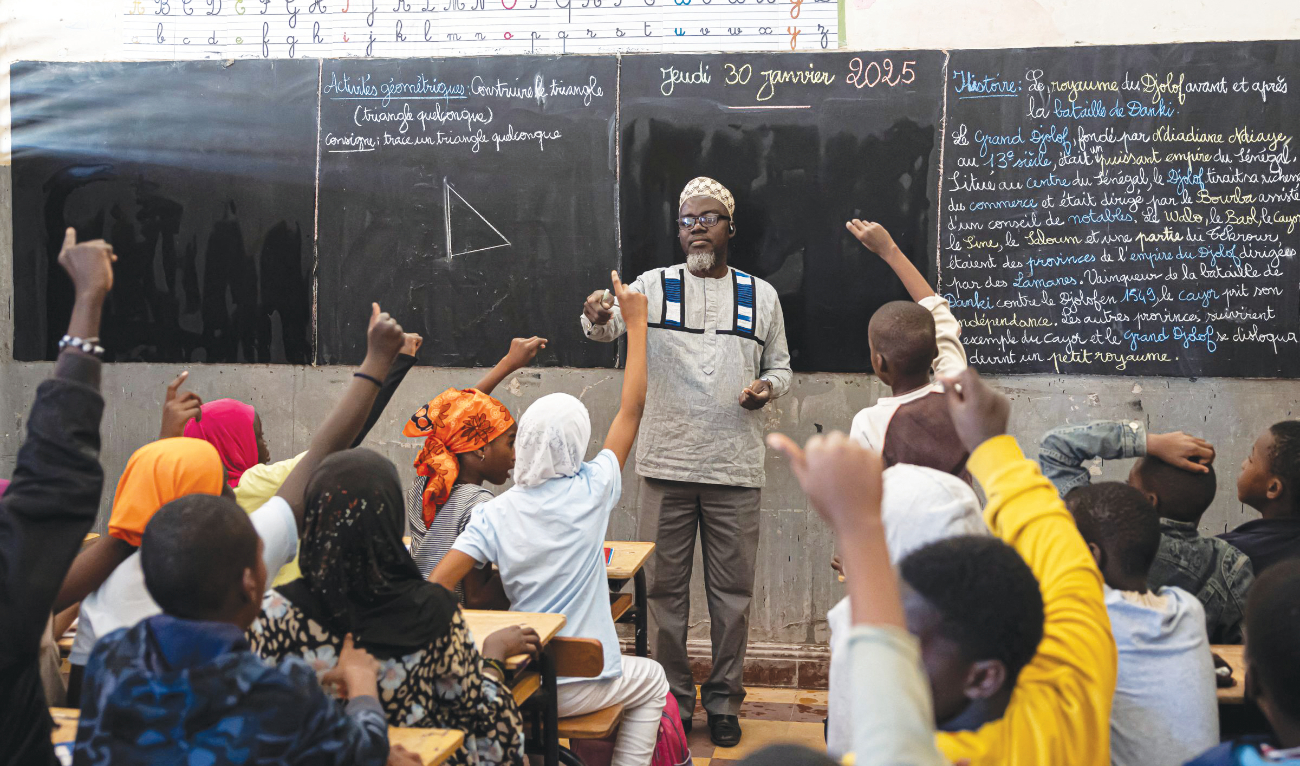
DAKAR: “Good morning, teacher!” a chorus of Senegalese five-year-olds responded at a school where English has been introduced alongside the official language of French.
The pupils at the nursery school near central Dakar repeated the English words out loud.
“They’re interested in the lesson, and they start a conversation with ‘how are you?’” teacher Absa Ndiaye said.
Hers is one of more than 600 classes in Senegal that have been testing a new program of teaching English in nursery and primary schools since mid-January in a push for better connectivity with the wider world.
The developing country, which has seen a massive youth boom but also an exodus of young people searching for a better life, has recently become an oil and gas producer.
Senegal is a member of the Francophonie group of French-speaking nations and uses French in public schools and in administration.
Students also learn Arabic and the country’s national languages.
Until recently, English was only taught in public high schools and universities, although it is sometimes taught from nursery school onwards in the private sector.
President Bassirou Diomaye Faye, who was elected in March on a nationalist ticket, is trying to recalibrate Senegal’s relationship with former colonial power France after decades of strong ties, without breaking away altogether.
Senegal will remain “the steadfast and reliable ally” of all its foreign partners, Faye announced, emphasising his desire to widen Senegal’s prospects.
Despite seven years of teaching, “students can barely communicate properly in English,” lamented Aissatou Sarr Cisse, who is in charge of the Education Ministry’s English program.
“We’re starting from a younger age so that they can improve their language skills.
“The aim is to shape people who are open to the world. Mastering English will give them access to opportunities and facilitate better collaboration with Senegal’s partners,” she said.
In the pilot schools, English is taught every Tuesday and Thursday — two lessons of 25 minutes each in nursery and two 30-minute lessons in primary schools.
The subjects taught include family, colors, everyday greetings, the environment and the weather.
Teacher Mamadou Kama listens to a conversation in English between two 13-year-olds in his class of around 60 at a primary school in Dakar’s working-class Medina neighborhood.
“I can see that the students are motivated. Some of them are asking for English lessons to be (taught) every day,” Kama, who has a degree in English, said.
Most of the teachers have not yet received the digital teaching materials the ministry is meant to provide, but Kama has tablets, video projectors and USB sticks given by the school’s management.
“We haven’t had the time to create handbooks. Computers have been ordered, and in the meantime, we have provided students with printed documents with fun pictures,” Cisse, from the education ministry, said.
The ministry has “invested in teachers who are proficient in English” and have been selected and trained after an application process, Cisse added.
The initiative has been praised by Ousmane Sene, director of the Dakar-based West African Research Center, which handles academic exchanges between US and west African universities.
“English is the most common language at an international level and it’s the most used language in diplomacy and international cooperation, so it’s an additional asset,” Sene said.
Additionally, the bulk of “global scientific output is written in English. If Senegal doesn’t adapt to this way of accessing knowledge, there will be an epistemological wall,” said his university colleague Mathiam Thiam, who was involved in creating the program.
But Sene said there was a “prerequisite — to train and equip the teachers well.”
Opponents of the scheme have criticized a shortfall in teachers.
“On these grounds alone, introducing English at nursery and primary school levels is a pipe dream, it’s impossible,” former member of parliament and retired teacher Samba Dioulde Thiam wrote in an opinion column.
“Is the aim to compete with French? Is the aim to flatter the Anglo-Saxons who dominate this planet and get them to give us resources?” Thiam wrote.
He pointed out that intellectuals have been demanding the introduction of Senegal’s national languages in education for many years which risks being “postponed indefinitely.”
Despite problems with training, Mathiam Thiam said “doctoral students are among the teachers who have been chosen.”
Former Education Minister Serigne Mbaye Thiam said that before launching the program, “it would have been wise to understand why Senegalese students who study English throughout high school struggle to reach the level required.”
Far from the controversy, though, Aissatou Barry, 13, said she “can’t wait to study English in sixth grade.”