

Sequestered Suu Kyi overshadows military-run Myanmar election

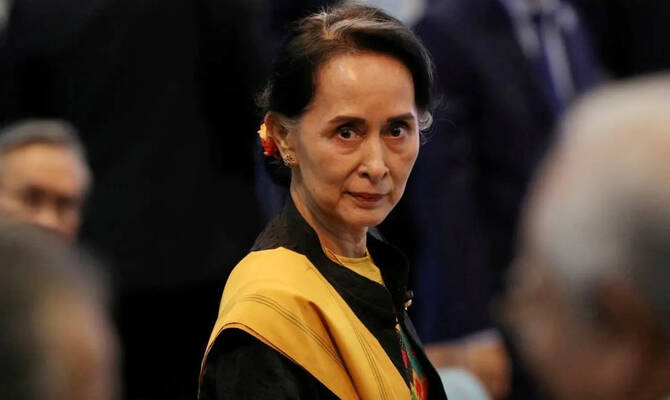
Ousted Myanmar leader Aung San Suu Kyi has been siloed in military detention since a 2021 coup, but her absence looms large over junta-run polls the generals are touting as a return to democracy. (Reuters/File)
Short Url
Updated 11 January 2026
Follow

Sequestered Suu Kyi overshadows military-run Myanmar election

  • Suu Kyi’s reputation abroad has been heavily tarnished over her government’s handling of the Rohingya crisis

YANGON: Ousted Myanmar leader Aung San Suu Kyi has been siloed in military detention since a 2021 coup, but her absence looms large over junta-run polls the generals are touting as a return to democracy.

The Nobel Peace Prize laureate was once the darling of foreign diplomats, with legions of supporters at home and a reputation for redeeming Myanmar from a history of iron-fisted martial rule.

Her followers swept a landslide victory in Myanmar’s last elections in 2020 but the military voided the vote, dissolved her National League for Democracy party and has jailed her in total seclusion.

As she disappeared and a decade-long democratic experiment was halted, activists rose up — first as street protesters and then as guerrilla rebels battling the military in an all-consuming civil war.

Suu Kyi’s reputation abroad has been heavily tarnished over her government’s handling of the Rohingya crisis.

But for her many followers in Myanmar, her name is still a byword for democracy, and her absence on the ballot, an indictment it will be neither free nor fair.

The octogenarian — known in Myanmar as “The Lady” and famed for wearing flowers in her hair — remains under lock and key as her junta jailers hold polls overwriting her 2020 victory. The second of the three-phase election began Sunday, with Suu Kyi’s constituency of Kawhmu outside Yangon being contested by parties cleared to run in the heavily restricted poll.

Suu Kyi has spent around two decades of her life in military detention — but in a striking contradiction, she is the daughter of the founder of Myanmar’s armed forces.

She was born on June 19, 1945, in Japanese-occupied Yangon during the final weeks of WWII.

Her father, Aung San, fought for and against both the British and the Japanese colonizers as he sought to secure independence for his country.


US Justice Department official eyes cases against Cuba leaders as Trump floats ‘friendly takeover’

Updated 07 March 2026
Follow

US Justice Department official eyes cases against Cuba leaders as Trump floats ‘friendly takeover’

  • “Working group” formed to build cases against people connected to the Cuban government
  • Trump’s has increasingly displayed aggressive stance against Cuba’s communist leadership

MIAMI: The top Justice Department prosecutor in Miami is considering criminal investigations of Cuban government officials, according to people familiar with the matter. The inquiry comes as President Donald Trump has raised the possibility of a “friendly takeover” of the communist-run island.
Jason Reding Quiñones, the US attorney for the Southern District of Florida, has created a “working group” that includes federal prosecutors and officials from the Drug Enforcement Administration and other agencies to try to build cases against people connected to the Cuban government and its Communist Party, according to one of the people. They spoke on the condition of anonymity because they were not authorized to publicly discuss the effort.
It was not immediately clear which Cuban officials the office is targeting or what criminal charges prosecutors may be looking to bring.
The Justice Department said in a statement Friday that “federal prosecutors from across the country work every day to pursue justice, which includes efforts to combat transnational crime.”
The effort is taking place against the backdrop of Trump’s increasingly aggressive stance against Cuba’s communist leadership.
Emboldened by the US capture of Cuba’s close ally, Venezuelan President Nicolás Maduro, Trump last month said his administration was in high-level talks with officials in Havana to pursue “a friendly takeover” of the country. He repeated those claims this week, saying his attention would turn back to Cuba once the war with Iran winds down.
“They want to make a deal so bad,” Trump said of Cuba’s leadership.
While Cuba has faded from Washington’s radar as a major national security threat in recent decades, it remains a priority in the US Attorney’s office in Miami, whose political, economic and cultural life is dominated by Cuban-American exiles.
The FBI field office has a dedicated Cuba group that in 2024 was instrumental in the arrest of former US Ambassador Victor Manuel Rocha on charges of serving as a secret agent of Cuba stretching back to the 1970s.
In recent weeks, several Miami Republicans, in addition to Florida Sen. Rick Scott, have called on the Trump administration to reopen its criminal investigation into the 1996 shootdown of four planes operated by anti-communist exiles.
In a letter to Trump on Feb. 13, lawmakers including Reps. Maria Elvira Salazar and Carlos Gimenez highlighted decades-old news reports indicating that former President Raúl Castro — the head of Cuba’s military at the time — gave the order to shoot down the unarmed Cessna aircraft.
“We believe unequivocally that Raúl Castro is responsible for this heinous crime,” lawmakers wrote. “It is time for him to be brought to justice.”
While no indictment against Castro has been announced, Florida’s attorney general said this week that he would open a state-level investigation into the crime.
The Trump administration has also accused Cuba of not cooperating with American counterterrorism efforts, adding it alongside North Korea and Iran to a select few nations the US considers state sponsors of terrorism.
The designation stems from Cuba’s harboring of US fugitives and its refusal to extradite several Colombian rebel leaders while they were engaged in peace talks with the South American nation.