Rohingya rue Myanmar’s election from exile

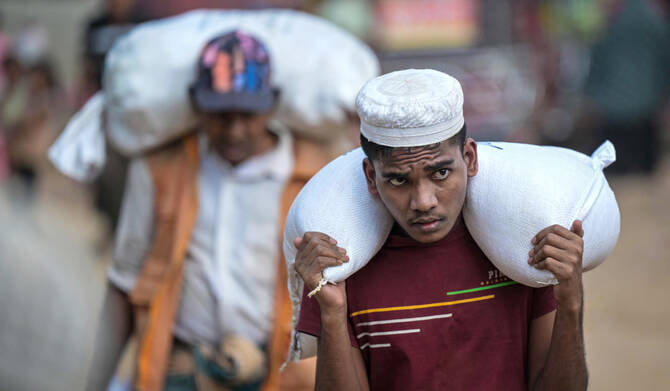
A Rohingya refugee carrying relief materials after collecting them from a distribution point at the Kutupalong refugee camp in Bangladesh's Ukhia. (AFP)
Short Url
Updated 26 December 2025
Follow

Rohingya rue Myanmar’s election from exile

  • Today 1.17 million Rohingya live crammed in dilapidated camps spread over 8,000 acres in Cox’s Bazar

COX’S BAZAR, Bangladesh: Myanmar’s military portrays its general election as a path to democracy and peace, but the vote offers neither to a million Rohingya exiles, robbed of citizenship rights and evicted from their homeland by force.
“How can you call this an election when the inhabitants are gone and a war is raging?” said 51-year-old Kabir Ahmed in Bangladesh’s Kutupalong, the world’s largest refugee camp complex.
Heavily restricted polls are due to start Sunday in areas of Myanmar governed by the military, which snatched power in a 2021 coup that triggered civil war.

SPEEDREAD

• Heavily restricted polls are due to start Sunday in areas of Myanmar governed by the military, which snatched power in a 2021 coup that triggered civil war.

• In 2017, a military crackdown sent legions of the mostly Muslim group fleeing Myanmar’s Rakhine state to neighboring Bangladesh.

But for the Rohingya minority, violence began well before that, with a military crackdown in 2017 sending legions of the mostly Muslim group fleeing Myanmar’s Rakhine state to neighboring Muslim-majority Bangladesh.
The month-long election will be the third national poll since they were stripped of their voting rights a decade ago, but comes amid a fresh exodus fueled by the all-out war. Ahmed once served as chairman of a village of more than 8,000 Rohingya in Myanmar’s Maungdaw township, just over the border from Cox’s Bazar in Bangladesh.
After their eviction, the area is now a “wasteland,” he told AFP.
“Who will appear on the ballot?” he asked. “Who is going to vote?“
Today 1.17 million Rohingya live crammed in dilapidated camps spread over 8,000 acres in Cox’s Bazar.
The majority came in the 2017 crackdown, which is now the subject of a UN genocide court case, with allegations of rampant rape, executions and arson.
Civil war has brought fresh violence, with the Rohingya caught between the warring military and separatist group the Arakan Army, one of the many factions challenging the junta’s rule.
Both forces have committed atrocities against the Rohingya, monitors say.
Some 150,000 people fled the persecution to Bangladesh in the 18 months to July, according to UN analysis.
The UN refugee agency said it was the largest surge in arrivals since 2017.
Aged 18, Mohammad Rahim would have been eligible to vote this year — if he was back home, if his country acknowledged his citizenship, and if polling went ahead despite the war.
“I just want the war to end and for steps to be taken to send us back to Myanmar,” said Rahim, the eldest of four siblings who have all grown up in the squalid camps.
The Arakan Army controls all but three of Rakhine’s 17 townships, according to conflict monitors, meaning the military’s long-promised polls are likely to be extremely limited there.
The military has blockaded the coastal western state, driving a stark hunger and humanitarian crisis.
Rahim still craves a homecoming. “If I were a citizen, I would negotiate for my rights. I could vote,” he said.
“I would have the right to education, vote for whoever I wanted, and work toward a better future.”


Trump urges Iranian Kurds to attack Iran as war widens

Updated 9 sec ago
Follow

Trump urges Iranian Kurds to attack Iran as war widens

  • Azerbaijan preparing unspecified retaliatory measures on Thursday
  • The seven-day war has now seen Iran target Israel, the Gulf states, Cyprus, Turkiye and Azerbaijan, and spread to the Indian Ocean off Sri Lanka

DUBAI/WASHINGTON: US President Donald Trump encouraged Iranian Kurdish forces in Iraq to launch attacks against Iran as the Middle East conflict widened, with Azerbaijan warning it would retaliate for being targeted by Iranian missiles.
Israel on Friday said it had ​started a “broad-scale” wave of attacks against infrastructure targets in Tehran, as Gulf cities came under renewed bombardment by Iran.
The seven-day war has now seen Iran target Israel, the Gulf states, Cyprus, Turkiye and Azerbaijan, and spread to the Indian Ocean off Sri Lanka where a US submarine sank an Iranian naval ship.
On the possibility of the Iranian Kurdish forces entering Iran, Trump told Reuters on Thursday: “I think it’s wonderful that they want to do that, I’d be all for it.”
Two Iranian drone attacks targeted an Iranian opposition camp in Iraqi Kurdistan on Thursday, security sources said.
Iranian Kurdish militias have consulted with the United States in recent days about whether, and how, to attack Iran’s security forces in the western part of the country, according to three sources with knowledge of the matter.
The Iranian Kurdish coalition of groups based on the Iran-Iraq border in ‌the semi-autonomous region ‌of Iraqi Kurdistan has been training to mount such an attack in hopes of weakening the country’s ​military, ‌as ⁠the United ​States ⁠and Israel pound Iranian targets with bombs and missiles. Trump, speaking with Reuters in a telephone interview, also said the United States must have a role in deciding who will be the next leader of Iran after airstrikes killed Supreme Leader Ayatollah Ali Khamenei last week.
“We’re going to have to choose that person along with Iran. We’re going to have to choose that person,” he said.
US Defense Secretary Pete Hegseth said on Thursday that the US was not expanding its military objectives in Iran, despite what Trump said about choosing the country’s next leader.
“There’s no expansion in our objectives. We know exactly what we’re trying to achieve,” he said. The attack on Iran is a major political gamble for the Republican president, with opinion polls showing little support and ⁠Americans concerned about the rise in gasoline prices caused by disruption to energy supplies. Trump dismissed that ‌concern. Shares on Wall Street fell on Thursday, weighed by surging oil prices, as the ‌economic impact of the campaign intensified, with countries around the world cut off from a ​fifth of global supplies of oil and liquefied natural gas and ‌air transport still facing chaos and global logistics increasingly snarled.

Azerbaijan prepares to retaliate
Azerbaijan was preparing unspecified retaliatory measures on Thursday after it said ‌four Iranian drones crossed its border and injured four people in the Nakhchivan exclave.
“We will not tolerate this unprovoked act of terror and aggression against Azerbaijan,” President Ilham Aliyev told a meeting of his Security Council.
Iran, which has a significant Azeri minority, denied it targeted its neighbor.
Lebanon’s Iran-backed Hezbollah militia warned Israeli residents to evacuate towns within 5 km (3 miles) of the border between the countries in a message posted on its Telegram channel in Hebrew early on Friday.
“Your military’s ‌aggression against Lebanese sovereignty and safe citizens, the destruction of civilian infrastructure and the expulsion campaign it is carrying out will not go unchallenged,” Hezbollah said.

Us munitions full
Hegseth and Admiral Brad Cooper, who leads ⁠US forces in the Middle East, ⁠said during a briefing about operations that the US has enough munitions to continue its bombardment indefinitely.
“Iran is hoping that we cannot sustain this, which is a really bad miscalculation,” Hegseth told reporters at Central Command headquarters in Florida. “Our munitions are full up and our will is ironclad.”
The Pentagon earlier this week said the military campaign, known as Operation Epic Fury, is focused on destroying Iran’s offensive missiles, missile production and navy, while not allowing Tehran to have a nuclear weapon.
Cooper said the US had now hit at least 30 Iranian ships, including a large drone carrier that he said was the size of a World War Two aircraft carrier.
He added that B-2 bombers had in the past few hours dropped dozens of 2,000 penetrator bombs targeting deeply buried ballistic missile launchers, and that bombings were also targeting Iran’s missile production facilities.
Iran’s ballistic missile attacks had decreased by 90 percent since the first day of the war, while drone attacks had decreased by 83 percent in that time frame, he said. In Iran, at least 1,230 people have been killed, according to the Iranian Red Crescent Society, including 175 schoolgirls and staff killed at a primary ​school in Minab in the country’s south on the first day ​of the war. Another 77 have been killed in Lebanon, its Health Ministry says. Thousands fled southern Beirut on Thursday after Israel warned residents to leave.