

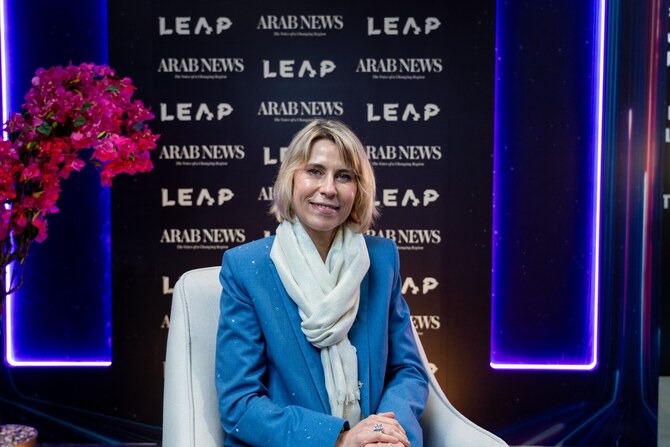

RIYADH: US-based software firm ServiceNow is set to launch data centers in Saudi Arabia in 2026, according to its Europe, the Middle East, and Africa president.
In an interview with Arab News on the sidelines of the second day of LEAP 2025, taking place in Riyadh from Feb. 9—12, Cathy Mauzaize revealed the date for the facilities, with the plans to develop them in the Kingdom announced at last year’s event.
The EMEA president also talked up ServiceNow’s ambitions to build cloud infrastructure and develop essential skills in Saudi Arabia to support its customers and partners better.
ServiceNow’s plan falls in line with Saudi Arabia’s National Strategy for Data and Artificial Intelligence, which aims to train 40 percent of the workforce in essential skills to combat data and AI illiteracy and develop a talent pool of 20,000 data and AI specialists.
It also aligns with the strategy’s target of attracting SR75 billion ($19.99 billion) in local and foreign investments, as well as supporting over 300 startups to encourage entrepreneurship.
Speaking on the timeline of the date centers, Mauzaize said: "We’re going to, crossing my fingers, announce the services in 2026.”
She added that it is “time for us to build the data centers and make them available for our customers and partners here, in the Kingdom, but also, at the same time, we are investing a lot in creating skills, because if we don’t have skills, and especially in the young people, it’s going to be difficult for us to sustain the growth.”
During the interview, Mauzaize went on to highlight that AI and generative AI will have a major impact on the EMEA economy.
“If you look at the numbers that IDC (International Data Corporation) predicts for EMEA and how much wellness or how much, you know, it impacts on the economy, it will have $5 trillion by 2030,” she said.
“But if you go into Saudi Arabia, 52 percent of the CEOs say AI is top of mind and 79 (percent) are saying: ‘we know that’s going to have a material impact on the way we run our business,’” the EMEA president added.
Mauzaize also underlined major partnerships sealed during LEAP 2025 with Salam, a leading digital infrastructure provider in the Kingdom, and the Saudi Telecom Co.
“Salam — it’s a big partnership to help them run on a much faster way, their own operation and to go after a brand-new set of customers in SME space. We have this vision together that, hey, let’s go modernize, help you develop your top line proper, new services embedded into platform and fuse with AI as a service to your end customer, and let’s together go after the small and medium business,” she said.
“STC, we are announcing again a very strategic partnership to help them on their modernization journey, but also as a partner to go to market together. We are very, very proud of those two announcements and we believe that those two will help us accelerate significantly how we get into the Kingdom with success,” the EMEA president added.
Mauzaize explained that ServiceNow is the only AI platform designed specifically for business and digital transformation.
“We have a platform that combines data, the ability to collect all the data and to connect to any source of system, structured data and unstructured data. We are having AI at the core and now Gen AI, generative AI, that has ability to interact with the human touch and augment human and collaborate with human,” she said.
The EMEA President added: “And then we have the workflow, and so the workflow are our ability to digitalize processes. If you think about it in any company anything you do is a process and then is a workflow, so you can either do workflow manually or do a workflow digitally and automate them.”
Held under the theme “Into New Worlds,” LEAP 2025 aims to expand business networking and investment opportunities in the tech sector.
The event plays a key role in Saudi Arabia’s ambition to become a global technology hub, aligning with its Vision 2030 plan to diversify the economy. As part of this initiative, the Kingdom has pledged $100 billion toward advancing its technology sector.


