Senior UN official slams inadequate global support for Pakistan’s climate efforts

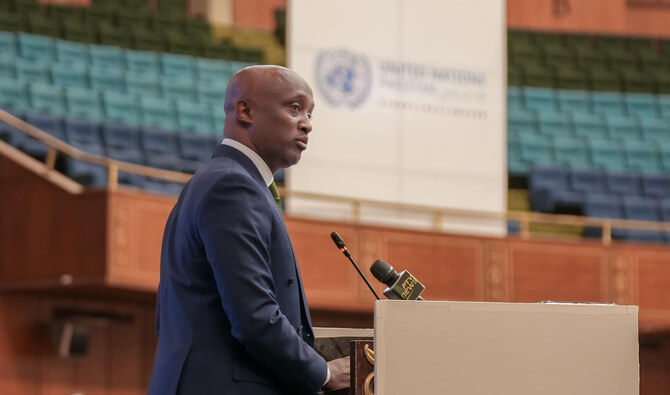
United Nations Resident and Humanitarian Coordinator Mohamed Yahya speaks during a climate change conference, “Breathe Pakistan,” in Islamabad on February 6, 2025. (Photo courtesy: UN Pakistan)
Short Url
Updated 08 February 2025
Follow

Senior UN official slams inadequate global support for Pakistan’s climate efforts

  • Mohamed Yahya urges polluting countries to show ‘stronger solidarity’ to rebuild destroyed homes in Pakistan
  • The country faced devastating floods in 2022 that killed 1,739 people, resulting in $14.9 billion in damages

ISLAMABAD: United Nations Resident and Humanitarian Coordinator Mohamed Yahya criticized the lack of global support for Pakistan in combating climate change this week, urging “stronger solidarity” with the South Asian nation to aid in the reconstruction of homes following the floods over two years ago.
In 2022, floods inundated one-third of Pakistan especially affecting the southeastern Sindh and southwestern Balochistan provinces, impacting 33 million people, causing 1,739 deaths and resulting in $14.9 billion (Rs4.1 trillion) in damage and $15.2 billion (Rs4.2 trillion) in economic losses, according to Pakistan’s National Disaster Management Authority.
The Global Climate Risk Index says Pakistan is among the countries most at risk from climate change. Extreme weather events like floods, droughts, cyclones, torrential rainstorms and heatwaves have been occurring more frequently and with greater intensity across Pakistan in recent years.
“One other things we are concerned about is the lack of stronger solidarity for Pakistan around the reconstruction after the 2022 floods,” Yahya told Arab News on the sidelines of the Breathe Pakistan Climate Conference in Islamabad on Friday.

He noted this was despite the fact that “Pakistan contributes even less than one percent of global emission and is in the top five countries impacted by climate change.”
Yahya described it as “unjust” for Pakistan to be asked to take loans for rebuilding homes destroyed in floods and mitigating a crisis caused by other countries, noting that 20 countries were responsible for 80 percent of global emissions.
According to the UN, the 20 countries contributing to the global greenhouse gas emissions include China, the United States, India, Russia, Japan, Germany and Iran etc.
“We obviously welcome the loans Pakistan has received but Pakistan should not be using or taking loans to rebuild things that it had very little to do with and that we think is not just,” he added.
The UN official maintained the world body consistently urged polluting countries, which have contributed to the climate change disaster, to do more and show solidarity and support to the countries bearing the brunt of the climate change impact.
International donors in January 2023 committed over $9 billion (Rs2.5 trillion) to help Pakistan recover from ruinous floods a year earlier, exceeding its external financing goals.
Officials from some 40 countries as well as private donors and international financial institutions gathered at a meeting in Geneva as Islamabad sought funds to cover around half of a recovery bill amounting to $16.3 billion (Rs 4.5 trillion).
Prime Minister Shehbaz Sharif also called for a grants-based and flexible financial assistance for climate resilience for developing nations like Pakistan this week.
He told the Breathe Pakistan Climate Conference that without global empathy and support, “the path to climate adaptation and green transformation will remain elusive.”


Pakistan’s first non-life Shariah-compliant takaful operator says ‘historic’ IPO oversubscribed 21 times

Updated 9 sec ago
Follow

Pakistan’s first non-life Shariah-compliant takaful operator says ‘historic’ IPO oversubscribed 21 times

  • Pak-Qatar General Takaful Limited offered 30 million shares to investors with ceiling price of Rs14 per share
  • Company says IPO proceeds will be used for investments in software, infrastructure, setting up new branches

ISLAMABAD: Pakistan’s first non-life Shariah-compliant takaful operator announced on Thursday that its initial public offering (IPO) was oversubscribed 21 times at the country’s stock exchange, saying the development reflected strong investor confidence in the Islamic insurance system. 

The Pak-Qatar General Takaful Limited said earlier this month it would issue 30 million shares with a floor price of Rs 10 and a ceiling price of Rs 14 per share. Institutional investors will receive 75 percent of the shares on offer, while the remaining 25 percent will be allocated to retail investors, it added. 

“Pak-Qatar General Takaful Limited’s (PQGTL) IPO book-building has concluded with a historic oversubscription of [21x] times, marking the first-ever IPO of a dedicated General Takaful company at PSX,” the company said in a statement. 

It said investors responded “strongly” as the strike price closed at Rs 14 per share, compared to the floor price of Rs 10. Total demand reached Rs 4.74 billion [$17 million].

The company said successful bidders will be provisionally allotted 22.5 million shares while the remaining 7.5 million shares will be offered to retail investors on Jan. 28-29. 

Shahid Ali Habib, CEO of Arif Habib Ltd., which was the lead manager for the IPO, said that country’s first-ever IPO of any dedicated general takaful company, has made a historic debut at PSX.

Habib said this reflects investor confidence in Pakistan’s fast-growing takaful sector and PQGTL’s strong market position.

The statement further said proceeds from the IPO will be utilized to fund strategic initiatives, such as investments in software and other intangible assets, hardware and infrastructure, marketing and brand development and human resource enhancement. 

Proceeds will also be used to establish new branches and transform existing ones to improve operational efficiency and customer experience, it added. 

Pak-Qatar General Takaful Limited is part of Pakistan’s pioneer Islamic financial services group and is backed by Qatar-based financial institutions.