

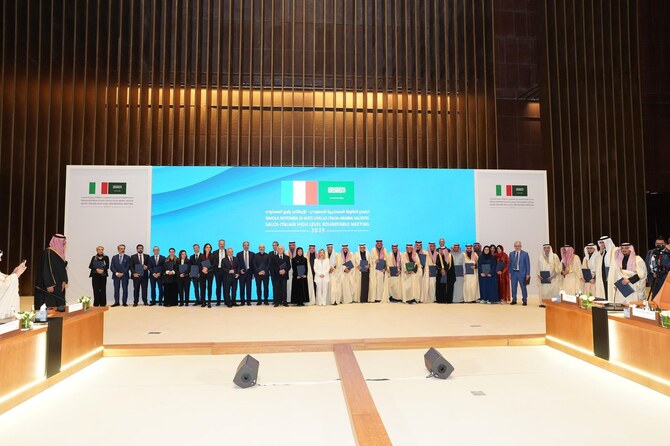

JEDDAH: Saudi Arabia and Italy have signed 26 memoranda of understanding between public and private sector institutions, further enhancing their bilateral relations.
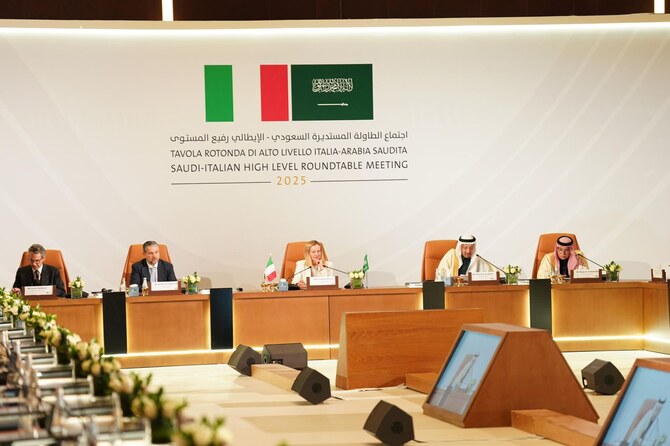
The agreements were formalized during a high-level roundtable meeting in the historicity of AlUla on Jan. 26, attended by Italy’s Prime Minister Giorgia Meloni, who began her three-day official visit to Saudi Arabia the previous day.
Earlier, Saudi Crown Prince Mohammed bin Salman welcomed Meloni in AlUla, where the two leaders discussed opportunities to deepen cooperation across various sectors.
Meloni said that Italy signed agreements worth around $10 billion with Saudi Arabia, reinforcing the strategic partnership between the two nations.
This comes as economic ties between Saudi Arabia and Italy have strengthened significantly in recent years, with Italian exports to the Kingdom rising by over 26 percent in the first 10 months of 2024 compared to the same period the previous year.
In a post on his X account, Minister of Investment, Khalid Al-Falih, said: “We held a meeting that included officials and representatives of several major companies in the Kingdom and Italy. We talked about investment opportunities in the two countries and the investment opportunities provided by Saudi Vision 2030.”
He added: “26 memoranda of understanding were signed between public and private sector institutions in the two countries.”
Among the major deals, Italy’s export credit agency SACE will provide $3 billion in loan guarantees for Saudi Arabia’s NEOM real estate project, supporting infrastructure, urban development, and transport. The deal is backed by a syndicate of international banks, including HSBC and Banco Bilbao Vizcaya Argentaria.
SACE also signed an MoU with Saudi Electricity Co. to support green projects and related engineering, procurement, and construction activities.
ACWA Power signed five MoUs with four prominent Italian organizations, including Cassa Depositi e Prestiti, Italy’s financial institution for development cooperation, and De Nora, a multinational company specializing in water treatment technologies.
The agreements also involve SACE, the Italian export credit agency, and Ansaldo Energia, a power generation equipment manufacturer, which signed with NOMAC Holding, a fully owned subsidiary of ACWA Power.
The agreements cover project financing, technology transfer, and supply chain collaboration to support development in regions such as Africa, Central Asia, and the Far East.
ACWA Power’s partnerships with Italy will strengthen EU-MENA cooperation in green energy, positioning the company as a key player in the global energy transition, the company said in a press release.
“The opportunities of cooperation between Saudi and Italian companies are immense in the sphere of supply, localization, financing and energy,” said Marco Arcelli, CEO of ACWA Power.
He added: “We believe that bringing together our competences and resources will significantly advance the energy transition and water security, promoting sustainable infrastructure developments not only in our countries but also in Africa, Central and Southeast Asia and the rest of the Middle East.”
In other agreements, Italian gas grid operator Snam entered into a deal with ACWA Power to explore joint investments in green hydrogen supply to Europe.
Italian defense group Leonardo also signed an MoU to enhance cooperation with Saudi partners in aerospace and defense.
The roundtable discussions focused on key challenges in global financial markets, with a particular emphasis on developing innovative solutions to strengthen economic ties.
In another deal, Sultan bin Abdulrahman Al-Marshad, CEO of the Saudi Fund for Development, and Dario Scannapieco, CEO of Italy’s National Promotional Institution, signed a development cooperation agreement to enhance social and economic development between the two countries.
The agreement will facilitate expertise exchange and promote sustainable growth in line with global development goals.
SACE also finalized deals worth $6.6 billion with major Saudi financial and business counterparts to support Italian exports and strengthen trade relations.
“We are proud and honored to stand alongside players of primary standing in Saudi Arabia to facilitate Italian exports and develop win-win trade and investment relations between our two countries,” said Alessandra Ricci, CEO of SACE.


