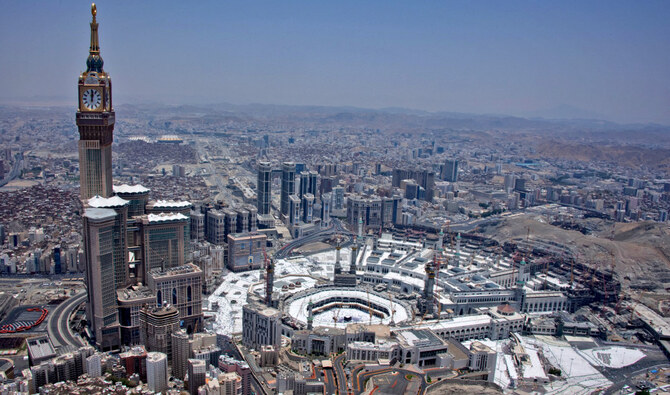

RIYADH: Foreigners can now invest in Saudi-listed companies owning real estate in Makkah and Madinah, following a landmark decision by the Saudi Capital Market Authority.
Effective immediately, the move aims to boost the capital market’s competitiveness and align with the Kingdom’s Vision 2030 economic diversification objectives, the CMA announced in a press release.
While non-Saudis are allowed to purchase properties in the Kingdom, there are specific restrictions, and in the holy cities ownership is generally limited to Saudi nationals — although foreigners are allowed to lease properties there.
Under the new guidelines, foreign investments are limited to shares or convertible debt instruments of listed companies. Total non-Saudi ownership, including individuals and legal entities, is capped at 49 percent of a company’s shares.
However, strategic foreign investors are prohibited from holding stakes in these companies.
The move comes amid reforms across the region, with most neighboring countries allowing foreigners to own properties, primarily in free zones or designated areas under certain restrictions.
“Through this announcement, the Capital Market Authority aims to stimulate investment, enhance the attractiveness and efficiency of the capital market, and strengthen its regional and international competitiveness while supporting the local economy,” said the CMA.
The changes are also designed to stimulate foreign direct investment in the Kingdom’s capital market, as well as bolster its regional and international competitiveness.
“This includes attracting foreign capital and providing the necessary liquidity for current and future projects in Makkah and Madinah through the investment products available in the Saudi market, positioning it as a key funding source for these distinctive developmental projects,” added the CMA.
Strengthening the real estate sector and attracting more FDI into the Kingdom is one of the key goals outlined under the Vision 2030 program, as Saudi Arabia aims to reduce its dependence on crude revenues and diversify its economy.
The Kingdom aims to attract $100 billion in FDI by the end of this decade, and the government body has been implementing various initiatives and reforms to enhance the attractiveness of the capital market.
Some of these efforts include allowing foreign residents to directly invest in the stock market, enabling non-Saudi investors to access the market through swap agreements, and permitting qualified foreign capital institutions to invest in listed securities.
The CMA has also allowed foreign strategic investors to acquire strategic stakes in listed companies and directly invest in debt instruments.
In 2021, the CMA also allowed non-Saudis to subscribe to real estate funds investing within the boundaries of Makkah and Madinah, which played a crucial role in increasing the attractiveness of the capital market to both regional and international investors.
The share prices of real estate companies listed on Saudi Arabia’s stock exchange surged following the CMA’s announcement.
Knowledge Economic City saw its share price rise by 9.89 percent to close at SR16.66 ($4.44).
Jabal Omar Development Co.’s share price also increased by 10 percent to SR25.85, while Makkah Construction and Development Co.’s stock price climbed 9.84 percent to close at SR106.