

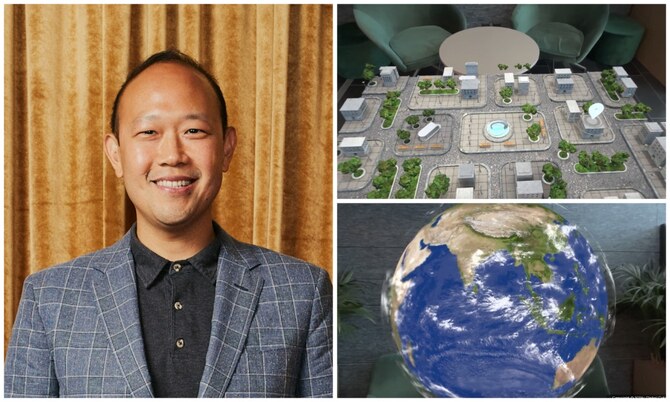
Global Collaboration Village: Redefining engagement with Next-Gen AR and VR at Davos

The Next-Gen platform, developed in partnership with Accenture and powered by Microsoft Mesh, debuted at the WEF annual meeting in Davos this week, and Chieh Huang (pictured, left) said that it aimed to extend the collaborative impact of Davos. (Supplied/WEF)
Short Url
Updated 26 January 2025
Follow

Global Collaboration Village: Redefining engagement with Next-Gen AR and VR at Davos

  • This year’s debut of Next-Gen AR at Davos has focused on collecting feedback to refine the platform

DAVOS: The World Economic Forum’s Global Collaboration Village is using augmented reality and virtual reality technologies to tackle some of the world’s most pressing issues, the president of the initiative told Arab News.

Its Next-Gen platform, developed in partnership with Accenture and powered by Microsoft Mesh, debuted at the WEF annual meeting in Davos this week, and Chieh Huang said that it aimed to extend the collaborative impact of Davos beyond the annual meeting by creating a virtual space that fostered engagement year-round.

He said: “So we often get the question, well, what is the Global Collaboration Village? We’re here in Davos — isn’t this the global collaboration village? And in some sense, yes, it is.”

He continued: “But as Davos and our annual meeting gets more crowded, we want to see if there are ways for us to extend impact throughout the world, 365 days a year.”

This year’s debut of Next-Gen AR at Davos has focused on collecting feedback to refine the platform.

“This is a platform in which we want to stoke more conversation between public entities and private entities,” Huang said. “As you build a platform and any technology product, you want to hear the feedback of, well, what worked well, what didn’t work well. And what better way to do that than here (at the annual meeting), where all of our constituents and users are here.”

Huang emphasized the importance of user input in shaping the experience.

“The graphics are higher fidelity, they’re photorealistic,” he said. “We’re mixing virtual reality in some cases where we want to transport you to a location, but other times we just want to sit around a table, visualize a 3D object, and say, ‘Hey, have you noticed this thing?’ or, ‘Have you noticed that thing?’ Using augmented reality when it’s apropos.”

Feedback so far has been overwhelmingly positive. “The most-used term this week has been: Wow,” Huang said. “When you see the state-of-the-art hardware and software these days, it is a wow moment.”

The tech offers an alternative to traditional 2D communication platforms such as Zoom or PowerPoint by immersing users in a 3D environment.

“If you talk to anyone that’s ever been in an immersive environment, it changes your perception,” Huang explained. “Through that immersiveness, there is a higher level of engagement.”

The platform also aims for inclusivity and device-neutrality. “Next-Gen is available not only with Meta devices but Apple’s Pro as well, and in the future, we want to add more devices onto that as well,” Huang said.

One example of the platform’s potential lies in its use by Saudi Arabia at this year’s WEF to showcase the Kingdom’s Vision 2030 initiative.

“From the outside, I don’t live in Saudi Arabia, I don’t live in the region. It might seem very foreign to say, ‘Hey, there’s this Vision 2030, where they’re trying to transform an entire country and society,’” Huang said.

“You can send around leaflets, you can watch that on YouTube, or maybe get a PowerPoint, but will that actually show and demonstrate what’s really going on? You could say nothing can replace going there. But is there an in-between? That’s where the Global Collaboration Village can shine,” he said.

The GCV mission is clear; to foster collaboration, spark innovation and enable participants to visualize solutions in transformative ways.

Huang concluded: “We want this platform to be a space where global solutions can be visualized, tested and realized — ultimately shaping a better future for all.”


GCC debt markets poised for major growth in 2026, led by record sukuk issuance: Fitch

Updated 17 sec ago
Follow

GCC debt markets poised for major growth in 2026, led by record sukuk issuance: Fitch

RIYADH: The Gulf Cooperation Council's debt capital market is set to exceed $1.25 trillion in 2026 as project funding and government initiatives fuel a 13.6 percent expansion, according to Fitch Ratings.

The region is set to remain one of the largest sources of US dollar debt and sukuk issuance among emerging markets , according to the agency, which also flagged cross-sector economic diversification, refinancing needs, and funding for deficits as drivers behind the growth.

The Gulf’s debt capital markets — which stood at $1.1 trillion at the end of the third quarter of 2025 — have evolved from primarily sovereign funding tools into increasingly sophisticated financing means, serving governments, banks, and corporates alike.

As diversification agendas accelerate and refinancing cycles intensify, regional issuers have become regular participants in global debt markets, strengthening the GCC’s role in emerging-market capital flows.

The report noted that the market is expected to be further supported by forecasted lower oil prices, averaging $63 per barrel in 2026 and 2027, and anticipated US Federal Reserve rate cuts to 3.25 percent and 3 percent in those respective years.

Bashar Al-Natoor, Fitch’s global head of Islamic Finance, highlighted the market’s resilience and the rising dominance of sukuk. “Most GCC issuers continued to maintain strong market access in 2025 and so far in 2026 despite global and regional shocks,” he stated, adding: “Sukuk funding share in the GCC DCM outstanding expanded to over 40 percent, the highest to date.”

The analysis noted the high credit quality of the region’s Islamic debt. “About 84 percent of Fitch-rated GCC sukuk are investment-grade, and 90 percent of issuers are on Stable Outlooks,” Al-Natoor added. “While there were no defaults or falling angels, there were rising stars with many Omani sukuk upgraded following the sovereign upgrade.”

In 2025, GCC nations accounted for 35 percent of all emerging market US dollar debt issuance, excluding China. Growth in US dollar sukuk issuance notably outpaced that of conventional bonds. The region’s total outstanding DCM grew by over 14 percent year on year to $1.1 trillion.

The market remains fragmented, with Saudi Arabia and the UAE hosting the most developed ecosystems.

Notably, Kuwait issued $11.25 billion in sovereign bonds, its first such issuance in eight years, while Oman’s DCM is expected to grow more conservatively as the country focuses on deleveraging. “Digitally native notes emerged in Qatar and the UAE,” the report said.

Fitch identified several risks to the outlook, including exposure to oil-price and interest-rate volatility, geopolitical tensions, and evolving Shariah compliance requirements for sukuk. 

Despite this, issuers are increasingly diversifying their funding through private credit, syndicated financing, and certificates of deposit.