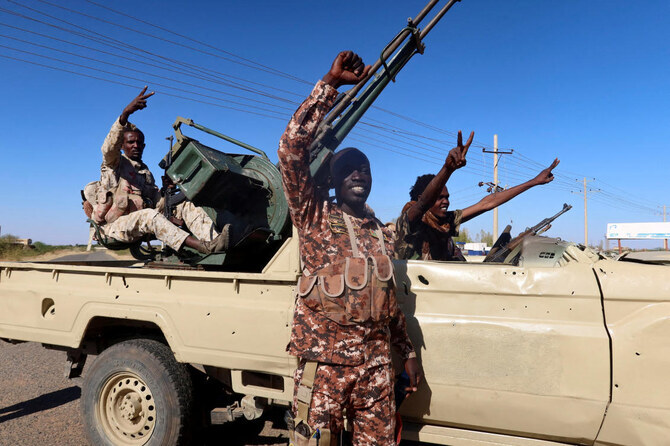
PORT SUDAN: The Sudanese army broke a paramilitary siege on one of its key Khartoum-area bases on Friday, paving the way to also freeing the besieged military headquarters, a military source said.
The paramilitary Rapid Support Forces (RSF) had since the outbreak of the war with Sudan’s army in April 2023 encircled both the Signal Corps in Khartoum North and the General Command of the Armed Forces, its headquarters just south across the Blue Nile river.
“Our forces were able to lift the siege on the Signal Corps,” the source in the Sudanese army told AFP.
With a months-long communications blackout in place, AFP was not able to independently verify the situation on the ground.
The RSF could not be immediately reached for comment.
“This victory opens the way to link our forces in Bahri (Khartoum North) with our forces in the General Command,” the military source said, requesting anonymity because he was not authorized to speak to the media.
A military source had previously told AFP the army was advancing closer to Khartoum North following days of military operations aimed at dislodging the RSF from fortified positions in the city.
This comes around two weeks after the army reclaimed the Al-Jazira state capital Wad Madani, just south of Khartoum, securing a key crossroads between the capital and surrounding states.
The army and the RSF had seemed to be in a stalemate since the military nearly a year ago seized control of Omdurman — Khartoum’s twin city on the west bank of the Nile.
RSF has controlled Khartoum North on the east bank.
They have regularly exchanged artillery fire across the river, with civilians reporting bombs and shrapnel often hitting homes.
The military source said Friday’s advance “will secure Omdurman from the artillery shelling launched from Bahri.”
Seizing the General Command would signal a major shift for the army, securing its positions in all three districts of the capital.
Since the early days of the war, when the RSF quickly spread through the streets of Khartoum, the military has had to supply its forces inside the headquarters via airdrops.
Army chief Abdel Fattah Al-Burhan was himself trapped inside for four months, before emerging in August 2023.
Khartoum and its surrounding state have been torn apart by the war, with 26,000 people killed between April 2023 and June 2024, according to a report by The London School of Hygiene & Tropical Medicine.
Entire neighborhoods have been emptied out and taken over by fighters as at least 3.6 million people fled the capital, according to United Nations figures.
Across the northeast African country, the war has claimed tens of thousands of lives and uprooted more than 12 million people in what the United Nations calls the world’s largest internal displacement crisis.
Famine has been declared in parts of Sudan but the risk is spreading for millions more people, a UN-backed assessment said last month.
Before leaving office on Monday, the administration of United States president Joe Biden sanctioned Sudanese army chief Abdel Fattah Al-Burhan, accusing the army of attacking schools, markets and hospitals and using food deprivation as a weapon of war.
That designation came about one week after Washington sanctioned RSF leader Mohammad Hamdan Dagalo and said his forces had “committed genocide.”


Sudan army breaks paramilitary siege on key base: military source
https://arab.news/mgjsw
Sudan army breaks paramilitary siege on key base: military source

- “Our forces were able to lift the siege on the Signal Corps,” the source in the Sudanese army told AFP
- “This victory opens the way to link our forces in Bahri (Khartoum North) with our forces in the General Command“


US plans meeting for Gaza ‘Board of Peace’ in Washington on Feb 19, Axios reports
- The Axios report cited a US official and diplomats from four countries that are on the board
- The plans for the meeting, which would also be a fundraising conference for Gaza reconstruction, are in early stages and could still change, Axios reported
WASHINGTON: The White House is planning the first leaders meeting for President Donald Trump’s so-called “Board of Peace” in relation to Gaza on February 19, Axios reported on Friday, citing a US official and diplomats from four countries that are on the board.
The plans for the meeting, which would also be a fundraising conference for Gaza reconstruction, are in early stages and could still change, Axios reported.
The meeting is planned to be held at the US Institute of Peace in Washington, the report added, noting that Israeli Prime Minister Benjamin Netanyahu is scheduled to meet Trump at the White House on February 18, a day before the planned meeting.
The White House and the US State Department did not respond to requests for comment.
In late January, Trump launched the board that he will chair and which he says will aim to resolve global conflicts, leading to many experts being concerned that such a board could undermine the United Nations.
Governments around the world have reacted cautiously to Trump’s invitation to join that initiative. While some of Washington’s Middle Eastern allies have joined, many of its traditional Western allies have thus far stayed away.
A UN Security Council resolution, adopted in mid-November, authorized the board and countries working with it to establish an international stabilization force in Gaza, where a fragile ceasefire began in October under a Trump plan on which Israel and Palestinian militant group Hamas signed off.
Under Trump’s Gaza plan revealed late last year, the board was meant to supervise Gaza’s temporary governance. Trump thereafter said it would be expanded to tackle global conflicts.
Many rights experts say that Trump overseeing a board to supervise a foreign territory’s affairs resembled a colonial structure and have criticized the board for not including a Palestinian.The fragile ceasefire in Gaza has been repeatedly violated, with over 550 Palestinians and four Israeli soldiers reported killed since the truce began in October. Israel’s assault on Gaza since late 2023 has killed over 71,000 Palestinians, caused a hunger crisis and internally displaced
Gaza’s entire population.
Multiple rights experts, scholars and a UN inquiry say it amounts to genocide. Israel calls its actions self-defense after Hamas-led militants killed 1,200 people and took over 250 hostages in a late 2023 attack.


