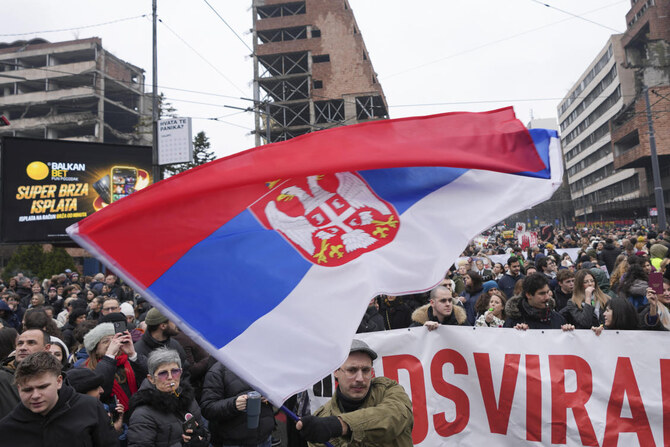
BELGRADE: A student-led strike closed down numerous businesses and drew tens of thousands into the streets throughout Serbia on Friday as populist President Aleksandar Vucic planned a big rally to counter persistent anti-government protests that have challenged his tight grip on power.
Daily traffic blockades took place on Friday in various cities and towns in the Balkan nation, held to commemorate the victims of a deadly canopy collapse which killed 15 people in November. Huge crowds later flooded the streets for noisy protest marches through the capital Belgrade and elsewhere in the country.
“Let’s take freedom in our hands,” students told the citizens in their strike call.
Many in Serbia believe the huge concrete canopy at a train station in the northern city of Novi Sad fell down because of sloppy reconstruction work that resulted from corruption.
Weeks-long protests demanding accountability over the crash have been the biggest since Vucic came to power more than a decade ago. He has faced accusations of curbing democratic freedoms despite formally seeking European Union membership for Serbia.
It was not immediately possible to determine how many people and companies joined the students’ call for a one-day general strike on Friday. They included restaurants, bars, theaters, bakeries, various shops and bookstores.
Vucic will gather his supporters in the central town of Jagodina later on Friday. He has announced plans to form a nationwide political movement in the style of Russia’s President Vladimir Putin that would help ensure the dominance of his right-wing Serbian Progressive Party.
The president and his mainstream media have accused the students of working under orders from foreign intelligence services to overthrow the authorities while pro-government thugs have repeatedly attacked protesting citizens.
No incidents were reported during the 15-minute traffic blockades on Friday that started at 11.52, the exact time of the canopy collapse in Novi Sad.
During a blockade last week in Belgrade, a car rammed into protesting students, seriously injuring a young woman.
Serbian universities have been blockaded for two months, along with many schools. A lawyers’ association also has gone on strike but it remained unclear how many people stayed away from work in the state-run institutions on Friday.
As well as Belgrade and Novi Sad, protest marches were also held Friday in the southern city of Nis and smaller cities, and even in Jagodina ahead of Vucic’s arrival.
“Things can’t stay the same anymore,” actor Goran Susljik told N1 regional television. “Students have offered us a possibility for a change.”
Serbia’s prosecutors have filed charges against 13 people for the canopy collapse, including a government minister and several state officials. But the former construction minister Goran Vesic has been released from detention, fueling doubts over the probe’s independence.
The main railway station in Novi Sad was renovated twice in recent years as part of a wider infrastructure deal with Chinese state companies.


![]()

University students lead a strike in Serbia as populist president plans a rally to counter protests
Short Url
https://arab.news/j53v8
University students lead a strike in Serbia as populist president plans a rally to counter protests
- Daily traffic blockades took place on Friday in various cities and towns in the Balkan nation
- “Let’s take freedom in our hands,” students told the citizens in their strike call


Latest updates


Recommended


© 2026 SAUDI RESEARCH & PUBLISHING COMPANY, All Rights Reserved And subject to Terms of Use Agreement.