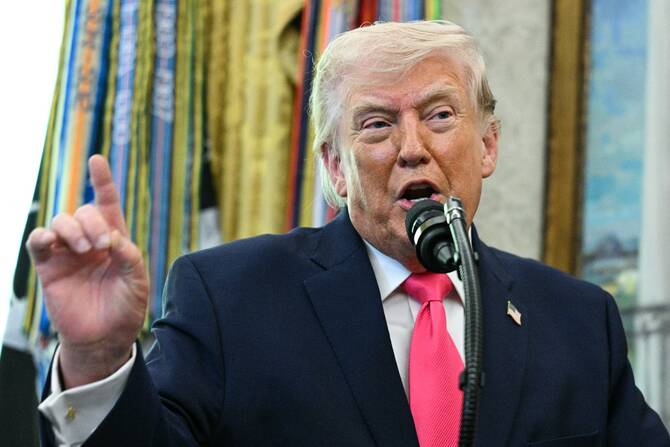

Here is what we know about US President Donald Trump’s 15-point plan to wind down the Iran war
The US administration plan to end the war is a step viewed as an attempt to de-escalate tensions in the Middle East.
Officials cited by several news outlets have confirmed that Iran has received an American plan to pause the war. Tehran, however, did not confirm receiving the plan and on Wednesday publicly dismissed the diplomatic effort.
Sources said the plan proposed a rollback of Iran’s nuclear program, limits on missiles, and reopening the Strait of Hormuz. The proposal also included restrictions on Iran’s support for armed groups.
The plan proposed by the Trump administration was delivered to Iran by mediators from Pakistan, according to The Associated Press.
While all details have not yet been released, here is what is known about the plan so far.
US Envoy Steve Witkoff has told Trump that the Iranians agreed on several key points, including giving up their stockpile of highly enriched uranium, according to a US source quoted by Axios.
Axios said that the US has shared the 15-point plan with the Israelis, and informed them of Iran’s willingness to give up “its 450kg stockpile of 60 percent enriched uranium.”
The US administration also said Iran “accept enhanced UN inspections and monitoring of its nuclear sites, limit the range of its ballistic missiles, and cut back on support for proxies,” the source said.
The document presented by Trump’s administration calls for zero uranium enrichment in Iran, an Israeli source said.
The US side said Iran had agreed to suspend enrichment, but it is not clear for how long, and added that the document has many of the same demands the US made during the last round of nuclear talks in Geneva.
Mediation efforts
Pakistan has been an intermediary between Tehran and Washington, alongside mediators from Egypt and Turkey, Axios said.
The mediators were still working to convince Iran to sit for talks with the US, as Tehran continues to deny that any negotiations were taking place with Washington, saying that it will continue to fight “until complete victory.”
An unnamed Egyptian official cited by The Independent Newspaper said ongoing efforts are “centered on 'trust-building' between the US and Iran, aiming to reach a pause in fighting and a mechanism to reopen the Strait of Hormuz.”
According to sources, one of the demands is to allow access for shipping through the Strait of Hormuz, the narrow mouth of the Arabian Gulf.
The Strait of Hormuz is a vital waterway for oil shipments that Iran has made virtually impassable since the war began. Its reopening and renewing the flow of traffic through it is a priority for Trump and the global economy.
Why now?
Trump’s sudden decision came just as the deadline was about to run out on an ultimatum he had made over the weekend threatening to “obliterate” Iran’s power plants unless the country released its stranglehold on the Strait of Hormuz.
But Tehran vowed retaliation by attacking power, water and oil infrastructure of its Gulf neighbors.
Esmaeil Baqaei, the spokesperson for Iran's Foreign Ministry, again rejected the US claim of negotiations between the US and Iran in comments given to India Today.
“We've had a very catastrophic experience, I should say, of the United States diplomacy," he said, adding that Iran was attacked "two times within a span of nine months when we were in the middle of a negotiating process to resolve the nuclear issue.”
The White House did not respond to requests for comment on the administration submitting the 15-point plan.
(with The Associated Press)