JERUSALEM/BEIRUT: Israel said on Thursday the terms of a ceasefire with Hezbollah were not being implemented fast enough and there was more work to do, while the Iran-backed group urged pressure to ensure Israeli troops leave south Lebanon by Sunday as set out in the deal.
The deal stipulates that Israeli troops withdraw from south Lebanon, Hezbollah remove fighters and weapons from the area and Lebanese troops deploy there — all within a 60-day timeframe which will conclude on Sunday at 4 a.m. (0200 GMT).
The deal, brokered by the United States and France, ended more than a year of hostilities triggered by the Gaza war. The fighting peaked with a major Israeli offensive that displaced more than 1.2 million people in Lebanon and left Hezbollah severely weakened.
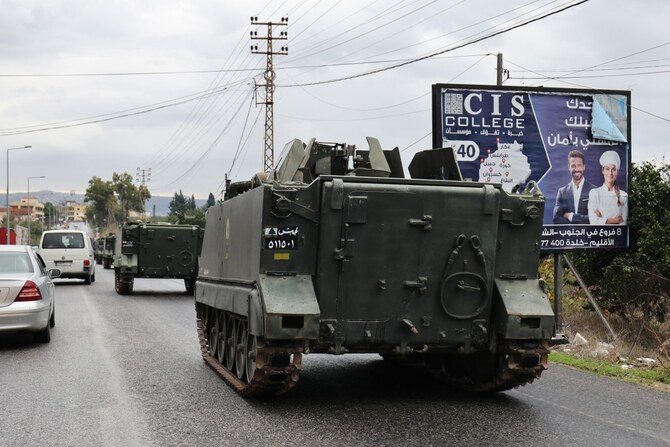
“There have been positive movements where the Lebanese army and UNIFIL have taken the place of Hezbollah forces, as stipulated in the agreement,” Israeli government spokesmen David Mencer told reporters, referring to UN peacekeepers in Lebanon.
“We’ve also made clear that these movements have not been fast enough, and there is much more work to do,” he said, affirming that Israel wanted the agreement to continue.
Mencer did not directly respond to questions about whether Israel had requested an extension of the deal or say whether Israeli forces would remain in Lebanon after Monday’s deadline.
Hezbollah said in a statement that there had been leaks talking about Israel postponing its withdrawal beyond the 60-day period, and that any breach of the agreement would be unacceptable.
The statement said that possibility required everyone, especially Lebanese political powers, to pile pressure on the states which sponsored the deal to ensure “the implementation of the full (Israeli) withdrawal and the deployment of the Lebanese army to the last inch of Lebanese territory and the return of the people to their villages quickly.”
Any delay beyond the 60 days would mark a blatant violation of the deal with which the Lebanese state would have to deal “through all means and methods guaranteed by international charters” to recover Lebanese land “from the occupation’s clutches,” Hezbollah said.
Israel said its campaign against Hezbollah aimed to secure the return home of tens of thousands of people forced to leave their homes in northern Israel by Hezbollah rocket fire.
It inflicted major blows on Hezbollah during the conflict, killing its leader Hassan Nasrallah and thousands of the group’s fighters and destroying much of its arsenal.
The group was further weakened in December when its Syrian ally, Bashar Assad, was toppled, cutting its overland supply route from Iran.
French Foreign Minister Jean-Noel Barrot, speaking at the World Economic Forum in Davos on Thursday, said Israel had put an end to hostilities and was removing its forces from Lebanon, and that the Lebanese army had gone to locations of Hezbollah ammunition stores and destroyed them.
He also indicated there was more to do to shore up the ceasefire. “Are we done? No. We will need more time to achieve results,” he said.
Three diplomats said on Thursday it looked like Israeli forces would still be in some parts of southern Lebanon after the 60-day mark.
A senior Lebanese political source said President Joseph Aoun had been in contact with US and French officials to urge Israel to complete the withdrawal within the stipulated timeframe.
The Lebanese government has told US mediators that Israel’s failure to withdraw on time could complicate the Lebanese army’s deployment, and this would be a blow to diplomatic efforts and the optimistic atmosphere in Lebanon since Aoun was elected president on Jan. 9.


![]()

Israel sees more to do on Lebanon ceasefire as deadline nears
Short Url
https://arab.news/yq9vk
Israel sees more to do on Lebanon ceasefire as deadline nears
- “We’ve also made clear that these movements have not been fast enough, and there is much more work to do,” Mencer said
- Three diplomats said on Thursday it looked like Israeli forces would still be in some parts of southern Lebanon after the 60-day mark


Latest updates


© 2026 SAUDI RESEARCH & PUBLISHING COMPANY, All Rights Reserved And subject to Terms of Use Agreement.