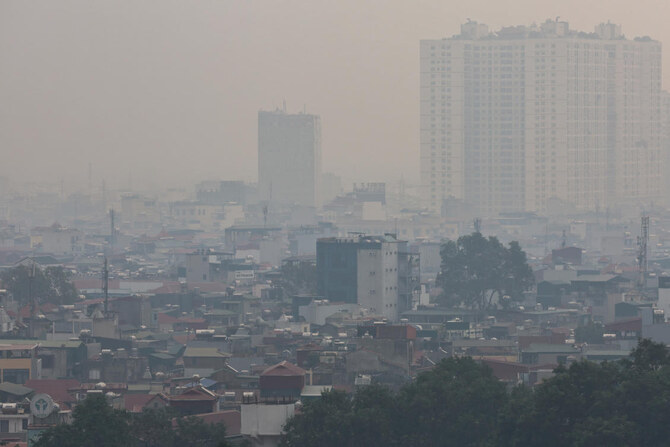
BANGKOK: Southeast Asian cities were among five most polluted in the world on Friday according to air-monitoring organization IQAir, with Ho Chi Minh City ranked second-most polluted, followed by Phnom Penh and Bangkok fourth and fifth, respectively.
In the Thai capital, a thick smog was seen covering the city’s skyline. Workers, especially those who spend most of their time outdoors, were suffering.
“My nose is constantly congested. I have to blow my nose all the time,” said motorcycle taxi driver Supot Sitthisiri, 55.
Air pollution is caused by a combination of crop-related burning, industrial pollution and heavy traffic.
In a bid to curb pollution, the government is allowing free public transportation for a week, Transport Minister Suriya Juangroongruangkit said.
Some 300 schools in Bangkok were closed this week, according to the city administration.
“They should take more action, not just announce high dust levels and close schools. There needs to be more than that,” said Khwannapat Intarit, 23.
“It keeps coming back, and it’s getting worse each time.”
Thai Prime Minister Paetongtarn Shinawatra said in a social media post that companies and government agencies should allow staff to work from home to reduce car use and construction sites should be using dust covers.
“The government is fully committed to solving the dust problem,” she said.
In Vietnam’s largest city, IQAir said the level of fine inhalable particles in Ho Chi Minh City was 11 times higher than the recommended level by the World Health Organization.
Weeks earlier, the capital Hanoi was ranked the world’s most polluted, prompting authorities to issue a warning about the health risks from air pollution and urging the public to wear masks and eye protection.
Governments in Southeast Asia were pushing for longer-term solutions to bring pollution down including a carbon tax and promoting the use of electric vehicles.

Southeast Asian cities among world’s most polluted, ranking shows
https://arab.news/m6jd2
Southeast Asian cities among world’s most polluted, ranking shows
- Air pollution is caused by a combination of crop-related burning, industrial pollution and heavy traffic
- Weeks earlier, Vietnam’s capital Hanoi was ranked the world’s most polluted
Bangladesh begins exhuming mass grave from 2024 uprising
- The United Nations says up to 1,400 people were killed in crackdowns as Hasina attempted to cling to power — deaths that formed part of her conviction last month for crimes against humanity
DHAKA: Bangladeshi police began exhuming on Sunday a mass grave believed to contain around 114 unidentified victims of a mass uprising that toppled autocratic former prime minister Sheikh Hasina last year.
The UN-supported effort is being advised by Argentine forensic anthropologist Luis Fondebrider, who has led recovery and identification missions at mass graves worldwide for decades.
The bodies were buried at the Rayerbazar Graveyard in Dhaka by the volunteer group Anjuman Mufidul Islam, which said it handled 80 unclaimed bodies in July and another 34 in August 2024 — all people reported to have been killed during weeks of deadly protests.
The United Nations says up to 1,400 people were killed in crackdowns as Hasina attempted to cling to power — deaths that formed part of her conviction last month for crimes against humanity.
Criminal Investigation Department (CID) chief Md Sibgat Ullah said investigators believed the mass grave held roughly 114 bodies, but the exact number would only be known once exhumations were complete.
“We can only confirm once we dig the graves and exhume the bodies,” Ullah told reporters.
- ‘Searched for him’ -
Among those hoping for answers is Mohammed Nabil, who is searching for the remains of his brother Sohel Rana, 28, who vanished in July 2024.
“We searched for him everywhere,” Nabil told AFP.
He said his family first suspected Rana’s death after seeing a Facebook video, then recognized his clothing — a blue T-shirt and black trousers — in a photograph taken by burial volunteers.
Exhumed bodies will be given post-mortem examinations and DNA testing. The process is expected to take several weeks to complete.
“It’s been more than a year, so it won’t be possible to extract DNA from the soft tissues,” senior police officer Abu Taleb told AFP. “Working with bones would be more time-consuming.”
Forensic experts from four Dhaka medical colleges are part of the team, with Fondebrider brought in to offer support as part of an agreement with the UN rights body the OHCHR.
“The process is complex and unique,” Fondebrider told reporters. “We will guarantee that international standards will be followed.”
Fondebrider previously headed the Argentine Forensic Anthropology Team, founded in 1984 to investigate the tens of thousands who disappeared during Argentina’s former military dictatorship.
Authorities say the exhumed bodies will be reburied in accordance with religious rites and their families’ wishes.
Hasina, convicted in absentia last month and sentenced to death, remains in self-imposed exile in India.


