

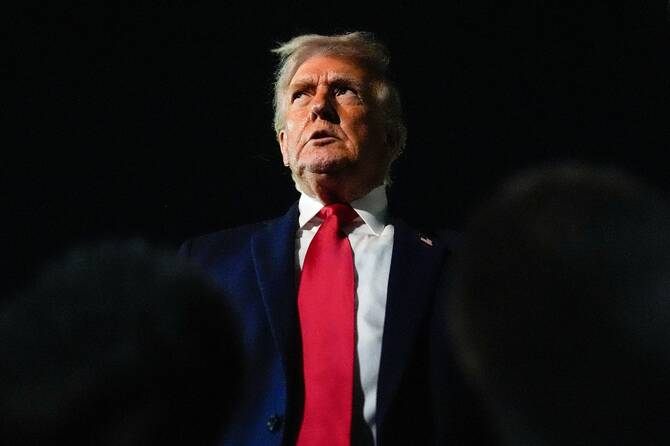

DAVOS, Switzerland/COPENHAGEN: US President Donald Trump on Tuesday vowed there was “no going back” on his goal to control Greenland, refusing to rule out taking the Arctic island by force and rounding on allies as European leaders struggled to respond.
Trump’s ambition — spelled out in social media posts and mock-up AI images — to wrest sovereignty over Greenland from fellow NATO member Denmark has threatened to blow apart the alliance that has underpinned Western security for decades.
It has also threatened to reignite a trade war with Europe that rattled markets and companies for months last year, though Trump’s Treasury Secretary Scott Bessent pushed back against what he called “hysteria” over Greenland.
“As I expressed to everyone, very plainly, Greenland is imperative for National and World Security. There can be no going back — On that, everyone agrees!” Trump said after speaking to NATO Secretary General Mark Rutte.
To drive home the message, Trump posted an AI image of himself in Greenland, holding a US flag. Another showed him speaking to leaders next to a map showing Canada and Greenland as part of the United States.
Separately, he leaked messages including from French President Emmanuel Macron, who questioned what Trump was “doing on Greenland.” Trump, who has vowed to impose tariffs on countries who stood in his way, had earlier threatened to hammer French wines and champagnes with a 200 percent tariff.
BESSENT PUSHES BACK AGAINST ‘HYSTERIA’
The European Union has threatened to hit back with trade measures. One option is a package of tariffs on 93 billion euros ($109 billion) of US imports that could automatically kick in on February 6 after a six-month suspension.
Another option is the “Anti-Coercion Instrument” (ACI), which has never yet been used. It could limit access to public tenders, investments or banking activity, or restrict trade in services, the sector in which the US has a surplus with the bloc, including the lucrative digital services provided by US tech giants.
“This is not a question about the Kingdom of Denmark, it is about the entire transatlantic relationship,” Denmark’s Economy Minister Stephanie Lose told journalists ahead of an EU meeting of economy and finance ministers in Brussels.
“At this point in time, we do not believe that anything should be ruled out. This is a serious situation that, although we would like to de-escalate, there are others who are contributing to escalating it right now, and therefore we will have to keep all options on the table as we move forward.”
Bessent, on the sidelines of the World Economic Forum annual meeting in Davos, Switzerland, said a solution would be found that ensures national security for the United States and Europe.
“It’s been 48 hours. As I said, sit back, relax,” he said. “I am confident that the leaders will not escalate and that this will work out in a manner that ends up in a very good place for all.”
Asked about the prospect of a prolonged trade war between the United States and Europe, Bessent replied: “Why are we jumping there? Why are you taking it to the worst case?... Calm down the hysteria. Take a deep breath.”
However, in her own speech in Davos, European Commission President Ursula von der Leyen said the series of recent geopolitical shocks will force the EU to build a new independent Europe.
“We will only be able to capitalize on this opportunity if we recognize that this change is permanent,” she said.
RUSSIA QUESTIONS DANISH SOVEREIGNTY OVER GREENLAND
Trump will also this week attend the Davos gathering of the global political and business elite. Swiss newspaper NZZ reported that protesters marched in Zurich, Switzerland, late on Monday, carrying a giant banner saying: “TRUMP NOT WELCOME. NO WEF! NO OLIGARCHY! NO IMPERIALIST WARS!“
The foreign minister of Russia, which has been watching with glee as Trump’s drive to acquire Greenland widens splits with Europe, said on Tuesday that Greenland was not “a natural part” of Denmark.
Trump’s renewed tariff threats against European allies have revived talk of the ‘Sell America’ trade that emerged in the aftermath of his sweeping levies last April.
Stock markets bore the brunt on Monday of fears that the trade war could re-escalate, with European equities dropping over 1 percent and US stock futures taking a similar hit that points to weakness following Monday’s US public holiday.
The dollar was on the back foot too, a sign that the world’s No.1 reserve currency was also in the crosshairs of Trump’s threat on Saturday to increase tariffs on Europe.


