

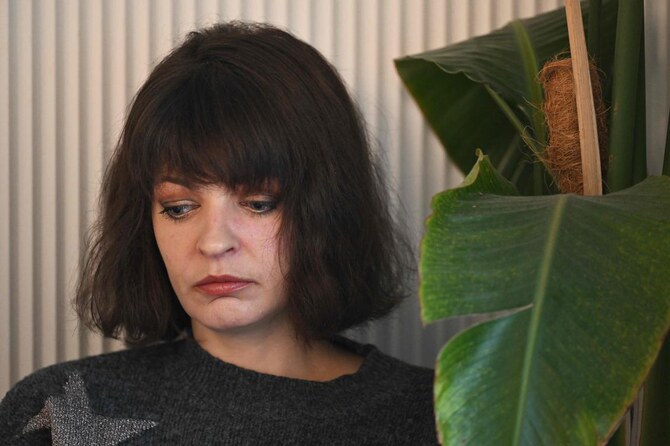

BIALYSTOK: Having missed almost four years of her son’s life while incarcerated in a Belarusian prison, Irina Schastnaya still wants to zip up the 14-year-old’s coat, struggling to digest how tall he grew in her absence.
German was 10 when security services broke into their home in Minsk, raiding the flat and arresting his mother in front of him for challenging authoritarian President Alexander Lukashenko’s rule.
“I managed to say to him: ‘German don’t worry, everything will be fine,” she told AFP, recalling the November 2020 morning that “changed our lives forever.”
Her arrest was just one of a huge crackdown on dissent orchestrated by Lukashenko after tens of thousands protested his 2020 election victory, claiming widespread fraud.
In power since 1994, the Moscow ally is set to secure another term in power this weekend in an election with no real competition.
The Viasna rights group says Belarus currently has 1,256 political prisoners, and all opposition leaders are either in jail or in exile.
Within days of Schastnaya’s 2020 arrest, German’s father fled the country with the boy — settling in Kyiv, before leaving for Poland when it became clear Russia may invade Ukraine.
Schastnaya was sentenced to four years for editing a Telegram channel critical of the government.
Sent to Penal Colony Number Four in the city of Gomel, she was made to sew military and construction uniforms at the prison factory.
But she spent most of the time “thinking of German.”
They were allowed one video call a month — under the close watch of a prison officer.
“He did not like those calls,” she said. “He could literally see the person listening in the frame.”
They were reunited in September 2024, when Schastnaya was released and fled Belarus to join her family in Poland’s Bialystok — close to Belarus and long a hub for exiles.
“When I opened the door, I saw this tall guy,” she told AFP, still visibly shaken.
“It’s like heaven and earth. It’s not the same mothering... He was 10 when I was arrested, he still held my hand when we walked in the street.”
Like other ex-prisoners AFP spoke to, Schastnaya now has one wish: to get those who remain behind bars out — by all “possible and impossible” means.
Schastnaya says her son has adapted to life in Poland.
But she has not.
She often drives up to the nearby Belarus border, “just to have a look.”
A few months ago, she was in prison, sleeping on the top bunk in a room with some 30 women.
Like all political prisoners, her uniform and bed was marked with a “yellow label,” signifying a “tendency for extremism and other destructive activities,” she said.
After being released she decided to flee, fearing she would “not be free for long” or could be barred from leaving.
She is encouraged by a wave of pre-election pardonings back home, hoping more will come.
“We have to get them out any way possible,” she said.
“Some people have not seen their kids in years.”
In Poland’s Gdansk, former political prisoner Kristina Cherenkova, 34, has been scouring for information of those recently pardoned.
Authorities do not release names, but information trickles out through relatives and lawyers.
A wedding decorator, Cherenkova took part in 2020 protests in her small town of Mazyr and refused to leave Belarus when the crackdown started.
She was eventually arrested in 2022 for a social media post criticizing Russia’s invasion of Ukraine, which it launched in part from Belarusian territory.
Cherenkova also ended up in the Gomel prison, before being released last year.
“Around 10 percent of the women are political prisoners there,” she estimated.
“I am happy to see some of the names released. But there are a lot of people left, many friends.”
While in prison, she said she witnessed pardonings being delayed by slow Soviet-like bureaucracy.
Daria Afanasyeva, a Belarusian feminist living in Warsaw freed last year, also said “everything should be done” to secure freedom for more political prisoners — “including talks with the regime.”
“It’s not just one person in prison, it’s their whole family,” the pink-haired activist said, adding that many feel intense “guilt” for relatives suffering on the outside.
Arrested in 2021, Afanasyeva said the solidarity among political prisoners helped her through her 2.5-year sentence.
“Thanks to the KGB for getting me a best friend,” she joked.
But the prison ordeal still “eats up” her life.
“There is snow in Warsaw, people are happy... But I’m just thinking that if there’s snow in the prison, the girls there are clearing it.”


