

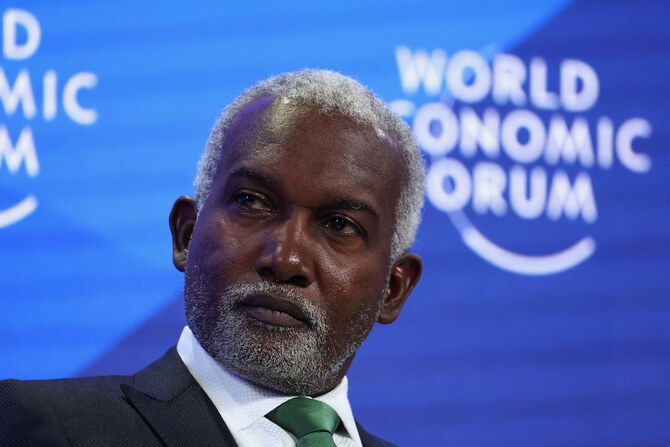
Social media disinformation fueling poor governance, Nigerian foreign minister tells WEF

Nigerian Foreign Minister Yusuf Tuggar told a panel at the World Economic Forum that disinformation on social media could have a "deleterious effect on governments and governance." (Reuters)
Short Url
Updated 24 January 2025
Follow

Social media disinformation fueling poor governance, Nigerian foreign minister tells WEF

  • Yusuf Tuggar says Sahel countries suffer from foreign state-backed social media campaigns
  • Comments come in WEF panel on what can be done to tackle poor governance

LONDON: Disinformation campaigns on social media, sometimes instigated by external countries, have fueled poor governance in parts of Africa, Nigeria’s foreign minister said on Wednesday.

Speaking during the World Economic Forum in Davos, Yusuf Tuggar said that while social media could have a positive effect on governance and improving transparency, disinformation spread on its platforms was something Nigeria was having to deal with.

He pointed to countries neighboring or near to Nigeria where foreign powers had been blamed for sophisticated social media campaigns that helped to swell support for military regimes.

Niger, Mali and Burkina Faso underwent military coups in recent years and broke away from the Economic Community of West African States — ECOWAS — last year to form their own alliance.

Disinformation or misinformation had a “deleterious effect on governments and governance, and sometimes it’s even destructive,” Tuggar said during a panel on the threat of poor governance.

“It’s so sophisticated, and then sometimes you also have external interference where you have other states sponsoring such attacks, if you will, on others.”

While he did not name any countries in particular, Tuggar said that this was something Nigeria was contending with in discussions about the three countries leaving ECOWAS. Nigeria is the most powerful member of the economic bloc, which is regarded as having helped to improve financial and political stability in the region.

“That sort of negative campaign sways public opinion one way or the other, and if you’re relying on votes on openness and transparency, then, you know, it’s not a fair game,” Tuggar said.

A study released last year by the Africa Center for Strategic Studies, which is based at the US Department of Defense, found Russia to be the leading source of disinformation in Africa, with West Africa and the Sahel the most targeted.

Tuggar’s comments came as the panel discussed how leaders could tackle the poor level of governance globally that is blamed for eroding global cooperation and stalling progress on critical social, economic and environmental issues.

Ngaire Woods, dean of the Blavatnik School of Government at Oxford University, said that good governance was about whether people could continue to trust you when you got things wrong.

“Resilience in leadership takes legitimacy as well as effectiveness,” she said. “Legitimacy is about the trust you engender among those you govern or those that you lead in your company.”

Johan Andresen, chairman of the Norwegian private investment company Ferd, said that good governance needed to be handled in two ways — risk and responsibility.

“You have to have management of the risks in the organizations, but you should also try to experiment with how much responsibility can you actually take,” he said.


In Ethiopia, Tigrayans fear return to ‘full-scale war’

Updated 02 February 2026
Follow

In Ethiopia, Tigrayans fear return to ‘full-scale war’

  • Flights have been suspended into Tigray since Thursday and local authorities reported drone strikes on goods lorries
  • The international community fears the fighting could turn into an international conflict between Ethiopia and Eritrea

ADDIS ABABA: Tigrayans in northern Ethiopia fear a return to all-out war amid reports that clashes were continuing between local and federal forces on Monday, barely three years after the last devastating conflict in the region.
The civil war of 2020-2022 between the Ethiopian government and Tigray forces killed more than 600,000 people and a peace deal known as the Pretoria Agreement has never fully resolved the tensions.
Fighting broke out again last week in a disputed area of western Tigray called Tselemt and the Afar region to the east of Tigray.
Abel, 38, a teacher in Tigray’s second city Adigrat, said he still hadn’t recovered from the trauma of the last war and had now “entered into another round of high anxiety.”
“If war breaks out now... it could lead to an endless conflict that can even be dangerous to the larger east African region,” added Abel, whose name has been changed along with other interviewees to protect their identity.
Flights have been suspended into Tigray since Thursday and local authorities reported drone strikes on goods lorries on Saturday that killed at least one driver.
In Afar, a humanitarian worker, speaking to AFP on condition of anonymity, said there had been air strikes on Tigrayan forces and that clashes were ongoing on Monday, with tens of thousands of people displaced.
AFP could not independently verify the claims and the government has yet to give any comment on the clashes.
In the regional capital Mekele, Nahom, 35, said many people were booking bus tickets this weekend to leave, fearing that land transport would also be restricted soon.
“My greatest fear is the latest clashes turning into full-scale war and complete siege like what happened before,” he told AFP by phone, adding that he, too, would leave if he could afford it.
Gebremedhin, a 40-year-old civil servant in the city of Axum, said banks had stopped distributing cash and there were shortages in grocery stores.
“This isn’t only a problem of lack of supplies but also hoarding by traders who fear return of conflict and siege,” he said.
The region was placed under a strict lockdown during the last war, with flights suspended, and banking and communications cut off.
The international community fears the fighting could turn into an international conflict between Ethiopia and Eritrea, whose relations have been increasingly tense in recent months.
The Ethiopian government accuses the Tigrayan authorities and Eritrea of forging closer ties.
United Nations Secretary-General Antonio Guterres is “deeply concerned about... the risk of a return to a wider conflict in a region still working to rebuild and recover,” his spokesman said.
The EU said that an “immediate de-escalation is imperative to prevent a renewed conflict.”