Jordanian FM says Saudi Arabia plays key role in bringing comprehensive peace to Middle East

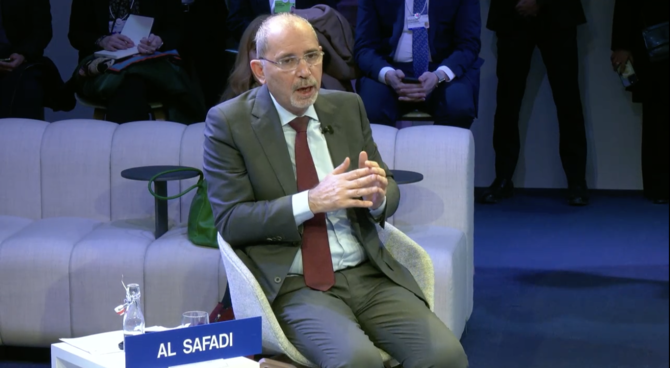
Al-Safadi credited US President Donald Trump and his administration with ensuring the ceasefire in Gaza would happen. (Screengrab)
Short Url
Updated 22 January 2025
Follow

Jordanian FM says Saudi Arabia plays key role in bringing comprehensive peace to Middle East

DAVOS: Jordanian Foreign Minister Ayman Al-Safadi said Saudi Arabia is playing a key role in bringing peace to the Middle East region and called for a two-state solution at the 2025 World Economic Forum in Davos on Wednesday.

Al-Safadi said the only way to maintain security in the region is to have strong leadership.

“There is a moment of opportunity in the region with everything happening in Lebanon and Syria; we should not leave leadership up to radicals,” he said.

A lasting ceasefire is Jordan’s main priority at the moment, explained Al-Safadi.

“Getting the ceasefire to hold is our priority, then flooding Gaza with immediate aid is necessary, then we can focus on other things like education and rebuilding the city,” he added.

Al-Safadi credited US President Donald Trump and his administration with ensuring the ceasefire in Gaza would happen.

A ceasefire deal between Israel and Hamas that included an exchange of hostages from both sides took effect on Sunday.

The plan was originally outlined by former President Joe Biden in May and was pushed through after unusual joint diplomacy by Biden and Trump envoys.

Under the terms of the ceasefire, Israel must withdraw its troops from central Gaza and permit the return of Palestinians to the north during an initial six-week phase, in which some hostages will be released.

Starting from the 16th day of the ceasefire, the two sides are set to negotiate a second phase, which is expected to include a permanent ceasefire and the complete withdrawal of Israeli troops.

Reconstruction, expected to cost billions of dollars and last for years, would only begin in a third and final phase.

Fifteen months of war have left Gaza a wasteland of rubble, bombed-out buildings and makeshift encampments, with hundreds of thousands of desperate people sheltering from the winter cold and living on whatever aid can reach them. More than 46,000 people have been killed, according to Palestinian health authorities.


First responders enter devastated Aleppo neighborhood after days of deadly fighting

Updated 10 sec ago
Follow

First responders enter devastated Aleppo neighborhood after days of deadly fighting

  • The US-backed SDF, which have played a key role in combating the Daesh group in large swaths of eastern Syria, are the largest force yet to be absorbed into Syria’s national army

ALEPPO, Syria: First responders on Sunday entered a contested neighborhood in Syria’ s northern city of Aleppo after days of deadly clashes between government forces and Kurdish-led forces. Syrian state media said the military was deployed in large numbers.
The clashes broke out Tuesday in the predominantly Kurdish neighborhoods of Sheikh Maqsoud, Achrafieh and Bani Zaid after the government and the Syrian Democratic Forces, the main Kurdish-led force in the country, failed to make progress on how to merge the SDF into the national army. Security forces captured Achrafieh and Bani Zaid.
The fighting between the two sides was the most intense since the fall of then-President Bashar Assad to insurgents in December 2024. At least 23 people were killed in five days of clashes and more than 140,000 were displaced amid shelling and drone strikes.
The US-backed SDF, which have played a key role in combating the Daesh group in large swaths of eastern Syria, are the largest force yet to be absorbed into Syria’s national army. Some of the factions that make up the army, however, were previously Turkish-backed insurgent groups that have a long history of clashing with Kurdish forces.
The Kurdish fighters have now evacuated from the Sheikh Maqsoud neighborhood to northeastern Syria, which is under the control of the SDF. However, they said in a statement they will continue to fight now that the wounded and civilians have been evacuated, in what they called a “partial ceasefire.”
The neighborhood appeared calm Sunday. The United Nations said it was trying to dispatch more convoys to the neighborhoods with food, fuel, blankets and other urgent supplies.
Government security forces brought journalists to tour the devastated area, showing them the damaged Khalid Al-Fajer Hospital and a military position belonging to the SDF’s security forces that government forces had targeted.
The SDF statement accused the government of targeting the hospital “dozens of times” before patients were evacuated. Damascus accused the Kurdish-led group of using the hospital and other civilian facilities as military positions.
On one street, Syrian Red Crescent first responders spoke to a resident surrounded by charred cars and badly damaged residential buildings.
Some residents told The Associated Press that SDF forces did not allow their cars through checkpoints to leave.
“We lived a night of horror. I still cannot believe that I am right here standing on my own two feet,” said Ahmad Shaikho. “So far the situation has been calm. There hasn’t been any gunfire.”
Syrian Civil Defense first responders have been disarming improvised mines that they say were left by the Kurdish forces as booby traps.
Residents who fled are not being allowed back into the neighborhood until all the mines are cleared. Some were reminded of the displacement during Syria’s long civil war.
“I want to go back to my home, I beg you,” said Hoda Alnasiri.