

Israel prepares for hostages’ return with scant knowledge of their condition

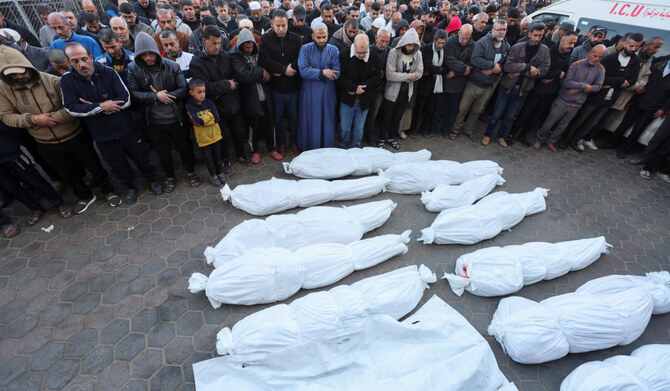
Mourners perform funeral prayers near the bodies of Palestinians killed in Israeli strikes, amid the ongoing conflict between Israel and Hamas, at Al-Aqsa Martyrs hospital, in Deir Al-Balah in the central Gaza Strip, January 15, 2025. (REUTERS)
Short Url
Updated 18 January 2025
Follow

Israel prepares for hostages’ return with scant knowledge of their condition

  • The war that followed the attack has killed more than 46,000 Palestinians, according to Gaza health officials, who do not distinguish between civilians and militants but say women and children make up more than half of those killed

TEL AVIV, Israel: Israel is preparing for the return of the hostages from Gaza with the expectation that many are likely to have severe, life-threatening complications after more than a year in captivity in Gaza.
While it’s impossible to know the exact conditions in which hostages have been held, the Health Ministry and the Hostages Family Forum, which represents families of the hostages, are preparing for several different scenarios based on information gathered from hostages previously released or rescued.
Hamas militants kidnapped about 250 people during a cross-border attack on Oct. 7, 2023, that also left 1,200 people dead. About 100 hostages are still being held, though Israel believes a third of them are no longer alive.
The war that followed the attack has killed more than 46,000 Palestinians, according to Gaza health officials, who do not distinguish between civilians and militants but say women and children make up more than half of those killed.
Hagai Levine, who heads the health team at the Hostages Families Forum, said he expects the hostages to return with cardiovascular and respiratory issues due to lack of ventilation in the tunnels. Among multiple other afflictions Levine expects are vitamin deficiencies, starvation, dramatic weight loss, vision problems due to a lack of sunlight, broken bones, cognitive impairment and mental health trauma.
As a result, doctors are expecting the hostages will require longer and more complex medical and mental health interventions than did those who returned after the last ceasefire in November 2023, said Dr. Einat Yehene, a psychologist at the Hostages Families Forum who oversees the captives’ rehabilitation.
Complex medical challenges
Doctors are keenly aware of the challenges they face in treating the surviving hostages. One of them is “refeeding syndrome,” when exposure to certain foods or too much food can lead to profound health complications and even death in those with prolonged vitamin and nutritional deficiencies, said Dr. Hagar Mizrahi, head of the Ministry of Health’s medical directorate.
The Red Cross team that will transfer the hostages from Gaza to Egypt and the small Israeli military medical team that will meet the hostages at the border as they cross into Israel have strict guidelines for what the hostages can eat in their first few hours, Mizrahi said.
Six hospitals are preparing to receive hostages, including two in the south, closer to Gaza, that will treat those with acute medical issues, health ministry officials said.
Yehene said the public should not expect joyful reunions like those seen following the last ceasefire, when released hostages ran through hospital halls into the ecstatic embraces of their loved ones.
“Given the physical and emotional conditions, we expect emotional withdrawal symptoms, such as maybe exhaustion, fatigue — and some will probably need assistance with their mobility,” she said.
Medical officials are also prepared for the possibility that returning hostages will need speech therapy, especially if they have been kept in isolation, Yehene noted. She said some might be so traumatized or in shock from the transfer to Israel that they will be unable to speak at all.
To minimize the hostages’ trauma and allow them to acclimate to their new reality, officials will try to limit the number of people who interact with them and have made accommodations to lessen their sensory stimulation, such as stripping down the hospital rooms and changing the lighting.
Israel’s Ministry of Social Welfare has also planned temporary housing solutions if hostages feel unable to return directly from the hospital to their home.
“The hostages don’t owe you anything”
Experts are pleading with the news media and the public to give the hostages and their families privacy, despite intense interest in their plight.
“The first days back are really holy, when a person finally gets to meet with their family, and everyone else needs to take a step back,” said Ofrit Shapira, a psychoanalyst who heads a group of health professionals treating freed hostages, their families, and survivors of the Oct. 7 attack. Hospital wings housing the hostages are expected to be “sterilized,” closed to all but direct family and doctors, to keep the public and news outlets away, medical officials have said.
“It doesn’t matter how much we care about them; they’re their own people, they’re not ‘ours,’” Shapira added. She noted that asking the hostages direct questions about their experiences can force them to relive their trauma. She said it’s best to allow them to release information at their own pace.
“Our curiosity is really not important compared with what the hostages need,” she said. “It doesn’t matter how much you volunteered or were active in this fight; they don’t owe you anything.”
Support for the families
Some of the previously freed hostages and their families have volunteered to help counsel those now going through the same process, Levine said. He noted the strength of the bonds created between the relatives of the hostages, and between the released hostages, who have become like “psychological families” helping each other adapt and heal, he said.
Many released hostages are neglecting their own rehabilitation because they are so wrapped up in the fight to bring the others home, Levine said.
A big priority is also to provide support for the families of hostages who did not survive.
Israel has confirmed the deaths of at least a third of the approximately 90 remaining captives. But Hamas has not confirmed the status of the 33 who are expected to be freed in the first stage of the ceasefire. Some might no longer be alive.
“This moment of the releases is an emotional and psychological trigger for something they were supposed to experience, and they never will experience, because this deal took too long,” Yehene said.


US Embassy resumes mechanism meetings ‘at full capacity’

US Embassy building in Awkar east of Beirut on June 23, 2025. (AFP)
Updated 11 sec ago
Follow

US Embassy resumes mechanism meetings ‘at full capacity’

  • Next meeting is scheduled for Feb. 25, settling debate in Lebanon over committee’s fate after postponement of January session
  • Beirut hopes resumption will allow US to press Israel for concessions in return for commitments to ceasefire security terms

BEIRUT: The US Embassy in Beirut said on Friday that the mechanism committee will meet on Feb. 25 to discuss next steps on Lebanon’s security.

The US-led five-member committee was established in the wake of the Israel-Hezbollah war in late 2024.

In a statement issued jointly with US Central Command, the embassy said that “the military coordination framework, as established in the cessation of hostilities agreement outlined on Nov. 27, 2024, remains fully in place and is operating at full capacity, with the same goals, participants and leadership.”

The embassy also listed upcoming meetings dates for March 25, April 22 and May 20, saying “these engagements will continue to serve as the primary forum for military coordination among the participating parties,” and adding that the mechanism will remain the key platform for such coordination.

A committee meeting had been tentatively scheduled for Feb. 18, but the participating parties did not receive official confirmation from the US.

A Lebanese official told Arab News that the Feb. 25 meeting would be limited to military personnel, with no civilian participation. “The US Embassy’s statement emphasized the participation of all parties, including the French side,” the source added.

The mechanism committee meetings constitute the only approved channel of communication for addressing military issues related to the cessation of hostilities between Lebanon and Israel.

The embassy’s announcement settled the debate in Lebanon over the committee’s fate after the postponement of a meeting scheduled for this month, amid Israeli pressure on Lebanon to convert civil negotiations into bilateral talks with US participation.

A Lebanese official closely following the work conducted by the mechanism committee previously told Arab News that there was “a structural crisis within the mechanism committee, specifically within the US delegation.”

The mechanism committee has held a series of meetings at the Ras Al-Naqoura border crossing. These meetings were described as technical and military in nature, and focused on establishing field communication mechanisms, addressing issues arising from violations, and ensuring continued coordination in line with the terms of the signed agreement. Civilian representatives from Lebanon and Israel were later added to the committee’s meetings.

At the beginning of December, Lebanon appointed former ambassador Simon Karam to head the Lebanese delegation to the Military Technical Committee for Lebanon. Karam attended meetings on two occasions, Dec. 3 and 19, during which he highlighted Lebanon’s demand that displaced residents be allowed to return to border villages as a prerequisite for discussing any economic buffer zone. A meeting scheduled for Jan. 14 was later postponed.

The Lebanese state hopes that the resumption of the mechanism’s meetings will enable the US to secure concessions from Israel in exchange for its commitment to the terms of the agreement to cease military operations, including the withdrawal from positions Israel still occupies inside Lebanese territory.

According to the official source, Lebanon is seeking through this request “to facilitate the next stages of the process of establishing the state monopoly on arms, particularly north of the Litani River.” The source said this followed the Lebanese army’s confiscation of illegal weapons south of the Litani, a step the US welcomed, while Hezbollah has refused to disarm north of the Litani line.

Another official source familiar with previous mechanism committee meetings said that “the Lebanese side stated that Israeli army violations on Lebanese territory provide Hezbollah with a justification to commit to its refusal to surrender its weapons.”

Lebanese army commander Gen. Rodolphe Haykal is scheduled to visit Washington next week, and will present to the Council of Ministers on Feb. 5 the next stages of the army’s plan to confine weapons between the Litani and Awali rivers.

According to the media office at the Presidential Palace, Lebanese President Joseph Aoun and Gen. Haykal reviewed on Friday the latest security developments in the south, amid repeated Israeli strikes and potential escalation risks along the border.

They also discussed Gen. Haykal’s meetings with US officials to “look into ways to support the army and coordinate on security issues at the border.”

Haykal also met Maj. Gen. Patrick Gauchat, head of mission and chief of staff of the UN Truce Supervision Organization at the command’s headquarters.

On Friday, an Israeli drone strike targeted a car in Seddiqin, Tyre, killing Mohammed Ahmad Youssef, the Lebanese Ministry of Health said.

Israeli army spokesman Avichay Adraee claimed that the strike was carried out in response to “Hezbollah violations,” accusing the party of “rebuilding itself.”

Israeli reconnaissance aircraft continued to fly over Beirut and its southern suburb throughout the day, in what Lebanon considered a violation of its airspace.

Meanwhile, the Lebanese army conducted armored patrols in the border town of Yaroun on Friday morning, after the Israeli army entered the town on Thursday night.