

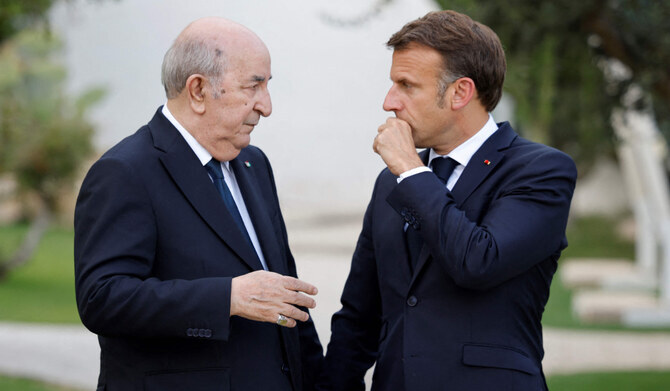

PARIS: President Emmanuel Macron and key members of the government will meet in the coming days to decide how to respond to what Paris deems as growing hostility from Algeria, France’s foreign minister said on Wednesday.
Ties between Paris and Algiers have been complicated for decades, but have taken a turn for the worse since last July when Macron angered Algeria by recognizing a plan for autonomy for the Western Sahara region under Moroccan sovereignty.
Although diplomatic ties have not been ruptured, French officials say Algiers is adopting a policy that aims to wipe France’s economic presence from the country, with trade falling by as much as 30 percent since the summer.
A poor relationship has major security, economic and social repercussions: trade is extensive and some 10 percent of France’s 68 million population has links to Algeria, according to French officials.
“The relationship between France and Algeria is not a bilateral relationship like any other, it is a relationship of deep intimacy,” Jean-Noel Barrot told lawmakers, accusing Algeria of taking a “hostile posture.”
Barrot has offered to go to Algeria to discuss the standoff.
In November, Algeria’s banking association tested the waters verbally to suggest a directive to end banking transactions to and from France, although did not go through with it given the extensive nature of trade ties between the two countries, three diplomats said.
Diplomats and traders say French firms are no longer being considered in tenders for wheat imports to Algeria, to which France had been a key exporter.
Beyond business, Macron accused Algiers of “dishonoring itself” by detaining arbitrarily Franco-Algerian author Boualem Sansal, whose health has worsened in recent weeks.
Algeria’s President Abdelmadjid Tebboune has called Sansal an “imposter” sent by France.
With Macron’s government under pressure to toughen immigration policies, a diplomatic spat also broke out last week after several Algerian social media influencers were arrested in France and accused of inciting violence.
One was deported to Algiers, where authorities sent him back to Paris, citing legal procedures. That sparked anger among France’s right-wing parties and Interior Minister Bruno Retailleau accused Algiers of trying to humiliate the former colonial power.
“This is a violation of the texts that govern our relationship and it is a precedent that we consider serious,” Barrot said, adding that this and the arrest of Sansal had forced Paris’ hands to decide how to respond.
Algeria’s foreign ministry denied on Saturday it was seeking escalation with France and said the far-right in France was carrying out a disinformation campaign against Algeria.
PAST TRAUMA
The relationship between the two countries is scarred by the trauma of the 1954-1962 independence war in which the North African country broke with France.
About 400,000 Algerian civilians and fighters were killed, as well as about 35,000 French and as many as 30,000 Muslim “harkis” who fought in the French army against Algerian insurgents.
Macron has over the years pushed for more transparency regarding France’s past with Algeria while also saying that Algeria’s “politico-military system” had rewritten the history of its colonization by France based on “a hatred of France.”
Jalel Harchaoui, associate fellow at the Royal United Services Institute, said the countries were locked in an escalating standoff.
“Many politicians in Paris say they want to force Algeria to soften its position, but Algiers has every intention to stand firm. Algeria feels all the more emboldened by the fact that France is far less important to its economy than a few years ago,” he said.


