Saudi Arabia, Italy deal opens door for Kingdom to supply green hydrogen to Europe

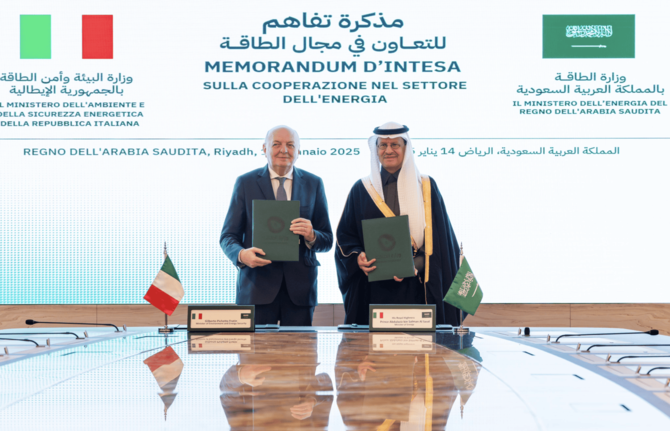
The Saudi Minister of Energy Prince Abdulaziz bin Salman met with Italy’s Minister of Energy and Environment Gilberto Pichetto Fratinon on Jan. 14. Ministry of Energy
Short Url
Updated 15 January 2025
Follow

Saudi Arabia, Italy deal opens door for Kingdom to supply green hydrogen to Europe

JEDDAH: Saudi Arabia and Italy have signed an agreement to boost energy cooperation, including a possible supply to Europe of green hydrogen made in the Kingdom.

The Saudi Minister of Energy Prince Abdulaziz bin Salman met with Italy’s Minister of Energy and Environment Gilberto Pichetto Fratinon on Jan. 14 to sign the memorandum of understanding, which covers collaboration in innovation and technology, such as hydrogen project development, climate change mitigation solutions, and the circular carbon economy, including carbon capture, utilization, and storage.

The deal comes as Saudi Arabia seeks to boost its green power credentials, with a facility at NEOM set to become the world’s largest utility-scale, commercially-based hydrogen plant powered entirely by renewable energy.

According to Reuters, the Italian minister stated that his country could serve as a gateway into Europe for renewable hydrogen and ammonia produced in Saudi Arabia, highlighting it would be “much closer, more competitive and strategic than other alternatives in the North Sea.”

The agreement also highlights the importance of digital transformation, cybersecurity, and artificial intelligence in the energy sector while promoting joint initiatives to support engineering and construction projects in alignment with the Paris Agreement and the 2030 Sustainable Development Agenda.

The ministers addressed key topics such as reducing methane emissions, energy storage solutions, and using traditional and transitional fuels, including oil, gas, and petroleum.

The discussions also focused on enhancing the stability and reliability of oil and natural gas markets, reducing volatility, and strengthening energy supply security and supply chains, according to a press release from the Saudi Ministry of Energy.

The Saudi ministry’s release indicated that cooperation would include developing qualitative partnerships on products and services related to all sectors of energy supply chains and their technologies. It added that the cooperation will also consider creating and using sustainable, polymeric, and innovative materials in construction and other sectors.

Scheduled for commissioning in 2026, the NEOM Green Hydrogen Project will produce 600 tonnes of clean hydrogen daily through electrolysis using thyssenkrupp technology, nitrogen through air separation powered by Air Products, and up to 1.2 million tonnes of green ammonia annually. Upon completion, the facility will offset 5 million metric tonnes of carbon emissions annually.

A collaboration between NEOM, Air Products, and ACWA Power, the joint venture will leverage cutting-edge technologies to integrate approximately 4 gigawatts of renewable energy from onshore solar, wind, and storage.

In July, Saudi Aramco signed agreements to acquire a 50 percent stake in the blue hydrogen industrial gases business of Air Products Qudra, reinforcing the Kingdom’s commitment to becoming a global leader in hydrogen production.


‘Future cities will be built for visitors, not just residents,’ Saudi tourism minister tells Arab News

Updated 10 November 2025
Follow

‘Future cities will be built for visitors, not just residents,’ Saudi tourism minister tells Arab News

RIYADH: Saudi Arabia is positioning itself at the forefront of the global travel evolution by designing destinations that will target the tourists of the future, the Kingdom’s tourism minister has said.

Ahmed Al-Khateeb added that sustainability would serve as the guiding principle behind Saudi Arabia’s role in tomorrow’s global travel landscape.

Travelers’ habits and the tourism industry’s revenue sources have shifted dramatically in recent years, he told Arab News in an interview.

“People used to travel in groups. Today, they are traveling in smaller groups. Hotels used to make most of their revenues from rooms — now, they are making more from lounges and restaurants.”

And younger generations, empowered by technology, are also redefining how travel is planned and experienced, Al-Khateeb added. “They are driving their own itineraries on the go, which puts pressure on traditional travel companies that once organized large group trips. We are witnessing big shifts in the global travel market.”

Among the world’s fastest-growing tourism markets, China and India are reshaping international travel flows. “China has become the most important source market for outbound travelers, while India is expected to double its number of travelers in the coming years,” the minister said. “This opens a major opportunity for the Middle East — and Saudi Arabia in particular — to emerge as a top destination for international tourists.”

Since 2019, Saudi Arabia has recorded the fastest tourism growth among all G20 nations, said Al-Khateeb. “We have a very strong domestic market and a very strong religious market. Now, we have opened our doors for leisure, business and holiday travelers — whether they seek the Red Sea coast, the southern mountains, our major cities or our beautiful islands.”

Yet the Kingdom’s long-term vision for tourism extends far beyond the present, with destinations being built to serve both visitors and residents sustainably, he added.

“In the 1950s and 1960s, cities were built for residents,” Al-Khateeb said. “Today, in places like Greece, visitors outnumber residents three to one. The cities of the future must be designed for visitors as well — and that’s what we are doing in Saudi Arabia.”

Sustainability has become a non-negotiable element of all tourism development in the Kingdom, he added. “In the last two decades, sustainability has become extremely important. As we build new destinations like the Red Sea, we are fully aligned with sustainability regulations. Whatever we build today is environmentally friendly, ensuring not only environmental, but also social and economic sustainability.”

This principle lies at the heart of Vision 2030’s tourism transformation: “Sustainability is at our forefront whenever we build or operate any new destination,” he added.